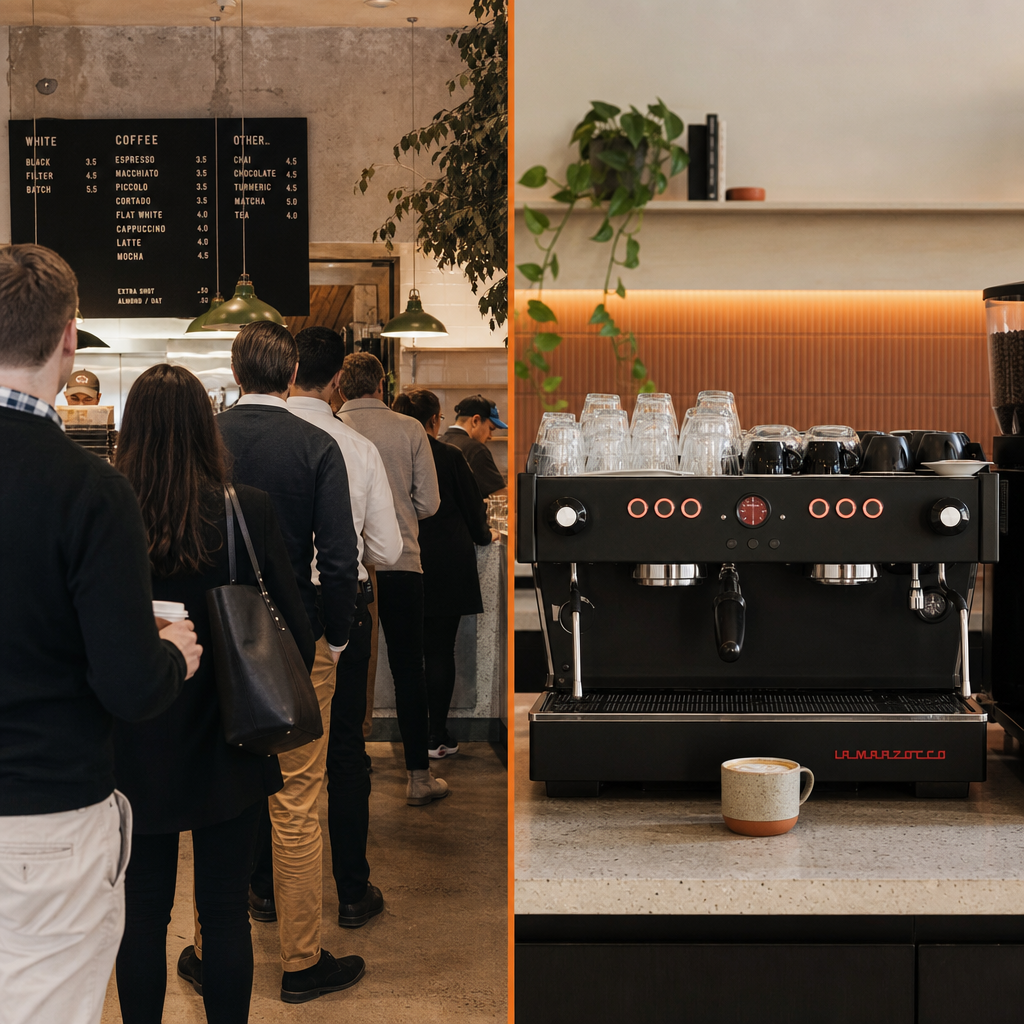
If your team of 30 is walking to the cafe twice a day, you are not just spending money on coffee. You are spending money on time, on attention gaps, on the slow erosion of momentum that happens every time someone walks out the door for 15 minutes to grab a flat white. The cost shows up on the P&L in ways most finance managers never actually total up.
This comparison is not about convincing you that office coffee is always the right answer. It is about giving you the honest numbers so you can make a decision that is right for your team and your budget. I have been matching Melbourne workplaces with the right coffee setup since 2008, and the calculation is almost always clearer than people expect once you lay it out properly.
Below you will find worked examples for offices of 10, 30 and 50 staff, a breakdown of hidden productivity costs, Australian-specific pricing, and the real break-even point for an in-house solution. If you want to skip straight to the numbers that apply to your situation, the summary table gives you a fast read. If you want to understand the full picture, read on.
Key Takeaways
- A single staff member spending $5.50 on two cafe coffees per day spends approximately $2,860 per year on coffee alone, before accounting for time off-site.
- A 30-person office making two cafe runs daily loses an estimated 1,500 work hours per year to travel time, based on a conservative 10-minute round trip per visit.
- In-house commercial coffee, including machine rental, beans and consumables, typically costs $1.00 to $2.50 per cup at scale, compared to $4.50 to $6.00 at a cafe.
- Break-even on an office coffee solution for a 10-person team typically occurs within the first two months of switching.
- GST on office coffee supplies is claimable as a business input tax credit, and staff amenity costs are generally deductible. Confirm specifics with your accountant.
- Month-to-month rental arrangements mean you can trial an in-house setup without a long-term commitment locking you in.
At a Glance: Office Coffee vs Cafe Cost by Team Size
| Team Size | Annual Cafe Cost (2 cups/day per person) | Annual Productivity Cost (lost time) | Est. Annual In-House Cost | Estimated Annual Saving |
|---|---|---|---|---|
| 10 staff | $28,600 | $18,200 (est.) | $4,800 to $7,200 | $21,400 to $23,800 |
| 30 staff | $85,800 | $54,600 (est.) | $10,800 to $18,000 | $67,800 to $75,000 |
| 50 staff | $143,000 | $91,000 (est.) | $15,600 to $26,400 | $116,600 to $127,400 |
Assumptions: $5.50 average cafe cup cost, 230 working days per year, 10-minute round trip per cafe visit, average loaded staff cost of $35 per hour. In-house cost based on commercial machine rental plus bean and consumable supply. Individual results vary based on team habits, suburb, and machine tier.
The Cafe Coffee Cost Per Employee: Working Through the Real Number
Let us start with what is visible and measurable: the money leaving the building every time someone walks to a cafe.
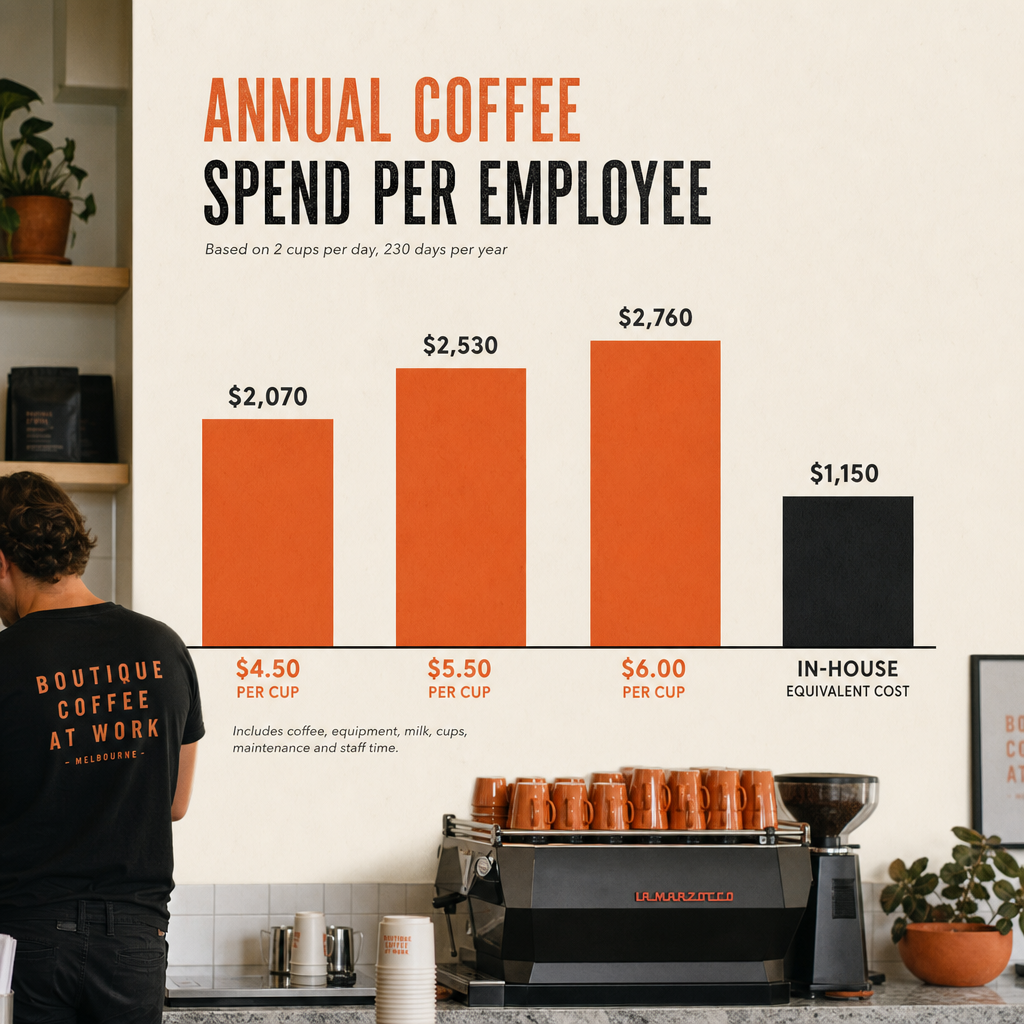
The average cafe coffee price in Melbourne sits between $4.50 and $6.00 in 2026, depending on the suburb and the venue. A flat white in the CBD typically runs $5.50 to $6.00. In inner-suburban offices, $4.80 to $5.50 is more common. For the purposes of this comparison, I will use $5.50 as the working average, which is conservative for most CBD and inner-Melbourne locations.
If a staff member buys two coffees per day across 230 working days (a standard full-time working year after leave and public holidays), the spend looks like this:
- 2 coffees x $5.50 x 230 days = $2,530 per person per year at $5.50 per cup
- At $6.00 per cup: $2,760 per person per year
For a team of 10, that is $25,300 to $27,600 per year spent at local cafes. None of that money is recoverable, none of it builds anything inside your business, and your team does not even get a particularly consistent product because the quality varies with the barista on shift.
Scale that to 30 staff and the figure is $75,900 to $82,800. For 50 staff, $126,500 to $138,000. These are conservative figures. Teams with higher earners or in higher-cost suburbs often land well above this range.
This is money that, in most cases, businesses are effectively subsidising through the implicit understanding that cafe runs are part of the working day. Whether your team is buying their own coffee or you are offering a cafe allowance, the economic reality is the same: a significant sum is leaving your workplace ecosystem daily.
What That Looks Like Across a Full Year
To make the per-employee figure concrete:
- $5.50 average cup cost
- 2 cups per working day
- 230 working days per year
- Annual spend per employee: $2,530
- Monthly equivalent: $211 per person
If you offer any form of coffee allowance, subsidised cafe cards, or similar staff benefit, the cost sits directly on your books. If staff are self-funding, the cost still affects recruitment, retention and satisfaction in ways that are harder to quantify but very real.
The Hidden Cost: Productivity Loss From Cafe Runs
The money is the part that gets budgeted. The time is the part that does not.
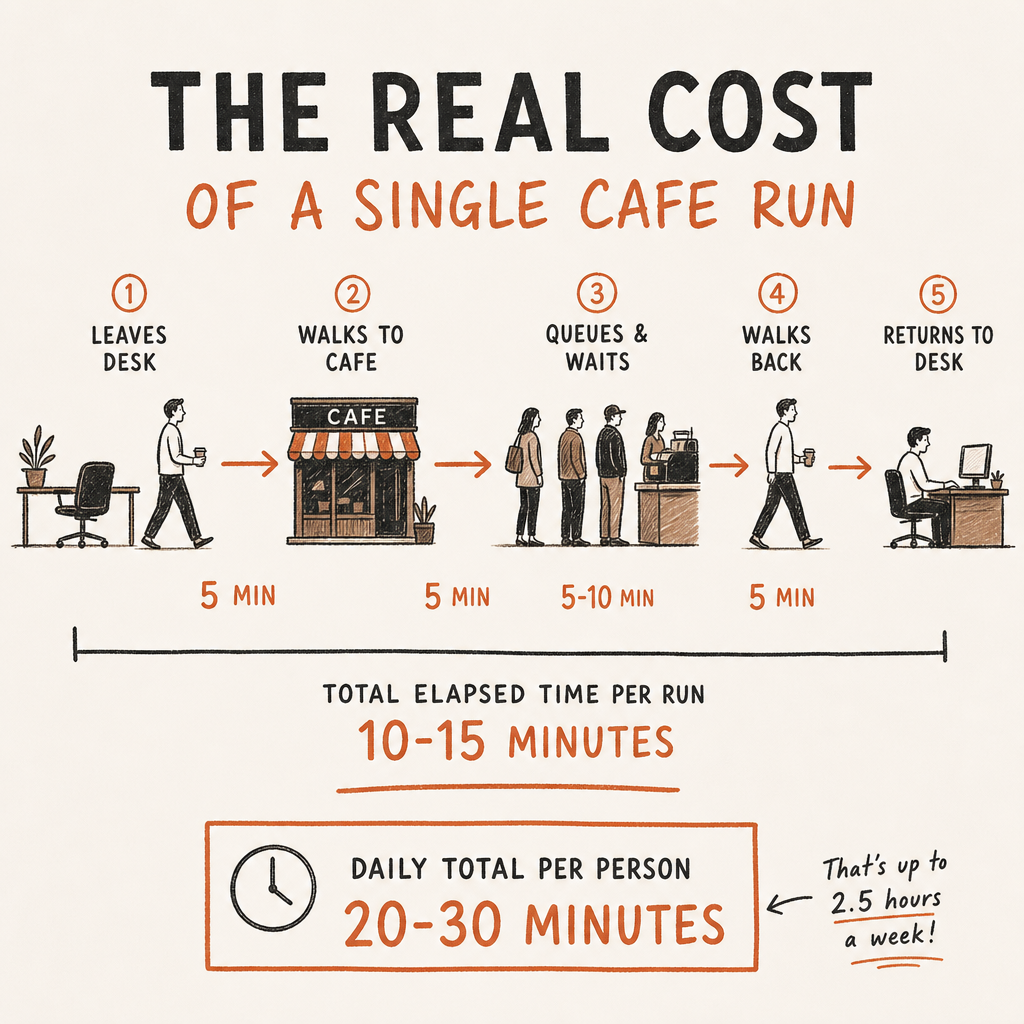
A conservative estimate for a cafe run in a typical inner-Melbourne or CBD office is 10 minutes round trip. That includes the walk, the queue, the wait for the order, and the walk back. In practice, particularly during peak morning and lunch periods, 12 to 15 minutes is more realistic. I will use 10 minutes to keep this conservative and defensible.
At two cafe runs per person per day, you are losing 20 minutes of productive time per employee daily. Across 230 working days, that is 76.7 hours per person per year. Rounded to 75 hours for simplicity.
Now apply a loaded staff cost. The ABS data on average weekly earnings in 2026 places full-time adult average ordinary time earnings at approximately $1,900 per week, which equates to roughly $50 per hour in base salary terms. When you factor in superannuation (currently 12%), leave loading, and on-costs, a loaded hourly cost in the range of $60 to $70 per hour is a reasonable working estimate for mid-level office roles. For this comparison, I will use a conservative $35 per hour to account for variation in team seniority, and because I would rather understate than overstate.
- 75 lost hours per person x $35 = $2,625 per employee per year in productive time lost
- For 10 staff: $26,250
- For 30 staff: $78,750
- For 50 staff: $131,250
These figures are estimates, not certainties. Not every minute away from a desk is lost productivity. People need breaks, and walking is good for focus. But there is a meaningful difference between a purposeful break and an inefficient trip that exists purely because the coffee inside the building is not worth drinking. The 10-minute break at the desk with a good coffee, versus the 15-minute walk to get a mediocre one, is a real distinction.
When you add the direct cafe spend to the productivity cost, the total economic impact per employee is in the range of $5,000 to $5,500 per year. For a 30-person team, that is $150,000 to $165,000 annually. Most businesses I talk to have not put that number together before we sit down.
What an In-House Office Coffee Solution Actually Costs
This is where the comparison gets interesting, because the in-house cost is much lower than most people assume before they look at it properly.
A commercial-grade office coffee setup in Melbourne in 2026 typically involves three components:
- Machine rental: A quality commercial machine suitable for a team of 10 to 30 people typically rents for $150 to $350 per month, depending on the machine tier and features. For a 50-person-plus office, a higher-output machine might sit at $400 to $600 per month. These are monthly rentals with no lock-in and include servicing.
- Bean supply: Fresh, commercial-grade coffee beans for a team of 10 might run $80 to $120 per month. For 30 people, $200 to $350. For 50 people, $350 to $600. Bean cost varies with roast quality and consumption patterns.
- Consumables: Milk, cleaning tablets, cups, filters. For most offices, this adds $50 to $150 per month depending on team size and drink preferences.
Putting those together:
| Team Size | Monthly Machine Rental | Monthly Beans | Monthly Consumables | Total Monthly | Total Annual |
|---|---|---|---|---|---|
| 10 staff | $150 to $200 | $100 to $150 | $50 to $80 | $300 to $430 | $3,600 to $5,160 |
| 30 staff | $200 to $350 | $200 to $350 | $80 to $120 | $480 to $820 | $5,760 to $9,840 |
| 50 staff | $350 to $500 | $350 to $600 | $120 to $200 | $820 to $1,300 | $9,840 to $15,600 |
Dividing annual in-house cost by cups consumed brings the per-cup cost to roughly $0.90 to $2.20 depending on team size, machine tier, and how much milk-based drink versus straight espresso the team prefers.
Compared to $5.50 at the cafe, the unit economics are not close.
A Caveat on Assumptions
These numbers assume consistent daily use. If your team works hybrid schedules and office attendance is three days per week for most people, your actual cup volume drops and the per-cup cost of the in-house solution rises. Conversely, your cafe spend also drops proportionally, so the relative advantage stays similar. Always model against your actual attendance patterns, not theoretical full-occupancy.
I tell every prospective client the same thing: bring me your honest headcount and your honest office days, and I will give you an honest recommendation. That sometimes means I tell someone their team is too small or too infrequently in-office to make the numbers work. A 4-person team that is in the office two days a week is probably better served by a quality home-style machine they own outright than a commercial rental.
The Break-Even Point: When Does Office Coffee Pay for Itself?
For most offices of 10 or more full-time, in-office staff, the break-even calculation is straightforward.
Using a 10-person team as the baseline:
- Monthly in-house cost: approximately $400 (mid-range estimate)
- Monthly cafe spend at $5.50 x 2 cups x 10 staff x 20 working days: $2,200
- Monthly saving on direct spend alone: $1,800
The in-house solution pays for itself in the first month. The payback period is not months, it is weeks.
For a 30-person team, the monthly cafe spend at the same assumptions is $6,600. The monthly in-house cost is approximately $650. The monthly saving is $5,950. The full annual saving on direct spend alone exceeds $70,000.
Even if you halve the productivity saving estimate to account for the legitimate value of walking breaks, the financial case for an in-house solution is clear at any team size above around 8 to 10 full-time, in-office staff.
Two Client Stories That Illustrate the Shift
From Frustration to Daily Reliability: A Mid-Size Melbourne Office
One of my longest-standing clients came to me after their previous machine setup had become a recurring source of frustration. The machine was going down at the worst possible times, during morning peak, before important meetings, and the supplier's response was slow and impersonal. Every breakdown meant the team defaulting to the cafe down the street, and the associated cost and time disruption added up fast.
We installed a WMF commercial machine with full install, training, and a regular servicing schedule. I did the site visit, I did the install, and I gave the team a single number to call if anything came up. Two staff members were trained properly on the first day and a reference sheet was left with the machine.
Chrissie, who manages the office, told me that reliable, regular service meant the team always had coffee when they needed it most. The havoc a broken machine used to cause was simply gone. That is not a small thing when you consider what a morning without working coffee does to team morale and the quiet resentment that builds when people feel like a basic amenity is not being maintained.
This is why I run the business the way I do. One person staying accountable for every client, from setup to ongoing service, with a single phone number and no escalation paths. Most fixes can be talked through in two minutes when the person who answers actually knows your setup. Same-day or next-day on-site response is only possible when there is no internal runaround to navigate first.
The Compounding Value of Getting It Right From the Start
Another client, a Melbourne workplace I have been servicing for several years now, was in a situation where the coffee setup was adequate but not great. The machine was not matched properly to the team's preferences, the bean supply was generic, and staff knew it. The result was that people were still making cafe runs despite having a machine in the office, which is the worst of both worlds: paying for an in-house solution and paying cafe prices on top.
When I came in, we started with what I call the Curated Coffee Plan. Before recommending a single bean, I asked the team about their preferences: were they mostly espresso drinkers or milk-based, did they want a strong roast or something more balanced, were there any strong dislikes? Based on that profile, we matched a specific blend, then adjusted based on feedback within the first month.
Paul, the site manager, told me how much his staff appreciated having genuinely great coffee. He said he told his team, "no problem, just keep doing what you are doing." That is the outcome I am after. When staff feel like the coffee has been chosen on purpose for them, rather than defaulted to the cheapest available supply, they actually use the machine. When they actually use the machine, the cafe run habit breaks. When the cafe run habit breaks, the numbers I outlined above start working in your favour.
Quality Is Part of the Calculation
The financial comparison is compelling, but it is not the whole story. One of the reasons cafe runs persist in offices that have a machine is that the machine produces inferior coffee. A home-grade espresso machine or a basic pod system does not produce a flat white that competes with a good cafe. If your solution is not producing something people actually want to drink, the habit does not change and the savings do not materialise.
This is why machine selection matters. I have serviced 200-plus Melbourne workplaces over 17 years, and I have seen the pattern play out consistently: the right machine for the right team size, with the right beans, produces a product that staff genuinely prefer to stay in-office for. The wrong machine, or the right machine with the wrong beans, does not.
Commercial machines in the rental tier I work with, including brands like WMF, produce cafe-quality extraction. They are not home machines with a commercial sticker on them. They are genuine commercial equipment managed by someone who has been doing this since 2008 and understands what consistent quality requires in a workplace setting.
I am also deliberate about matching machine size to actual team size. A 12-person team does not need a machine rated for 200 cups per day. An 80-person team will break a lower-output machine within weeks. Honest fit advice is not just good ethics, it is what produces the outcome you are actually paying for.
GST and Tax Treatment of Office Coffee
For Australian businesses, the tax treatment of office coffee is worth understanding clearly, though I always recommend confirming specifics with your accountant.
GST input tax credits: If your business is registered for GST and you are purchasing coffee supplies (beans, milk, consumables) for use in the business, the GST component is generally claimable as an input tax credit. The same applies to machine rental invoices. This effectively reduces your net cost by 1/11th.
Income tax deductibility: Costs incurred in providing amenities to staff, including coffee supplies, are generally deductible as a business expense under section 8-1 of the Income Tax Assessment Act 1997, provided they are incurred in the course of producing assessable income. Staff amenity costs are typically treated as a deductible business expense rather than a fringe benefit, particularly where the coffee is available to all staff on business premises during working hours. The ATO's position on in-house food and drink exemptions under FBT is relevant here for employers who want to understand the full picture.
In practical terms, the post-tax cost of an in-house coffee solution is lower than the headline figures I have quoted above. For a business paying the standard company tax rate of 30%, every dollar spent on a deductible coffee supply costs 70 cents in real terms.
This is not tax advice, and individual circumstances vary. But the direction is clear: an in-house office coffee solution is more tax-efficient than individual cafe spend, which is made with after-tax dollars and is not deductible at the business level.
How the Setup Process Works: From First Call to First Coffee
One of the questions I get most often from office managers and business owners is how complicated and disruptive the installation process is. The honest answer is: not very, when it is done properly.
My Six-Step Process is designed to take most Melbourne clients from first enquiry to installed machine in 5 to 7 business days:
- Enquiry: Two minutes to submit basic team details.
- Phone call with me: 15 to 20 minutes. I build a machine shortlist and give rough pricing.
- On-site visit: 30 minutes. I assess power, plumbing, bench space, and team flow.
- Install day: 45 minutes. Machine connected, grinder dialled in, shots tested.
- First brew and training: 20 minutes. At least two staff trained, cheat sheet left with the machine.
- Ongoing rhythm: Weekly or fortnightly service visits, beans and consumables topped up.
There is no procurement process that takes months, no IT integration, no renovation. For most offices, the whole transition from decision to working machine happens in under a week. The first coffee comes out of the machine on install day.
For businesses that want to test the setup before committing, a free trial is available. There is no lock-in, ever. All rentals run month-to-month with one month's notice to exit and free machine pickup. In 17 years, the no-lock-in policy has not cost a client worth keeping.
Making the Right Decision for Your Office
The numbers are clear, but the decision is still yours and it should be made with an honest look at your specific situation. Here is a simple framework:
The in-house solution makes strong financial sense if:
- You have 8 or more full-time staff in the office at least 3 days per week
- Your team currently makes regular cafe runs (1 to 2 per day per person)
- You are in an inner-city or CBD location where cafe prices are at the upper end
- You want to offer coffee as a staff benefit without the recurring cost of cafe allowances
The in-house solution may not be the right fit if:
- Your team is predominantly remote with only occasional office attendance
- You have fewer than 6 to 8 people in the office regularly
- Your office has no plumbing access and installation would require significant infrastructure work
If you are unsure which category you fall into, the 30-minute on-site visit I offer at no cost is exactly designed to answer that question. I would rather tell you the numbers do not work for your setup than rent you a machine that does not earn its place.
For a deeper look at the full economics of workplace coffee, including how different machine tiers compare and what a long-term coffee budget looks like, the Boutique Coffee workplace coffee guide covers those specifics in detail. You can also explore the range of solutions to get a sense of what is available at different team sizes.
If you are ready to talk through your specific office, reach out directly. One call, 15 to 20 minutes, and you will know whether it makes sense to move forward.
References
-
Australian Bureau of Statistics, Average Weekly Earnings, 2026, ABS national data on full-time adult average ordinary time earnings, used to derive loaded hourly staff cost estimates for productivity loss calculations.
-
Australian Taxation Office, Fringe Benefits Tax Guide for Employers (current edition), ATO guidance on the in-house benefit exemption and the deductibility of staff amenity costs including food and drink supplied on business premises.
-
ATO, Income Tax Assessment Act 1997, Section 8-1 (General Deductions), Legislative basis for the deductibility of ordinary business expenses including staff amenity costs.
-
Boutique Coffee at Work, Internal Client Data, 2026, Aggregated data from 200-plus active Melbourne workplace clients covering machine rental pricing, bean consumption rates, and client relationship tenure across 17 years of operation.
-
ACCC, Retail Pricing Guidelines, Context for consumer price monitoring relevant to coffee retail pricing trends in Australian metropolitan markets.
-
Boutique Coffee at Work, Guide to the Real Cost of Workplace Coffee (2026), Proprietary guide covering machine tier comparisons, long-term coffee budgeting for Australian workplaces, and per-cup cost breakdowns across different office sizes.
Frequently asked questions
What is the average cost of cafe coffee per year for an Australian office worker?
At $5.50 per cup and two cups per working day across 230 working days, the annual cafe spend per employee is approximately $2,530. At $6.00 per cup, that rises to $2,760. For a 30-person office, the collective annual cafe spend sits between $75,900 and $82,800, not including any productivity loss from time spent off-site.
How much does in-house office coffee cost per employee?
For most Melbourne offices, an in-house commercial coffee setup costs between $1.00 and $2.50 per cup when you divide the total monthly outlay (machine rental plus beans plus consumables) by cups consumed. For a 30-person team drinking two coffees each per day, the all-in monthly cost typically sits between $480 and $820, which works out to $16 to $27 per employee per month.
When does an office coffee solution break even compared to cafe runs?
For a team of 10 or more full-time, in-office staff, break-even typically occurs within the first month of switching. The monthly saving on direct cafe spend alone generally exceeds the monthly cost of the in-house solution from day one. For smaller teams or part-time office arrangements, the break-even point shifts and should be modelled against your specific attendance pattern.
Is office coffee GST-claimable and tax-deductible in Australia?
For GST-registered businesses, the GST component of coffee supplies and machine rental invoices is generally claimable as an input tax credit. Staff amenity costs, including coffee supplied on business premises to all employees during working hours, are generally deductible as an ordinary business expense. The ATO's FBT in-house benefit exemption may also be relevant. Confirm your specific situation with a qualified accountant.
Do I need to sign a long-term contract for an office coffee machine rental?
Not with Boutique Coffee at Work. All rentals are month-to-month with one month's notice to exit and free machine pickup included. There is no lock-in, ever. You can also start with a free trial before committing to an ongoing arrangement.
How long does it take to get a coffee machine installed in a Melbourne office?
For most Melbourne clients, the process from first enquiry to installed, working machine takes 5 to 7 business days. The install itself takes around 45 minutes, followed by a 20-minute training session with at least two staff members. There is no major disruption to the office and no infrastructure work required for most setups, assuming standard power and plumbing access.
What if our team has mixed coffee preferences, including milk-based drinks and black coffee?
This is the norm rather than the exception. A well-specced commercial machine handles espresso, flat whites, lattes, cappuccinos and long blacks from the same setup. At onboarding, a Curated Coffee Plan process matches the bean selection to the team's actual preferences, including roast strength and whether the team skews toward espresso or milk-based drinks. Adjustments are made based on team feedback in the first month.
Is there a free trial available before committing to an office coffee rental?
Yes. Boutique Coffee at Work offers a free trial so you can see how the setup works in your office before making any ongoing commitment. If it is not the right fit, there is no obligation and the machine is picked up at no cost to you.
Chris
Chris
Keep reading
Coffee Bean Types for Office Machines: Blends, Roasts and What Suits Your Workplace
If your office coffee tastes flat, bitter, or just a step above instant, the machine probably isn't the problem. In most cases, it's the beans. The right…
27 Workplace Coffee Statistics for 2025: Australian Consumption, Costs & Trends
Key Statistics at a Glance Australians drink approximately 3.2 kg of coffee per person per year, placing the country among the top coffee-consuming nations in…
Office Coffee in Melbourne: The Complete Workplace Guide to Machines, Costs, Beans and Service
The best office coffee in Melbourne comes from a commercial bean-to-cup or espresso machine sized to your headcount, rented month-to-month with installation,…