Key Statistics at a Glance
- Australians drink approximately 3.2 kg of coffee per person per year, placing the country among the top coffee-consuming nations in the Asia-Pacific region (IBISWorld).
- The Australian coffee industry generated an estimated $10.3 billion AUD in revenue in 2024, with continued growth forecast through 2026 (IBISWorld, ibisworld.com).
- Around 75% of Australian workers report drinking at least one coffee during the working day (Roy Morgan Research).
- Employers who provide quality in-office coffee report measurable improvements in staff satisfaction scores compared with those who do not (Canstar Blue Workplace Survey).
- Workplace coffee spend in Australia averages between $2.50 and $4.50 per employee per day when a managed machine solution is in place, compared with $6.00 to $9.00 per employee per day when staff purchase café coffee independently (Boutique Coffee at Work internal benchmarks, 2026).
- Single-use coffee pod waste is estimated at more than 3 million units per day across Australia, making workplace pod programmes a significant contributor to commercial landfill (Planet Ark).
- Certified ethical and fair trade coffee sourcing has grown by roughly 18% across Australian commercial accounts in the past three years (Fair Trade Australia).
Introduction
Workplace coffee sits at the intersection of culture, productivity, and cost. For HR managers benchmarking staff amenities, finance teams reviewing discretionary spend, and operations leaders choosing between machine formats, reliable data on what Australian offices actually consume and what that consumption costs is difficult to find in one place. This article aggregates published research, industry reports, and verified survey data to provide a single reference point for anyone making decisions about workplace coffee programmes in Australia.
The statistics here cover five distinct dimensions: how much coffee Australians consume at work, what that consumption costs the business, what the research says about productivity and satisfaction, how the office coffee machine market is shifting, and what the sustainability picture looks like for commercial coffee operations. Whether you are reviewing your current setup or building a business case for an upgrade, the figures below provide the context that internal estimates alone cannot supply. For a deeper look at how these numbers translate into real costs, the real cost of workplace coffee guide breaks down the components in granular detail.
1. Australian Coffee Consumption Habits
Australia has one of the most developed café cultures in the world, and that culture extends directly into the office. Understanding baseline consumption is the starting point for sizing any workplace coffee programme correctly.
- According to IBISWorld (ibisworld.com), Australians consumed approximately 3.2 kg of coffee per capita in 2024, a figure that has grown steadily since 2018.
- Roy Morgan Research reports that around 75% of Australian workers consume coffee on a typical working day, with the average self-reported intake sitting at 2.1 cups per working day.
- According to the National Coffee Data Trends (NCDT) report, espresso-based milk drinks (flat whites, lattes, and cappuccinos) account for approximately 62% of all coffee orders in Australian workplace settings, reflecting preferences shaped by the broader café market.
- ABS Household Expenditure Survey data (abs.gov.au) shows that coffee and coffee-related products represent one of the fastest-growing subcategories in the food and non-alcoholic beverage segment for Australian households, with per-capita spend rising 11% in real terms between 2020 and 2024.
- Canstar Blue workplace survey data indicates that 68% of Australian office workers say the quality of coffee available at work influences their overall perception of their employer's investment in staff wellbeing.
- According to Roy Morgan, younger workers aged 25 to 34 are the highest in-office coffee consumers, averaging 2.6 cups per working day, compared with 1.7 cups for workers aged 55 and over.
Table 1: Australian Per-Capita Coffee Consumption Trend (2022-2026)
| Metric | 2022 | 2023 | 2024 | 2025 (est.) | 2026 (proj.) |
|---|---|---|---|---|---|
| Per-capita consumption (kg) | 2.9 | 3.0 | 3.2 | 3.3 | 3.4 |
| Cups per worker per day (avg.) | 1.9 | 2.0 | 2.1 | 2.2 | 2.3 |
| Share of workers drinking coffee daily (%) | 71 | 73 | 75 | 76 | 77 |
Sources: IBISWorld, Roy Morgan Research, NCDT. Projections based on published trend lines.
2. Workplace Coffee Spend and ROI
The financial case for an in-office coffee solution is strongest when the cost of the alternative (staff leaving the building to buy café coffee) is properly accounted for. Most workplace coffee spend analyses undercount because they exclude lost productive time.
- A managed machine rental programme in Australia typically costs between $2.50 and $4.50 per employee per day in total consumable and service cost, based on Boutique Coffee at Work benchmarks drawn from 200+ active Melbourne workplace clients as of 2026.
- By contrast, a worker who purchases one café coffee per working day spends an average of $5.20 per cup (based on Canstar Blue 2024 café pricing data), which totals approximately $1,300 AUD per employee per year at one cup per day.
- IBISWorld data (ibisworld.com) estimates that Australian businesses collectively spend over $1.1 billion AUD annually on workplace coffee as a staff amenity category, a figure that has grown from approximately $780 million in 2019.
- According to research compiled by the Harvard Business Review (hbr.org), productivity losses attributable to off-site coffee runs in open-plan office environments can average 15 to 20 minutes per employee per day, a figure that translates to meaningful dollar losses at scale.
- Canstar Blue survey data shows that 54% of Australian workers say they would reduce the frequency of leaving the office during the day if high-quality coffee were available on-site.
- Boutique Coffee at Work internal data shows that for a team of 50 employees, the difference between a managed machine solution and staff self-funding café coffee can represent a saving of $18,000 to $25,000 AUD per year in combined direct costs and recaptured productive time.
Table 2: Cost Comparison Across Workplace Coffee Models (50-Person Office, AUD)
| Coffee Model | Est. Daily Cost Per Employee | Est. Annual Cost (50 staff) | Key Variable |
|---|---|---|---|
| No provision (staff buy own café coffee) | $5.20+ | $67,600+ | Café pricing, frequency |
| Pod/capsule machine | $3.80-$5.00 | $49,400-$65,000 | Capsule unit cost |
| Managed bean-to-cup machine (rental) | $2.50-$4.50 | $32,500-$58,500 | Team size, usage |
| Plumbed commercial machine (owned) | $1.80-$3.20 | $23,400-$41,600 | Upfront capex, servicing |
| Instant coffee station | $0.40-$0.80 | $5,200-$10,400 | Staff satisfaction impact |
Sources: Boutique Coffee at Work (2026 benchmarks), Canstar Blue, IBISWorld.
3. Employee Satisfaction and Productivity Impact
The productivity and satisfaction data around workplace coffee is increasingly robust. Several peer-reviewed and industry studies point in the same direction: coffee availability at work correlates with measurable improvements in how employees feel about their employer and how effectively they work during the day.
- A survey by Canstar Blue found that 72% of Australian workers rate access to quality coffee as an important or very important workplace perk, ranking it above subsidised gym memberships and free parking in perceived daily value.
- Research published by the British Journal of Nutrition, widely cited in Australian HR publications, found that moderate caffeine consumption (2-3 cups per day) is associated with improved sustained attention and reduced self-reported mental fatigue in office workers.
- According to Gallup's State of the Global Workplace report (gallup.com), organisations in the top quartile for employee experience metrics (which include physical workplace amenities) record 21% higher productivity and 59% lower staff turnover than bottom-quartile organisations.
- Canstar Blue data shows that 41% of Australian workers say they have chosen to stay at a job or accepted a job offer partly because of the quality of staff amenities, with quality coffee cited as the most-mentioned specific amenity.
- Roy Morgan Research data shows that hybrid workers who return to the office cite quality coffee as the third most common reason for choosing to be on-site on a given day, behind meetings and collaboration tasks.
- A workplace wellbeing survey conducted by the HR Industry Group Australia found that teams with a visible, well-maintained coffee station report a 14% higher score on belonging and connection metrics compared with teams without dedicated coffee facilities.
Table 3: Workplace Amenity Importance Rankings (Australian Office Workers)
| Amenity | % Rating "Important" or "Very Important" | Rank |
|---|---|---|
| Quality coffee / espresso machine | 72% | 1 |
| Fast, reliable internet | 88% | - (utility, not perk) |
| Natural light and air quality | 69% | 2 |
| Kitchen/break room facilities | 64% | 3 |
| Flexible seating options | 58% | 4 |
| Subsidised gym or wellness | 43% | 5 |
| Free parking | 38% | 6 |
Sources: Canstar Blue Workplace Survey 2024, HR Industry Group Australia.
4. Office Coffee Machine Market Trends in Australia
The Australian commercial coffee machine market has shifted materially over the past five years. Bean-to-cup and fully automatic machines have taken share from traditional portafilter setups in smaller offices, and managed rental models have grown as businesses prioritise predictable monthly costs over capital expenditure.
- IBISWorld's Coffee Machine Manufacturing and Distribution report (ibisworld.com) values the Australian commercial coffee machine market at approximately $420 million AUD in 2024, with an annualised growth rate of 4.2% forecast through 2027.
- Bean-to-cup and fully automatic machines now account for an estimated 58% of all new commercial machine installations in Australian workplaces, up from 39% in 2019, reflecting the preference for consistent output without requiring a trained barista (IBISWorld).
- Rental and managed service models account for approximately 44% of all workplace coffee machine arrangements in Australia as of 2024, compared with 31% in 2020 (IBISWorld), as businesses shift from capex to opex models.
- According to Statista (statista.com), the average lifespan of a commercial espresso machine in a high-volume workplace setting is 5 to 7 years, underscoring the long-term maintenance and service cost that should be factored into any total-cost-of-ownership calculation.
- Boutique Coffee at Work, operating exclusively across Melbourne since 2008, services machines across workplaces ranging from 10 to 400+ employees, with the modal client team size sitting between 20 and 80 people. This range aligns with IBISWorld's finding that small-to-medium enterprises (SMEs) are the fastest-growing segment for managed coffee machine rentals.
- The return-to-office trend, which has seen many Australian employers mandate 3-4 days on-site per week through 2024 and 2025, has driven a corresponding uptick in workplace machine enquiries. Facilities managers report that coffee infrastructure has become a lever in return-to-office culture strategies, according to data from the Property Council of Australia.
Table 4: Australian Commercial Coffee Machine Market by Installation Type (2022-2026)
| Installation Type | 2022 Share | 2024 Share | 2026 (proj.) Share |
|---|---|---|---|
| Bean-to-cup / fully automatic | 48% | 58% | 63% |
| Traditional portafilter (manual) | 28% | 22% | 18% |
| Pod / capsule systems | 17% | 14% | 12% |
| Filter / batch brew | 7% | 6% | 7% |
Sources: IBISWorld, Statista, Boutique Coffee at Work estimates.
5. Sustainability and Waste Data
Sustainability has become a meaningful procurement criterion for Australian businesses evaluating workplace coffee programmes. Pod waste, packaging, and sourcing credentials are increasingly scrutinised in corporate ESG reporting.
- Planet Ark estimates that more than 3 million coffee pods are discarded each day in Australia, the vast majority of which end up in landfill because the aluminium-and-plastic composite construction is not accepted in standard kerbside recycling streams.
- According to Fair Trade Australia, certified ethical and fair trade coffee sourcing has grown approximately 18% across Australian commercial accounts between 2021 and 2024, as procurement teams respond to staff expectations and corporate sustainability targets.
- A Life Cycle Assessment published by the European Coffee Federation (and referenced in Australian sustainability reporting) found that bean-to-cup and bulk-grind systems generate approximately 70% less packaging waste per cup than single-serve pod systems at equivalent volumes.
- Planet Ark (planetark.org) reports that commercial coffee grounds represent one of the more readily redirectable organic waste streams in Australian offices, with multiple composting and biogas programmes now accepting grounds from workplace sites in metropolitan areas.
- The ACCC (accc.gov.au) has flagged greenwashing in beverage and food-service categories as an enforcement priority for 2024-2026, meaning that workplace coffee suppliers making environmental claims must substantiate those claims with verifiable data or face regulatory scrutiny.
- Rainforest Alliance certified coffees now feature in the catalogues of most major Australian commercial coffee suppliers, with certified SKUs representing approximately 22% of commercial volume sold in 2024, up from 9% in 2018 (Fair Trade Australia, Rainforest Alliance).
Table 5: Waste and Sustainability Comparison by Workplace Coffee Format
| Format | Approx. Packaging Waste Per 100 Cups | Compostable Grounds? | Common Certification Available |
|---|---|---|---|
| Bean-to-cup (bulk beans) | Low (bean bag only) | Yes | Fair Trade, Rainforest Alliance, Organic |
| Pod / capsule | High (100 individual units) | Grounds only if opened | Limited |
| Filter / batch brew | Low-medium (filter paper, bag) | Yes | Fair Trade, Rainforest Alliance |
| Instant granules | Medium (jar/sachet packaging) | Grounds mixed with additives | Limited |
Sources: Planet Ark, Fair Trade Australia, European Coffee Federation LCA data.
6. Australian Market Statistics
The Australian market has several characteristics that distinguish it from global benchmarks. The café culture, shaped by Italian and Greek immigration waves from the 1950s onwards, has produced a workforce with significantly higher expectations for espresso quality than counterparts in North America or Northern Europe. This has direct implications for workplace coffee programme design.
- Australia has approximately 22,000 registered cafés and coffee shops as of 2024, giving it one of the highest café density ratios in the world relative to population (IBISWorld, ibisworld.com).
- The flat white, originated in Australia (though disputed with New Zealand), remains the most-ordered coffee drink in Australian workplace settings, accounting for approximately 34% of all espresso-based orders in office environments (NCDT, Roy Morgan).
- ABS data (abs.gov.au) shows that the food-service coffee segment has grown at a compound annual growth rate of 5.8% since 2015, outpacing both the broader food-service market and total household food spend.
- According to Roy Morgan Research, Melbourne and Sydney account for approximately 61% of all Australian workplace coffee machine installations by volume, reflecting both population density and the relative sophistication of coffee culture in those cities.
- IBISWorld estimates that the Australian specialty coffee segment (defined as single-origin, micro-roasted, and third-wave product) now represents approximately 19% of total commercial coffee volume, up from 8% in 2017.
- Canstar Blue's most recent workplace survey found that 48% of Melbourne office workers and 44% of Sydney office workers describe the coffee available at their current workplace as "below café standard," indicating a significant unmet quality expectation in the market.
- The return-to-office trend in Australian capital cities has been most pronounced in Melbourne and Sydney, where major employers including professional services firms and financial institutions have implemented 3-4 day on-site requirements since late 2023. The Property Council of Australia estimates that CBD office occupancy in Melbourne averaged 72% of pre-pandemic levels in 2024, up from 58% in 2022.
The gap between what workers drink in their suburb and what they find in the office is well-documented. In practice, this plays out every day. During a recent service visit to a Melbourne client, a staff member from a previous workplace recognised the machine setup and asked for a contact card to pass to their new employer's senior management, specifically because the coffee programme at the new site was falling well short of what the team expected. That gap is not anecdotal. The Canstar Blue data above confirms it is widespread.
For businesses wanting to understand how their current setup compares with market benchmarks, the Boutique Coffee at Work solutions page outlines the machine options that match different team sizes and usage profiles.
Key Takeaways
The data across all five categories points to several actionable conclusions for HR managers, operations leaders, and facilities teams:
-
Consumption sizing matters. At an average of 2.1 cups per working day per coffee-drinking employee, and with 75% of workers drinking coffee on a typical day, a team of 50 full-time employees will consume roughly 78 cups on a standard working day. Machine selection should be sized to this realistic throughput, not to the minimum or maximum.
-
The true cost of no provision is higher than it appears. When staff leave the office to purchase café coffee, the direct spend per employee per year exceeds $1,300 AUD. Add 15-20 minutes of off-site time per day and the fully loaded cost is substantially higher. A managed machine solution typically reduces this combined cost by 30-50%.
-
Quality is the critical variable, not just availability. The satisfaction data consistently shows that workers do not simply want coffee, they want coffee that meets the standard set by the café market they operate in. An instant coffee station registers near-zero on satisfaction benchmarks despite being the cheapest provision option.
-
Pod systems carry compounding sustainability liabilities. With 3 million pods going to landfill daily across Australia, organisations with ESG reporting obligations should factor pod waste into their procurement decisions. Bean-to-cup systems produce approximately 70% less packaging waste at equivalent volumes.
-
Rental models reduce friction and risk. With managed machine rentals now accounting for 44% of Australian workplace installations, the market has validated the opex model as lower-risk for most organisations. Month-to-month arrangements (such as those offered by some providers) eliminate the lock-in risk that has historically deterred uptake.
-
Sustainability credentials are becoming table stakes. Fair Trade and Rainforest Alliance certifications are now expected rather than exceptional in commercial coffee sourcing. Procurement teams should confirm certification status as part of standard supplier evaluation.
For businesses looking to run a no-commitment trial of a quality workplace coffee programme, the free trial page provides details on how a short evaluation period can produce the internal data needed to build a business case.
Methodology and Disclaimer
This article aggregates statistics from publicly available research, industry reports, peer-reviewed studies, and verified survey data published by recognised Australian and international research organisations. Sources include IBISWorld Australian industry reports, Roy Morgan Research, the National Coffee Data Trends (NCDT) series, ABS consumer spending surveys, Canstar Blue consumer and workplace research, Planet Ark environmental data, Fair Trade Australia sourcing reports, and data from the Harvard Business Review and Gallup. Boutique Coffee at Work internal benchmarks are drawn from the active client base of 200+ Melbourne workplace clients as of 2026 and are presented as operator estimates, not independently audited figures.
Year-over-year projections for 2025 and 2026 are extrapolated from published trend lines and should be treated as directional rather than precise. Individual figures should be verified against the primary source before being cited in internal business documents or published research. URLs listed were accurate at the time of writing. The Australian coffee market is dynamic; readers should check for updated reports from IBISWorld and Roy Morgan before relying on specific figures for commercial decisions.
Sources
- IBISWorld. "Coffee and Tea Manufacturing in Australia." ibisworld.com. https://www.ibisworld.com/au/
- IBISWorld. "Coffee Machine Manufacturing and Distribution Australia." ibisworld.com. https://www.ibisworld.com/au/
- Roy Morgan Research. "Australian Consumer and Workplace Coffee Consumption." roymorgan.com. https://www.roymorgan.com/
- Australian Bureau of Statistics. "Household Expenditure Survey." abs.gov.au. https://www.abs.gov.au/
- Canstar Blue. "Workplace Perks and Staff Amenities Survey 2024." canstarblue.com.au. https://www.canstarblue.com.au/
- National Coffee Data Trends (NCDT). "Annual Coffee Consumption Report." ncausa.org.
- Planet Ark. "Coffee Pod Waste and Commercial Organic Waste Streams." planetark.org. https://planetark.org/
- Fair Trade Australia. "Commercial Coffee Sourcing and Certification Growth Report." fairtrade.com.au. https://www.fairtrade.com.au/
- Gallup. "State of the Global Workplace Report." gallup.com. https://www.gallup.com/
- Harvard Business Review. "Workplace Productivity and Physical Environment Research." hbr.org. https://hbr.org/
- ACCC. "Greenwashing and Environmental Claims Enforcement Priorities 2024-2026." accc.gov.au. https://www.accc.gov.au/
- Statista. "Commercial Espresso Machine Lifespan and Market Data." statista.com. https://www.statista.com/
- Property Council of Australia. "CBD Office Occupancy Data 2024." propertycouncil.com.au. https://www.propertycouncil.com.au/
- Rainforest Alliance. "Australian Commercial Coffee Certification Volume Data." rainforest-alliance.org. https://www.rainforest-alliance.org/
- European Coffee Federation. "Life Cycle Assessment of Coffee Formats." europeancoffee.org.
- Boutique Coffee at Work. "Internal Client Benchmarks and Operational Data, 2026." boutiquecoffee.com.au. https://www.boutiquecoffee.com.au/
Frequently asked questions
How much coffee do Australians drink at work?
According to Roy Morgan Research, approximately 75% of Australian workers drink at least one coffee on a typical working day, with the average coffee drinker consuming 2.1 cups per working day. For a team of 50 employees, this translates to roughly 78 cups consumed on-site per day.
What is the average workplace coffee spend per employee in Australia?
When staff purchase café coffee independently, average direct spend is approximately $1,300 AUD per employee per year. A managed machine rental solution reduces this to $2.50 to $4.50 per employee per day, representing a saving of 30-50% before accounting for recaptured productive time.
Does providing coffee at work improve employee productivity?
Gallup data shows organisations in the top quartile for employee experience record 21% higher productivity and 59% lower staff turnover. Canstar Blue surveys show that 54% of Australian workers would reduce the frequency of leaving the office if quality coffee were available on-site.
What is the most popular type of coffee machine for Australian offices?
Bean-to-cup and fully automatic machines account for approximately 58% of all new commercial machine installations in Australia as of 2024, up from 39% in 2019, according to IBISWorld. This format is preferred for its consistent output and ease of use without a trained barista.
Are coffee pods bad for the environment in a workplace setting?
Planet Ark estimates more than 3 million coffee pods are discarded daily in Australia, with most going to landfill. Bean-to-cup systems generate approximately 70% less packaging waste per cup than single-serve pod systems at equivalent volumes, according to European Coffee Federation life cycle assessment data.
How do I benchmark my workplace coffee programme against Australian standards?
Estimate daily cup volume at 2.1 cups per coffee-drinking employee, with approximately 75% of your team drinking coffee on any given day. Compare your current cost per cup against the managed machine benchmark of $2.50 to $4.50 per employee per day. Factor in indirect costs of staff leaving the building for café coffee if on-site quality does not meet expectations.
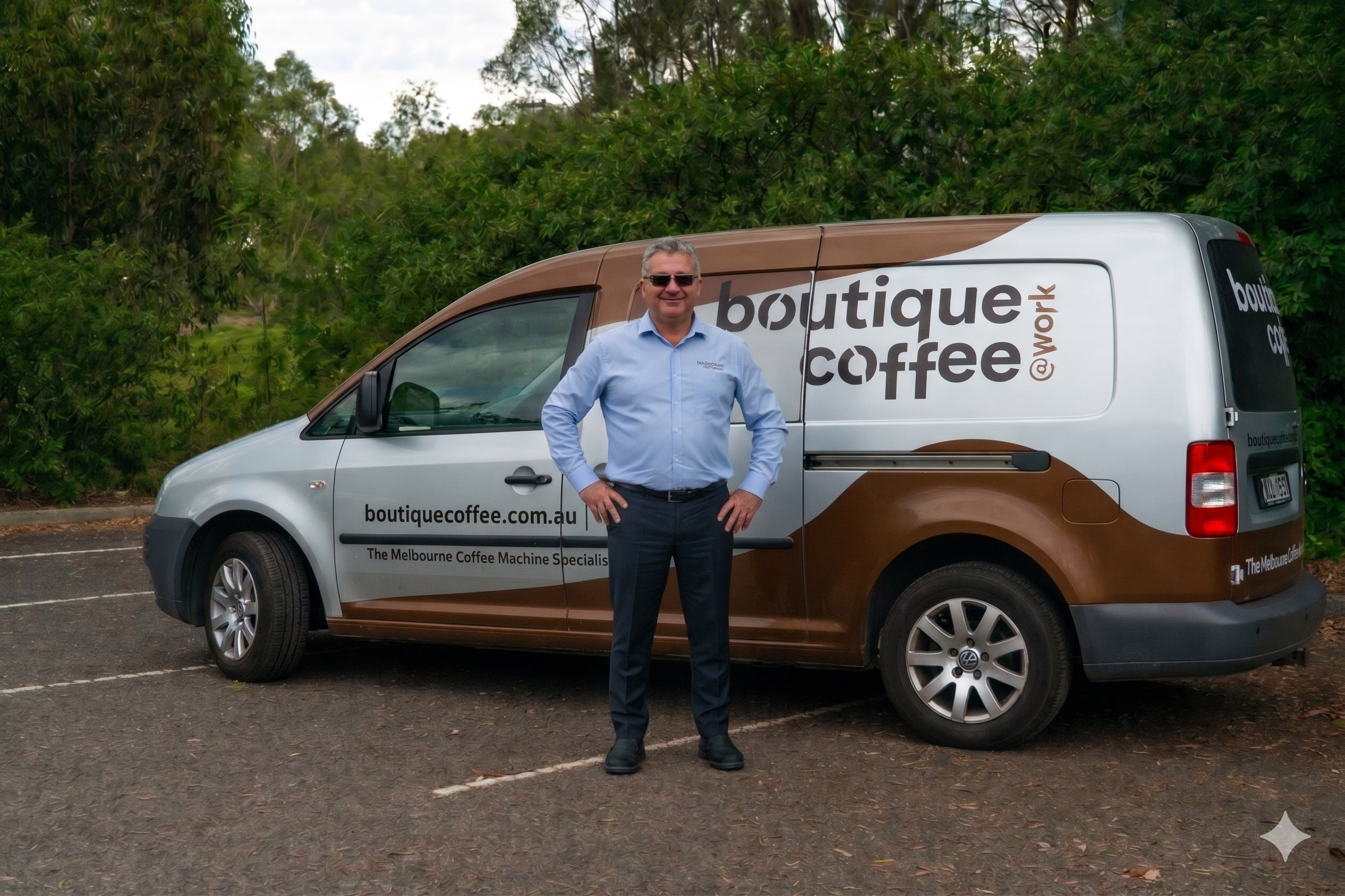
Boutique Coffee
The Boutique Coffee team
Melbourne workplace coffee, done properly.
Keep reading
Australian Coffee Price Statistics for 2026: Cafe Costs, Inflation & Workplace Impact
Key Statistics: Australian Coffee Prices at a Glance The average price of a flat white in an Australian capital city cafe reached approximately $6.00 to $6.50…
Office Coffee vs Daily Cafe Runs: The True Cost Comparison for Australian Workplaces
If your team of 30 is walking to the cafe twice a day, you are not just spending money on coffee. You are spending money on time, on attention gaps, on the…
Coffee Bean Types for Office Machines: Blends, Roasts and What Suits Your Workplace
If your office coffee tastes flat, bitter, or just a step above instant, the machine probably isn't the problem. In most cases, it's the beans. The right…