Introduction
If you are deciding between a plumbed office coffee machine and a water tank model, you are really choosing between consistency at scale and flexibility on the fly. Get it wrong and you will either run out of water at 10.30 am, or pay for plumbing you never use. Get it right and your team drinks café-quality coffee, made practical, with no drama.
I have installed, maintained, and supplied office coffee in Melbourne for 17 years. We now support 200 plus active workplace clients, and the same questions come up every week. What are the coffee machine plumbing requirements. Do we really need a water line coffee machine in our office. How much does it cost to run. What about filtered water. This guide gives you a direct answer for Australian offices, with real examples, a decision framework, and a plain-English cost breakdown.
Hero stats at a glance
- 17 years installing office coffee across Melbourne
- 200 plus active workplace clients as of 2026
- 24-hour typical response time on service calls
- Average client relationship length 5 plus years
- Largest office installed across 400 plus people
Key Takeaways
- Plumbed machines suit 25 plus staff or any site where refilling a tank will interrupt service. Tanks suit small teams, pop-ups, or where plumbing is not possible.
- Water quality matters. Melbourne water is very soft, Sydney is more variable. Filter choice and change frequency should match your location and machine type.
- Installation is straightforward when you plan power, water, and bench space properly. Most plumbed installs take 45 minutes on the day after a quick site check.
- Total cost depends on usage. Plumbed machines remove water refill labour and reduce scale risk, which saves money at 40 plus cups per day.
- Lease and strata rules matter. Get landlord approval for any water connection. Plan for make-good and backflow prevention.
- If in doubt, trial it. We offer a free trial and month-to-month rentals, no lock-in, ever, so you can prove the fit before committing.
Summary Table
| Factor | Plumbed office coffee machine | Water tank office coffee machine |
|---|---|---|
| Water source | Direct to mains with inline filtration | Internal removable tank filled manually |
| Best for | 25-400 people, high volume, shared hubs | 5-25 people, small kitchenettes, flexible layouts |
| Installation | Requires water line, shut-off valve, often drainage | No plumbing required, standard power |
| Upfront cost | Allow $350-$1,500 for plumbing works if needed | Nil plumbing cost |
| Ongoing costs | Filters $120-$300 per change, lower scale repairs | More frequent descaling, staff time to refill |
| Capacity | Continuous, limited by machine throughput | Limited by tank size and refill frequency |
| Downtime risk | Lower, no tank refills mid-service | Higher during refills or if tank runs dry |
| Flexibility | Fixed location, great for hubs | Portable, easy to move or trial |
| Taste and consistency | Stable with proper filtration | Can vary if refilled from jugs or poor-quality water |
What a "plumbed" office coffee machine really means
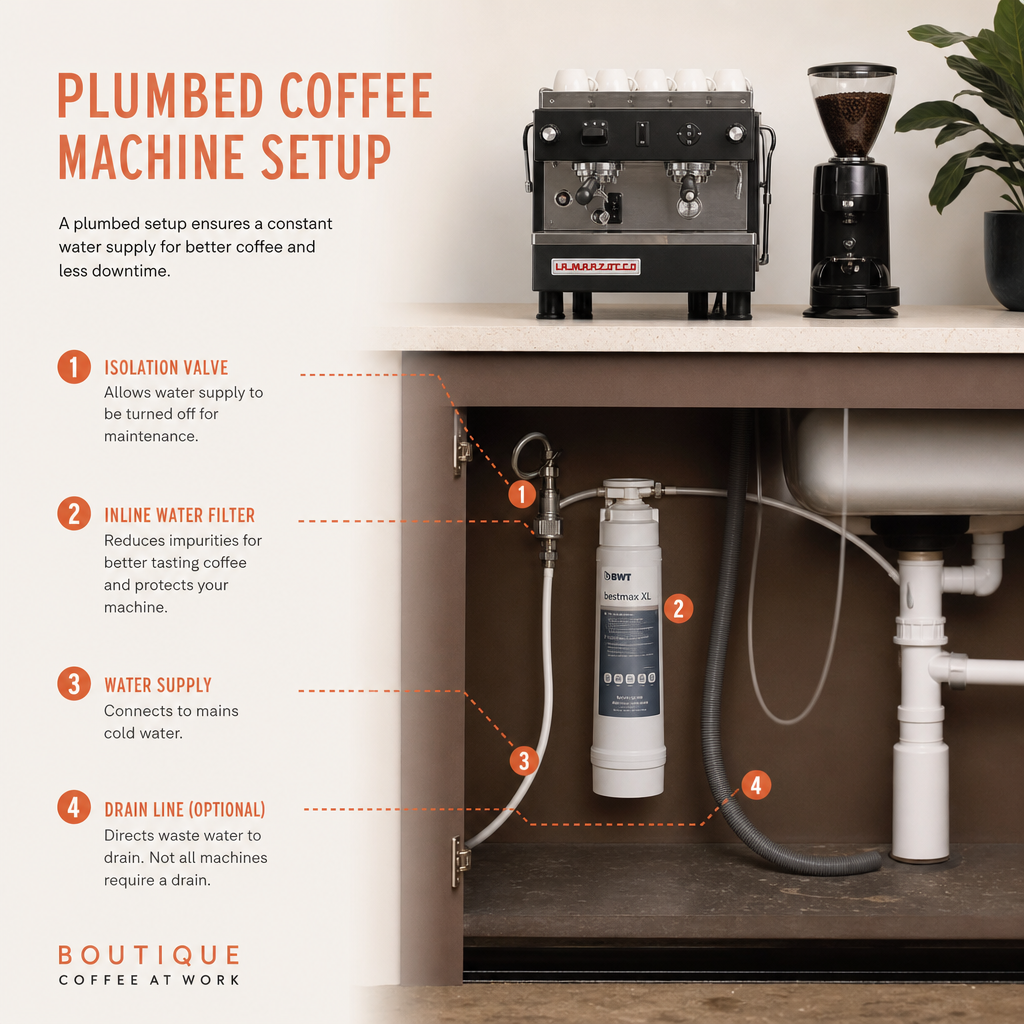
A plumbed office coffee machine connects directly to your building's water supply through a food-grade hose, a shut-off valve, and an inline filtration system. Some models also connect to a drain for automatic waste water discharge. The key is consistency. With mains water, the machine never runs out mid-rush, and the filtration system conditions the water to protect the machine and keep flavour consistent.
A tank machine holds its water in a built-in reservoir you refill by hand. Most reservoirs are 1.8-5.0 litres on compact automatics and 8-10 litres on larger units with separate tanks. Tank machines are quicker to place. They excel in small offices, pop-up setups, or fit-outs where a water line is not approved.
The decision is not about prestige. It is about flow of service, risk of limescale, and the practicalities of your floorplate. I am not trying to be the biggest. I am trying to match the machine and the connection method to your actual team size and layout, chosen on purpose.
Throughput and why it matters more than you think
The moment the tank runs dry, the machine stops and the queue grows. A 3-litre tank supports about 20-30 milk coffees before refilling, depending on purge cycles and cleaning routines. In a 40-person office where coffee peaks 8.30-10.00 am, you will refill a tank 2-4 times each morning. In a 120-person hub, you will lose patience within a week.
With a plumbed machine, throughput is limited by grinder speed, brew group capacity, milk frothing performance, and staff usage, not by water volume. That is one reason why plumbed is the default for 25 plus users.
Coffee machine plumbing requirements in Australian offices
A little planning upfront makes installation clean and quick. Here is the standard checklist we run on every on-site visit.
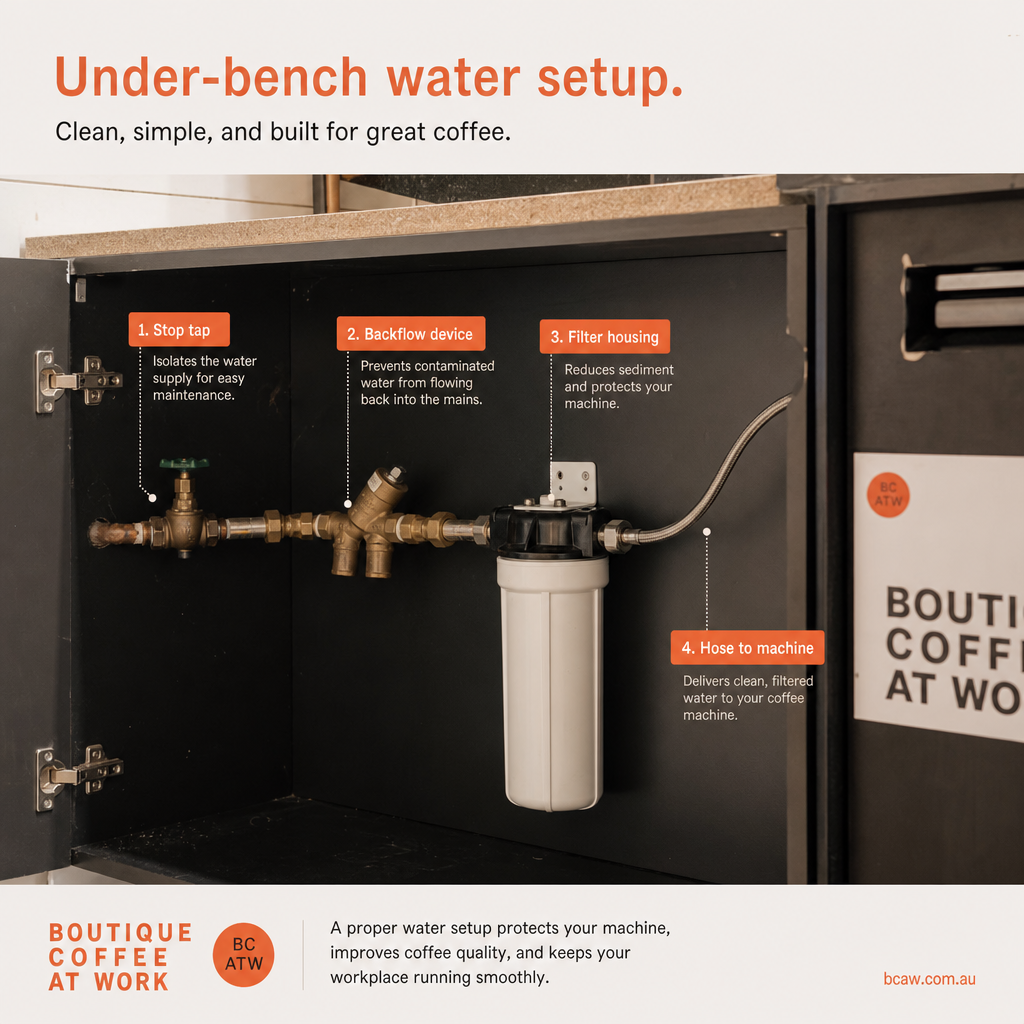
- Water supply: A cold potable water point within 1.5-3.0 metres of the bench or cabinet where the machine will sit. A 15 mm stop tap is ideal. We connect via a braided or polyethylene food-grade hose with a pressure-limiting valve if required.
- Isolation valve: A local shut-off under bench or in the adjacent cabinet so the machine can be serviced without isolating the entire kitchenette.
- Backflow prevention: A suitable device at the connection point, typically a dual check valve or as specified by your water authority and AS/NZS 3500. Your building may already have site-level containment backflow. We still install an appropriate device at the machine to protect both the building and the appliance.
- Filtration housing: Space under bench or nearby for a single or twin-stage filter, mounted vertically for easy cartridge changes. Leave 30 cm clearance below the canister for removal.
- Drainage: Some machines benefit from a waste line to a trapped waste connection in the cabinet. If a drain is not available, we use a benchtop knock box or internal dreg drawer as designed by the manufacturer.
- Power: Most super-automatic office machines require a standard 10 A GPO. Larger traditional machines with separate boilers may require 15 A. Confirm the circuit is not already overloaded by fridges and dishwashers.
- Bench space and ventilation: Allow footprint for the machine, grinder if separate, and milk fridge if external. Check cupboard ventilation so the power supply does not overheat.
- Access for service: We need space to pull the machine forward, remove side panels, and access the brew group. A tight cupboard that traps heat is a false economy.
These requirements are straight out of how we work and align with Australian plumbing norms under AS/NZS 3500.1 Water services. The exact fittings we use depend on the building and the selected model, but this list will get your tenant rep and facilities manager aligned quickly.
Building approvals, strata, and make-good
If you are in a managed building or strata, obtain written approval to connect to potable water. Most landlords will approve as a minor improvement if you commit to make-good on exit. We provide a short scope for your building manager that covers the connection method, backflow device, and that no structural works are involved. This usually clears in a day or two.
Installation lead time
Our Six-Step Process takes most Melbourne clients from first call to coffee in 5-7 business days. The physical install on the day is 45 minutes for a standard plumbed machine with an existing water point. If a plumber needs to run a new point or add a drain, allow an extra 60-90 minutes.
Water quality and filtration: Melbourne vs Sydney and why it matters
Water is the main ingredient in every coffee you serve. It affects flavour, machine longevity, and in some cases warranty coverage. Australian cities vary.
- Melbourne water is generally very soft. Melbourne Water reports hardness commonly in the range of about 10-30 mg/L as CaCO3, which is considered very soft. This is kind to boilers and reduces scale risk.
- Sydney water varies by source and suburb. Sydney Water publishes hardness values ranging from soft through moderately hard. Many areas sit around 50-120 mg/L as CaCO3, which increases limescale risk in hot water circuits.
Soft water is not a free pass. Even in Melbourne, bicarbonate alkalinity and chloride levels can influence corrosion and taste. You still want filtration that removes chlorine, taste and odour compounds, and manages scale precursors. In harder Sydney pockets, you either use a strong scale inhibitor or go to partial demineralisation for some machines.
Filter types we specify
- Carbon block with scale inhibitor: The baseline for most offices. Removes chlorine and organics, includes a food-grade polyphosphate or equivalent to keep calcium in suspension. Suits Melbourne and many Sydney postcodes.
- Twin-stage systems: Carbon plus a dedicated softening resin. Ideal when incoming hardness consistently exceeds 80-100 mg/L as CaCO3. Slows limescale in boilers and steam circuits.
- Reverse osmosis with remineralisation: Rare in offices, used when feed water is very hard or very high TDS. Adds cost and complexity, typically reserved for specific commercial applications, not standard workplaces.
Filter change intervals that are based on reality
Filter cartridges are rated in litres and months. Real intervals depend on cup volume, incoming water, and filter size. Here is how we schedule it in Melbourne and Sydney offices we service.
- Melbourne soft water, 30-60 cups per day: 6-monthly cartridge changes, typically 3,000-6,000 litres capacity per cartridge.
- Melbourne soft water, 100-200 cups per day: 3-4 monthly changes, larger capacity cartridges.
- Sydney moderate hardness, 30-60 cups per day: 3-4 monthly on scale-inhibiting cartridges.
- Sydney higher hardness, 100 plus cups per day: 8-12 weekly on twin-stage softening to stay ahead of scale.
We track changes as part of our ongoing rhythm. Your team never goes without coffee because a filter clogged on a Friday afternoon.
Taste and consistency
Well-filtered water reduces chlorine bite and metallic notes. That means milk drinks taste rounder and espresso has cleaner sweetness. Filters also protect temperature stability by keeping boilers free of scale. Stability matters more than chasing a perfect lab profile. Café-quality, made practical, beats theory.
Costs: installation, rental, maintenance, and the real cost per cup
Let us put numbers on the choice so you can run it past finance without drama. All figures are typical for Melbourne offices in 2026, excluding GST unless stated.
Upfront installation
- Plumbed machine, existing water point and power: Included in rental with us. Allow 45 minutes on the day.
- Plumbed machine, new water point needed: Licensed plumber to install a 15 mm stop tap, isolation valve, and backflow device. Typical $350-$1,500 depending on cabinet access and distance to riser. One-off.
- Tank machine: Nil plumbing cost. Placement and commissioning included in rental.
Equipment rental
Month-to-month, no lock-in, ever. Example ranges.
- Super-automatic tank model for 10-25 staff: $200-$350 per month.
- Super-automatic plumbed model for 25-60 staff: $350-$550 per month.
- Higher-throughput plumbed model for 60-150 staff: $550-$900 per month.
- Large hub with twin grinders and external milk fridge for 150-400 people: Priced to spec after site visit.
We recommend the machine that fits your actual team size. A 12-person team does not need a $15,000 flagship unit. An 80-person team will break a home-grade machine within a month. Honest fit advice builds the long-term relationships we run on.
Filtration and consumables
- Filter cartridges: $120-$300 per change depending on size and type. Change intervals as above. We change them during routine visits and leave a tag with date and volume.
- Cleaning tablets and milk line cleaner: $10-$30 per month depending on model and usage.
Service and response
- Included with us. Typical response within 24 hours across active clients. One number, one person. No call centres, no corporate runaround. Most issues are solved with a two-minute call because we know your exact setup.
Water and electricity
- Water: Negligible cost for offices. An automatic that produces 100 cups per day might use 40-120 litres including purges and cleaning cycles. Even at higher usage, this is dollars per month, not tens of dollars.
- Electricity: A super-automatic draws 1.5-3.0 kWh per day depending on usage and standby settings. At 30 cents per kWh, expect $15-$27 per month. Traditional heat-exchanger or multi-boiler units can be higher.
Staff time and hidden costs
- Tank machines require refilling. If your receptionist or office manager spends 10 minutes a day carrying jugs and wiping spills, that is nearly 4 hours per month. At a $35 per hour fully loaded rate, that is $140 per month in hidden cost. Over a year, it often exceeds the extra rental for a plumbed unit.
- Scale-related downtime: In moderate to hard water, scale is the number one preventable cause of breakdowns. A $250 filter change is cheaper than a $700 descaling and component swap, and much cheaper than a morning without coffee when clients are in the boardroom.
Cost per cup
A typical Melbourne office paying $35 per kg for dialled-in beans and producing 10 g espresso shots will land at 35 cents of beans per shot, plus milk for milk drinks, plus machine and service. Most clients land at 60-90 cents per milk coffee all-in when volume is 40-150 cups per day. That compares well to $4.50-$6.00 at a café and saves time walking to the street during peak meetings.
Maintenance frequency and downtime: what you should expect
The best machine is the one that works every morning without fuss. Here is the reality.
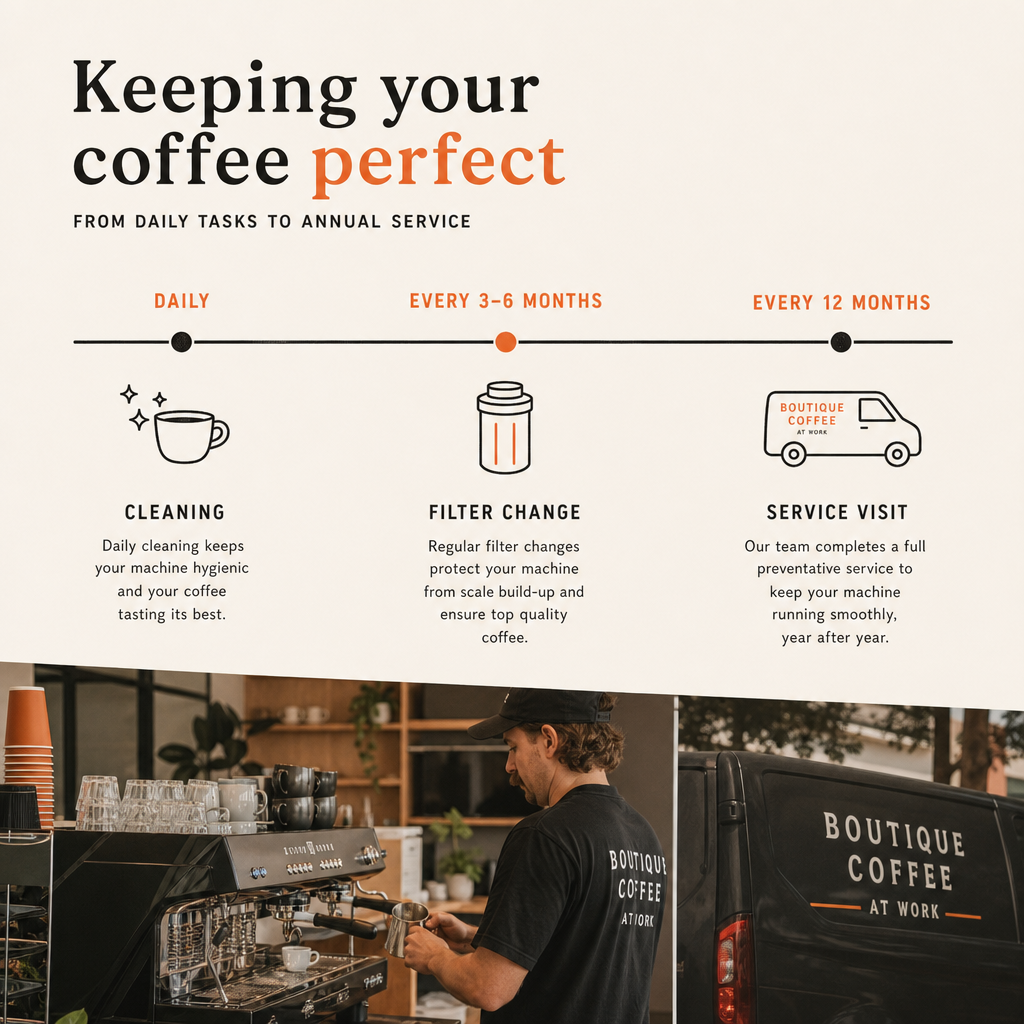
- Daily: Staff empty waste drawers, wipe the steam wand if using one, run the automatic rinse at open and close.
- Weekly: We or your team run the guided cleaning cycle with tablets. Takes 5-10 minutes and clears coffee oils from the brew group.
- Fortnightly: Milk system clean on super-automatics that froth milk internally. We schedule this and stock the cleaner.
- Quarterly to six-monthly: Filter cartridge change. We log the date and volume and swap it during a routine visit.
- Annually: Full inspection, replace seals and o-rings where required. We prefer preventative swaps rather than waiting for a seal to fail on a Monday.
Our model is founder-led, always. One person stays accountable for your experience from site visit to ongoing service. Same-day or next-day onsite is only possible when there is no internal runaround to navigate. Your team never goes without coffee during the coffee moments that matter.
Decision framework: which suits your workplace size, layout, and lease
Choosing between a water line coffee machine and a tank model becomes simple when you look at headcount, layout, and lease constraints. Use this framework to land on the right side faster.
Small kitchenette, 5-15 people
- Recommend: Water tank model or compact plumbed if a water point already exists.
- Why: Cup volume is low enough that refilling a 3-litre tank once or twice a day is fine. A tank model avoids any lease approval headaches.
- Watchouts: Keep the tank and lid clean. Use filtered jug water if you are in a harder-water suburb to minimise scale.
Growing team, 15-30 people
- Recommend: Plumbed if you have a kitchenette on the main floor. Tank can work if your team has staggered breaks and someone owns refills.
- Why: Two refills a morning gets old. Plumbed removes an avoidable task and stabilises taste.
- Watchouts: Confirm power and bench space. If you are in a serviced office, check the contract for water connection rules.
Single large floorplate, 30-100 people
- Recommend: Plumbed machine with proper filtration. If the floor is deep and the team is spread, consider two smaller plumbed machines rather than one large one.
- Why: Walk distance kills adoption. Put machines where people already gather. Continuous service matters when all hands break after a town hall.
- Watchouts: Noise and line management near meeting rooms. We help you choose a location where the grinder does not interrupt video calls.
Multi-zone or multi-floor, 80-400 people
- Recommend: Plumbed machines in each hub or floor pod. If you run events or pop-up areas, complement with a tank unit on a mobile bench.
- Why: Consistency in main zones plus flexibility for temporary spaces gives you the best of both worlds. One central location forces queues and discourages casual connections over coffee.
- Watchouts: Milk logistics. External milk fridges help throughput and hygiene. Drainage for waste water improves cleanliness.
Leased premises with strict make-good
- Recommend: Start with a tank machine to avoid delays. If adoption is strong after a month, we upgrade to plumbed with landlord approval. Month-to-month means no lock-in while you decide.
- Why: You avoid needless project friction. Once the team is hooked, approvals are easier because stakeholders have already felt the benefit.
- Watchouts: Document make-good. We cap any unused points on exit, leaving cabinetry tidy.
Strata and older buildings
- Recommend: Plumbed still works, but check cupboard access, waste traps, and backflow rules. If the cupboard is cramped, a tank machine avoids heat build-up.
- Why: Simpler sometimes wins in older fit-outs.
- Watchouts: Heat and ventilation. Machines hate hot, sealed cupboards.
Case studies with real numbers
Case study 1: Mid-size Melbourne office eliminates refill downtime
Context: A mid-size Melbourne office had an existing setup that was not meeting expectations. Coffee quality and uptime were inconsistent during the morning rush.
Intervention: We upgraded the office to a commercial WMF super-automatic, plumbed with twin-stage filtration. Full install, training, and ongoing service were included in the rental.
Outcome and metrics:
- Headcount: 60 staff on a single floor.
- Before: Tank-based machine, 3-4 refills each morning, 15-20 minutes of lost time per day.
- After: Plumbed machine, 0 refills, continuous service during peak.
- Cups per day: 120-150, measured via machine counters.
- Downtime: Reduced from 1-2 incidents per fortnight to near zero. Service calls handled within 24 hours.
- Cost per cup: Stabilised at 70-85 cents all-in after first month.
A note from Paul, the site manager: "The team loves the coffee and hot chocolate. I told them just keep doing what you are doing. Easy to use every day and looked after properly."
Case study 2: Busy workspace avoids havoc from machine outages
Context: A busy Melbourne workplace experienced chaos when their machine went down in peak hours. Meetings were delayed and staff left the floor for café runs.
Intervention: We supplied a reliably maintained plumbed machine, scheduled servicing, and direct contact for any issue. One number, one person.
Outcome and metrics:
- Headcount: 120 staff across two wings.
- Before: Ad hoc servicing, two outages per month on average, 60-90 minutes to resume service.
- After: Regular service rhythm, most issues prevented, same-day response on the few that occurred.
- Cups per day: 220-280.
- Downtime reduction: 80 percent fewer incidents. The team always had coffee when it mattered most.
Feedback from Chrissie, operations lead: "Regular service means we always have coffee when we need it. We stopped the havoc a broken machine would cause."
Case study 3: Retail-facing office serving staff and customers
Context: A Melbourne business in a busy retail environment needed consistent coffee for staff and walk-in visitors.
Intervention: We supplied a fully maintained plumbed machine and managed fresh beans and consumables personally.
Outcome and metrics:
- Headcount and visitors: 25 staff, 30-50 visitor cups on busy days.
- Cups per day: 70-120 depending on foot traffic.
- Taste consistency: Improved customer feedback on in-store coffee within the first week, noted informally at the counter.
- Supply continuity: Zero stock-outs on beans and cleaning products across the first 6 months.
Comment from Michael, the manager: "Chris's attention to detail is why we can serve great coffee every day without interruption."
Installation, step by step: The Six-Step Process
Our Six-Step Process is designed to get most Melbourne offices from first call to first brew in 5-7 business days.
- Enquiry, 2 minutes: You submit basic team details and floor layout notes. If you want a deeper dive into machine options by office size, start with our solutions page at Boutique Coffee solutions.
- Phone call with Chris, 15-20 minutes: We shortlist machines, discuss plumbed vs tank, and outline rough pricing. No upsell. Just the right fit.
- On-site visit, 30 minutes: We assess power, plumbing, bench space, and traffic flow. We also cover landlord approval and strata if relevant.
- Install day, 45 minutes: Machine connected, filter mounted, grinder dialled in, shots tested. We leave the area clean.
- First brew and training, 20 minutes: At least two staff trained. We leave a cheat sheet near the machine with daily and weekly tasks.
- Ongoing rhythm, weekly or fortnightly: We visit on a cadence that suits your volume. Filters changed on schedule, beans and consumables topped up, issues handled fast. Your team never goes without coffee.
If you would like to prove the fit before committing, book a free trial. Rentals are month-to-month with one month's notice to exit and free machine pickup.
Coffee machine water tank vs mains: flexibility vs consistency
There is no single right answer for every office. It is a trade-off between flexibility and consistency. Here is how we frame it with clients.
- Flexibility: Tank machines can live on a mobile bench for events, move floors during a refurb, or sit in a remote nook where no water line exists. They are perfect for testing adoption in a new area before investing in plumbing.
- Consistency: Plumbed machines shine when you need to serve continuous coffee without refilling or watching the tank level. A line of six people waiting is the point where the extra plumbing pays for itself in morale and time.
- Hybrid approach: Many multi-floor clients run plumbed machines in main hubs and keep a tank unit available for pop-ups, offsites, or a project war room.
Coffee machine plumbing requirements, distilled into a punch list you can hand to FM
Hand this to your facilities manager or building contact.
- Cold potable water within 1.5-3.0 metres of final location
- 15 mm stop tap and isolation valve
- Appropriate backflow device as required by local water authority and AS/NZS 3500.1
- Space for filter housing and 30 cm clearance for cartridge changes
- Optional drain connection to a trapped waste for automatic waste water discharge
- 10 A or 15 A dedicated GPO within reach, with spare circuit capacity
- Adequate bench space and ventilation around the unit
- Landlord or strata written approval if required by lease
We provide a simple schematic and equipment list after the site visit so your trades can price cleanly if any new points are needed.
Layout examples and practical placement tips
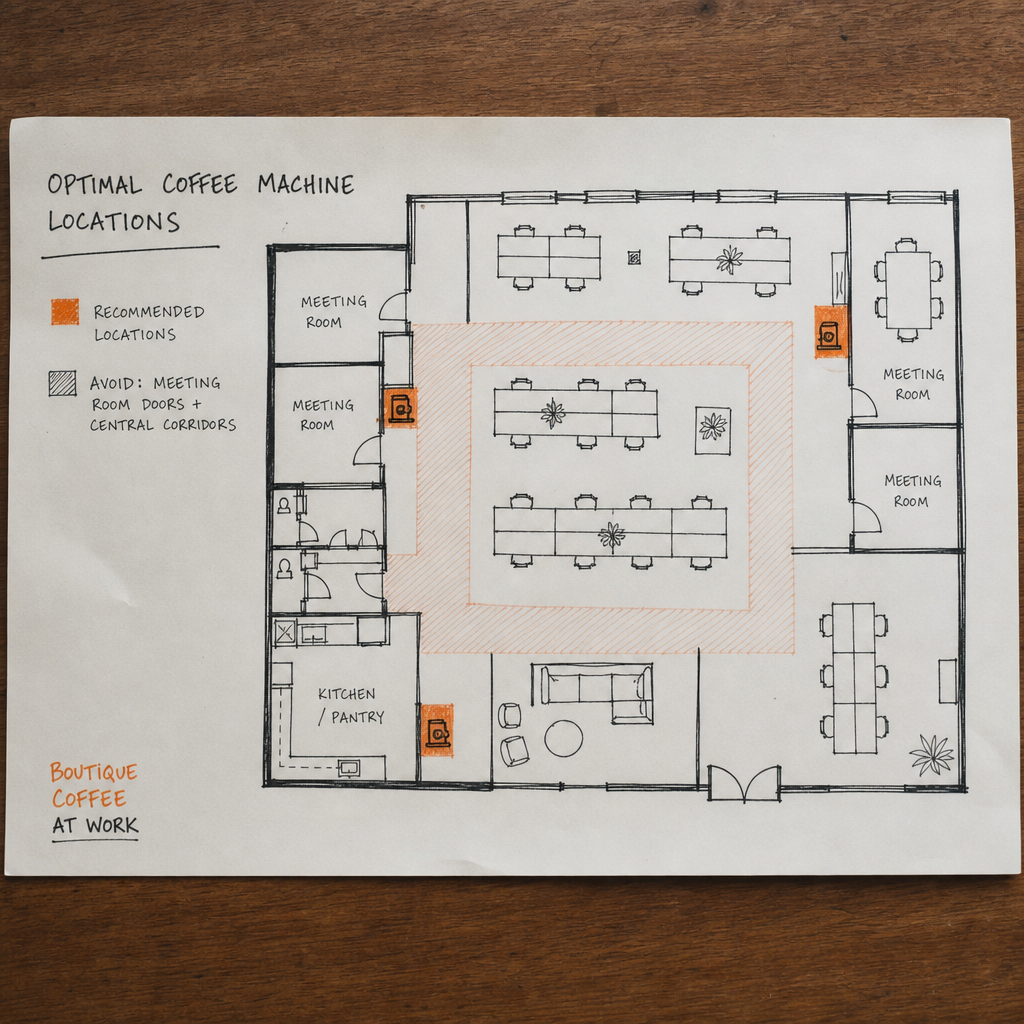
- Near the fridge, not the sink: Keep foot traffic flowing. A machine beside the sink creates blockages when someone washes up.
- Away from meeting room doors: Grinder noise is short but sharp. Place the machine where conversations are normal, not where a video call picks up every burr.
- Visible, but not central corridor: You want a coffee corner people naturally gravitate toward, not a queue blocking an exit.
- Two modest machines beat one hero: On a wide floor, two plumbed units closer to teams will outperform one large machine at the far end. Walk time kills usage.
Tenancy, council, and strata implications you should know about
- Landlord consent: Most commercial leases require consent for any connection to building services. A simple email with our scope and a commitment to make-good is usually enough. We help draft it.
- Backflow compliance: Water authorities require backflow prevention to protect the network. Many buildings already have site-level devices. We still install an appropriate local device to protect your appliance and comply with AS/NZS 3500.1. Your building manager will know the classification needed.
- Make-good on exit: We cap and blank any tees installed and return cabinetry to a tidy state. If we have mounted a filter bracket, we remove it and patch the screw holes. This is standard.
- Council health permits: Offices do not generally require council food premises registration for an internal coffee machine serving staff. If you are selling coffee to the public, check with your local council. This is rare in standard offices.
Cleaning and hygiene made practical
- Milk hygiene: If your machine has an internal milk frothing system, weekly milk line cleaning is non-negotiable. We supply the cleaner and leave a cheat sheet near the unit.
- Steam wand care: If you are on a traditional or hybrid machine, wipe and purge after each use. Leave a damp cloth beside the machine for staff.
- Waste management: If there is no drain, empty dreg drawers and waste trays daily. Place a bin nearby for convenience.
Hygiene is a behaviour as much as a feature. We set it up so the right behaviour is the easy one.
Curated Coffee Plan: beans matched to your team, not just your machine
A machine is half the story. Beans that suit your team's taste profile and your water make the difference between good and "can I have another".
Our Curated Coffee Plan is simple and works.
- Ask about preferences: Espresso heavy or milk heavy. Strength preferences. Any dislikes. We read the room and the suburb too.
- Start on a matched blend: We choose a blend we know performs with your machine and water. If you are milk-dominant, we choose something with chocolate and caramel notes that still cuts through.
- Adjust in the first month: We run a quick feedback loop, then adjust roast or blend. This can be as simple as moving from a medium to a medium-dark profile.
We call it café-quality, made practical. Dialled-in beans plus a properly set machine and filtration is what gives you the same cup on Monday morning and Thursday afternoon.
Why supplier model matters as much as machine choice
Most suppliers route issues through helpdesks and ticket systems. My view is different. One person stays accountable from setup to ongoing service. It is founder-led, always. When you call, the person who answers can usually talk you through a fix in two minutes because they know your exact setup. When a visit is needed, it is same-day or next-day because there is no internal runaround. That is how your team never goes without coffee.
On contracts, the industry standard is to lock clients into long terms to protect revenue. We run month-to-month, with one month's notice to exit and free pickup. In 17 years, that policy has not cost us a client worth keeping. Clients retained by choice are worth more than clients retained by contract. That is how you get a coffee partner, not a supplier.
A simple call to action
If you want a straight answer on whether plumbed or tank suits your office, book a site assessment and we will map it in 15 minutes. Use contact to lock a time. If you would rather try first, start a free trial. If you are weighing machine types by team size, browse our solutions for a quick shortlist. All month-to-month. No lock-in, ever.
Visual guide: how a plumbed connection fits together
Below are simple visual prompts. If you want a diagram for your facilities manager, we provide one during the site visit and include model-specific fittings.
Maintenance schedule and service model at a glance
Floorplate placement examples for better adoption
FAQs
Frequently asked questions
How often should filters be changed in Melbourne and Sydney offices?
In Melbourne's soft water, most offices at 30-60 cups per day change filters every 6 months. Higher volume sites change every 3-4 months. In Sydney's moderately hard areas, plan for 3-4 monthly at 30-60 cups, and 8-12 weekly above 100 cups. We size the cartridge to your usage and water and change it on a schedule so you do not need to track it.
Will a plumbed machine reduce limescale problems?
Yes, if paired with the right filtration. Plumbed machines let us condition every litre that goes into the machine. In moderate to hard water this reduces the risk of scale in boilers and valves, which is the number one preventable cause of breakdowns. Tank machines can be fed from jugs with filtered water, but consistency depends on staff remembering to use the filter every time.
Can we install a plumbed machine in a leased office?
Usually yes with landlord consent. It is a minor improvement. We provide a short scope covering the water point, isolation valve, and backflow device. We commit to make-good on exit. If approvals will take time, start with a tank unit, then upgrade to plumbed once approved. Month-to-month rental means no lock-in while you decide.
Do we need a drain connection?
A drain is nice to have for some machines because it automates waste water discharge. If a trapped waste is not available in the cabinet, we run without a drain and use the internal waste tray or a benchtop knock box as designed. Many offices operate cleanly without a drain connection.
What power does an office coffee machine need?
Most super-automatic office machines use a standard 10 A GPO. Some larger units or traditional machines can require 15 A. We confirm this during the site visit. Avoid plugging into crowded power boards shared with fridges or dishwashers to prevent nuisance trips.
How long does installation take?
Once approved, a standard plumbed install takes about 45 minutes on the day when a water point already exists. If a new point is needed, a plumber may take an extra 60-90 minutes. Tank machines are even faster since they do not require plumbing.
What happens if the machine stops working during peak hours?
Call the same mobile number you used to book the install. One number, one person. Because we know your setup, many issues are resolved in a two-minute call. If a visit is needed, we target same-day or next-day. Our service rhythm and preventative maintenance keep surprises rare.
Do you offer a free trial?
Yes. If you want to prove adoption or compare plumbed vs tank in your space, we set up a free trial. Start at https://www.boutiquecoffee.com.au/https://boutiquecoffee.com.au/free-trial and we will line up dates.
Chris
Chris
Keep reading
Office Coffee Machine Rental Services in Melbourne: How the Process Actually Works
An office coffee machine rental service in Melbourne supplies a commercial-grade machine, installs it properly, trains your staff, and keeps beans and…
Australian Workplace Perks and Amenities Statistics 2026
Key Statistics Summary According to the Australian Bureau of Statistics (ABS), 36% of employed Australians usually worked from home in August 2024. According…
Office Coffee Machine Hygiene: Cleaning Standards & Food Safety for Australian Workplaces
If your office coffee machine has never been professionally cleaned, you are not alone. Across Melbourne workplaces, I see the same pattern repeatedly: a…