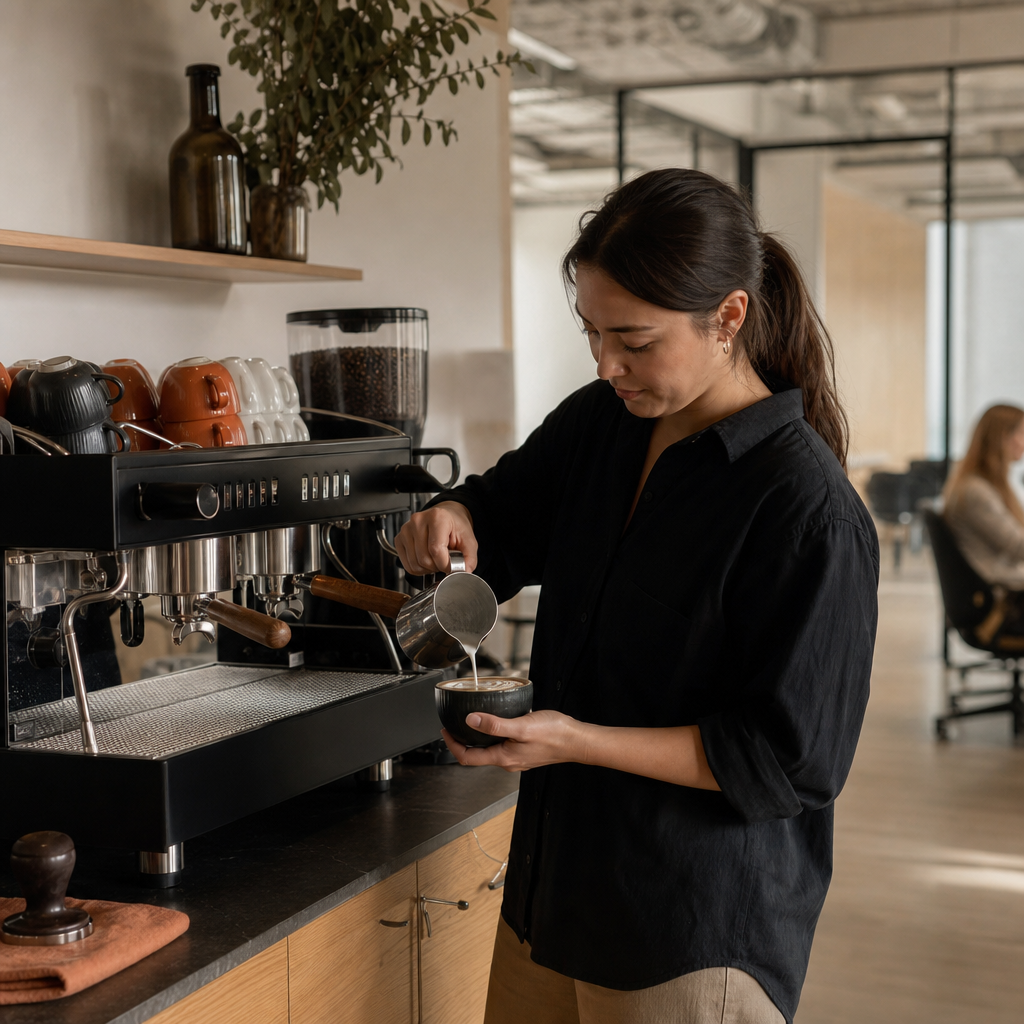
An office coffee machine rental service in Melbourne supplies a commercial-grade machine, installs it properly, trains your staff, and keeps beans and consumables topped up for a fixed monthly fee. Boutique Coffee at Work runs this month-to-month, with one point of contact, one month's notice to exit, and free machine pickup at the end.
If you've been asked to 'sort out the coffee' for your Melbourne office, you're probably comparing a rental against buying a machine outright, or against just leaving the instant coffee tin where it is. All three options look simple on the surface. What separates them is what happens after the machine arrives: who services it, who pays when it breaks, and how easily you can change your mind if your team grows, shrinks, or goes hybrid.
This guide walks through what a proper rental service actually includes, how the process runs from first enquiry to your first coffee, and what to ask any supplier before you sign anything. It's written from 17 years of doing exactly this, exclusively, across Melbourne workplaces.
Key Takeaways
- A genuine rental includes the machine, professional installation, ongoing servicing, consumables supply, and staff training, not just the hardware.
- Boutique Coffee at Work has worked exclusively in this space since 2008, with 200+ active Melbourne workplace clients currently renting.
- The average client relationship runs 5+ years, on month-to-month terms with no lock-in contract.
- Typical response time on any service call is 24 hours, answered by one accountable person, not a call centre.
- Machines are matched to your actual daily cup volume, not upsold to the biggest model on the price list.
- Exiting is one month's notice with free machine pickup. No leftover equipment, no drawn-out disputes.
At a Glance: Renting vs Buying vs the Instant Coffee Tin
| Factor | Rental | Buying Outright | Instant Coffee Tin |
|---|---|---|---|
| Upfront cost | Low, spread monthly | High, paid in full or financed | Minimal |
| Who carries repair risk | Supplier | You | N/A |
| Flexibility for headcount change | High, month-to-month | Low, fixed asset | High but low value |
| Coffee quality | Café-standard when properly maintained | Depends on ongoing maintenance | Poor, no consistency |
| Exit terms | One month's notice, free pickup | Resale is your problem | None needed |
What's Actually Included in an Office Coffee Machine Rental
A proper rental includes the commercial machine, installation, regular servicing, a running supply of beans and consumables, and training for your staff. Most people renting for the first time assume they're only paying for the box. The real value sits in everything that keeps that box working, week after week, for years.
A lot of cheaper rental deals strip this back to just the machine and a bag of beans dropped off occasionally. That's not a coffee partner, that's a vending arrangement with better marketing. The gap shows up six months in, when the group head needs descaling and nobody picks up the phone.
Bean matching is part of what a rental should include, not an afterthought. We run what we call a Curated Coffee Plan: we ask about the team's drink preferences (espresso versus milk-based, strength, any dislikes), start them on a well-matched blend based on that profile, then adjust based on feedback within the first month. A 15-person creative agency and an 80-person logistics office don't want the same beans, and they shouldn't be sold the same default supply.
Training is the other piece people underestimate. A commercial machine isn't a pod machine. At least two staff members are trained to use it properly on install day, and a cheat sheet is left behind for everyone else. Without this step, machines get misused, shots get pulled wrong, and the office decides 'the coffee isn't as good as we thought it would be' when the real issue is nobody was shown how to use it.
How the Rental Process Runs, Step by Step

Most Melbourne clients go from first enquiry to an installed, working machine in 5 to 7 business days. The process runs through six defined steps, each with a clear purpose, so nothing gets guessed at or skipped along the way.
We call this the Six-Step Process, and it's the same sequence for every new client, from a 10-person startup to a 400-person office floor:
- Enquiry (about 2 minutes): you submit basic details about your team size and current setup.
- Phone call with Chris (15 to 20 minutes): a machine shortlist and rough pricing, based on your actual cup volume, not a sales script.
- On-site visit (30 minutes): power, plumbing, and bench space are assessed in person, not guessed from a floor plan.
- Install day (45 minutes): the machine is connected, the grinder is dialled in, and shots are tested before anyone touches it.
- First brew and training (20 minutes): at least two staff are trained, and a cheat sheet is left for the rest of the team.
- Ongoing rhythm: weekly or fortnightly service visits, with beans and consumables topped up before they run low.
That on-site visit in step three matters more than most suppliers let on. Plumbing and power requirements vary a lot between a fitted-out CBD office and an older suburban warehouse conversion. Getting this wrong before install day means delays, or worse, a machine that's the wrong fit for the space it's sitting in.
Renting vs Buying Outright (and vs the Instant Coffee Tin)
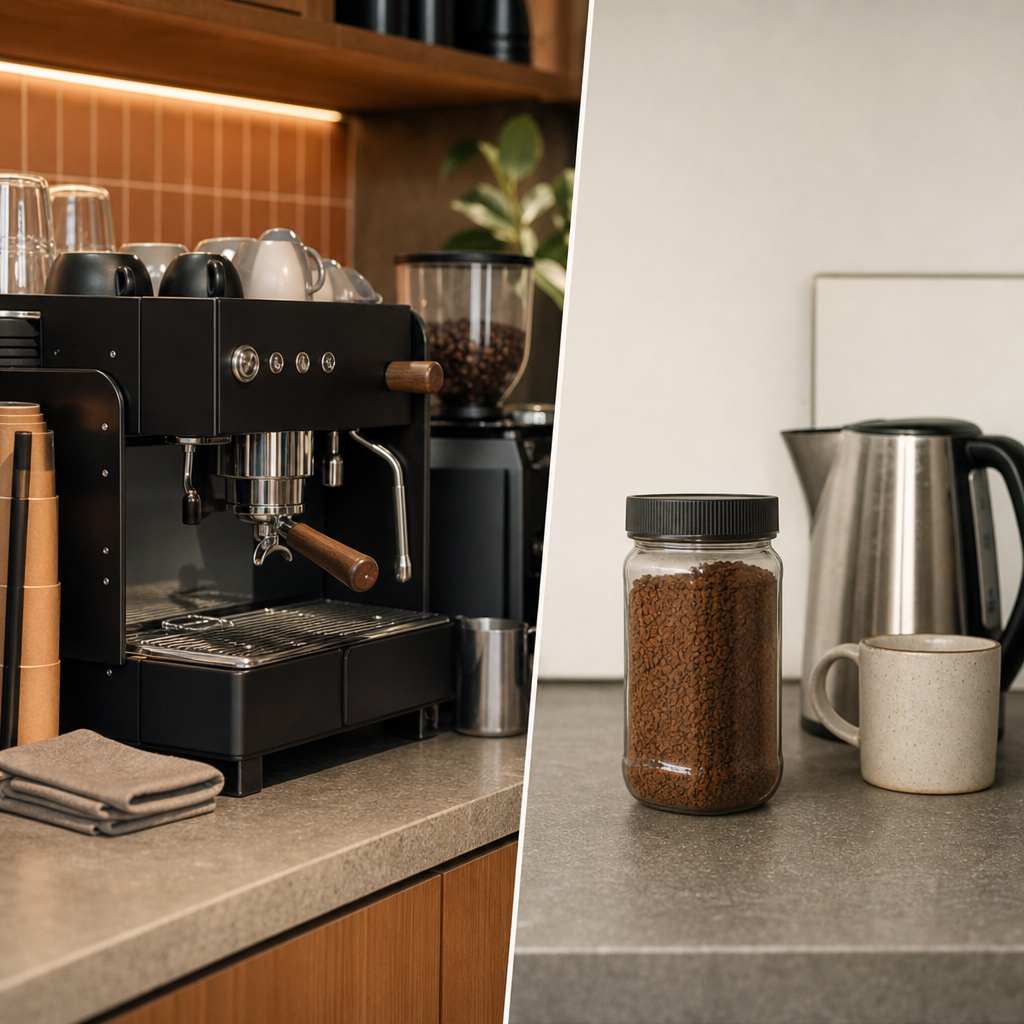
Renting spreads the cost monthly and shifts repair risk to the supplier, while buying outright means a large upfront outlay and full responsibility when something breaks. Month-to-month rental also suits hybrid offices where headcount and daily cup volume change from one quarter to the next, in a way that a purchased asset can't.
When you buy a commercial machine outright, you own the maintenance problem the day the warranty ends. Group heads wear out. Boilers scale up. Someone needs to source parts and book a technician, usually while the office is standing around without coffee. Renting keeps that risk with the people who install and service the machine, which is where it belongs.
Ageing out is the other issue nobody plans for. A machine bought five years ago for a 20-person office doesn't shrink or grow with the business. If the team doubles, it's undersized. If half the team goes hybrid two days a week, it's oversized and expensive to run for the volume it's actually producing. According to the Australian Bureau of Statistics (https://www.abs.gov.au), working-from-home arrangements remain common across a wide range of Australian industries, which is part of why in-office headcounts move around more than they used to. Month-to-month terms mean you can step up or down without renegotiating a contract or eating a loss on equipment you own.
Then there's the instant coffee tin, still sitting in more Melbourne kitchens than it should be. The gap between the café-quality coffee outside the office door and the instant coffee inside it has never made sense to me. Melbourne workers walk past three good cafés on the way to their desk, then drink instant coffee once they sit down. That gap is entirely fixable, and closing it has been the whole point of this business since 2008.
What Ongoing Service Should Look Like
Ongoing service should mean a scheduled visit every week or fortnight, beans and consumables topped up before they run out, and one phone number that gets answered when something goes wrong. The typical response time on any service call across our active client base is 24 hours. That number only works because there's no internal runaround to navigate first.
Most corporate coffee suppliers route issues through helpdesks, ticket systems, and tiered support. You log a fault, wait for a callback, then wait again for a technician to be assigned. In a busy Melbourne workplace, a broken machine during peak morning hours isn't a minor inconvenience, it's forty people standing around a dead machine at 9am.
One busy Melbourne workplace I've worked with for years used to lose real time whenever their old machine went down mid-morning. Once they moved to a reliably serviced machine with regular scheduled visits and one direct contact for any issue, that disruption stopped. Their office manager, Chrissie Straw, has said the reliable, regular service means the team has coffee when they need it most, without the havoc a breakdown used to cause.
Ask any supplier these questions before you sign anything: Who actually answers the phone when the machine goes down? Is that the same person who did your install? What's the average response time, and is that a guarantee or a guess? If the answers involve an account manager, a ticket number, or a call centre, keep looking.
Costs and Contract Terms in Real Language
The monthly rental figure is driven by the machine tier your team needs, your expected daily cup volume, and how much bean and consumable supply that volume uses. There's no single flat rate that applies to every office, because a 12-person team and a 150-person team don't use the same machine or the same volume of beans.
Exit terms should be simple: month-to-month, one month's notice, free pickup of the machine at the end. That's how every rental we run works, and it's how any legitimate rental should work. No lock-in, ever. The Australian Competition and Consumer Commission (https://www.accc.gov.au) advises businesses to check exit clauses carefully before signing any equipment rental or lease agreement, and that advice holds here too: read the fine print on notice periods and pickup fees before you commit.
For a full breakdown of what drives the daily cost of running an office coffee machine, our cost-per-day guide covers the maths in more detail than this section can. If you're comparing machine types before you call anyone, our machine features guide and installation guide are worth reading first, and our service contracts article goes deeper into what a fair agreement should look like on paper.
How to Choose a Supplier: Red Flags to Watch For
The clearest red flags in this industry are long lock-in contracts, call-centre support instead of a direct line, and no local technicians who actually know your machine. Any one of these should make you keep comparing before you sign.
Long lock-in contracts protect the supplier's revenue, not your flexibility. I've never needed one. In 17 years, the no-lock-in policy has never cost us a client worth keeping. The clients who stay, stay because the coffee's good and the service is reliable, not because they're contractually stuck. A long-term client retained by choice is worth more than one retained by a contract they resent.
Call-centre support is the other giveaway. If the person answering your fault call doesn't know your machine, your site, or your history, you're not getting a coffee partner, you're getting a ticket number. Founder-led, always, means the person who did your site visit is the same person who answers when something breaks. One number, one person, no escalation paths.
Watch for upselling too. Some suppliers push the highest-spec machine because it lifts the deal value, regardless of whether your team needs it. A 12-person team doesn't need a $15,000-class machine built for continuous high volume. An 80-person team will break a home-grade unit within a month. The honest answer is the machine that fits your actual team size, even when that's the cheaper option.
If you'd rather skip the guesswork, book a no-obligation site assessment and machine recommendation for your Melbourne office. Reach out through boutiquecoffee.com.au and you'll speak directly with the person who does the install and answers the service calls, not a booking system.
Why the Café-Outside-the-Door, Instant-Coffee-Inside-It Gap Never Made Sense
My view on this hasn't changed in 17 years: workplace coffee should match the standard of the city around it, and closing that gap has been the entire focus of this business since 2008. Melbourne has some of the best café coffee in the country sitting on almost every corner. There's no reason the coffee at someone's desk should be worse than the coffee they walked past to get there.
We currently look after 200+ active Melbourne workplace clients, ranging from small teams to a single office of 400+ people, our largest installation to date. The average client relationship runs 5+ years, which tells me the model works when the fit is right and the service is consistent.
One example that's stuck with me involved a mid-size Melbourne office running an old setup that wasn't meeting the team's expectations. We upgraded them to a proper commercial WMF machine (https://www.wmf.com), with full install, training, and ongoing service built into the rental from day one. The change across the whole office was immediate. Their site manager, Paul Bruno, has told me directly how much the team appreciates having good coffee and hot chocolate available every day, and the service has stayed consistent for years since.
Another client, in a busy retail environment, needed consistently great coffee served to both staff and customers, every single day, without interruption. We manage the bean supply and machine upkeep personally there. Their manager, Michael May, has credited that attention to detail as the reason they can serve good coffee daily without a gap in service. That's the standard I hold every install to, whether it's a 10-person office or a 400-person floor.
I'm not trying to be the biggest coffee supplier in Melbourne. I'm trying to be the one who actually answers the phone, matches the right machine to the right team, and makes sure your team never goes without coffee. That's what a coffee partner does, and it's a different thing to what most suppliers offer.
References
- Australian Bureau of Statistics, working arrangements and work-from-home data: https://www.abs.gov.au
- Australian Competition and Consumer Commission, guidance on business equipment rental and lease agreements: https://www.accc.gov.au
- WMF Professional Coffee Machines: https://www.wmf.com
Frequently asked questions
How much does office coffee machine rental cost in Melbourne?
Monthly cost depends on the machine tier your team needs and your expected daily cup volume, not a flat industry rate. A small team on a compact machine costs less than a large office running high daily volume. Ask for a site assessment before comparing quotes, since machine fit changes the figure significantly.
Is there a minimum contract length for coffee machine rental?
No, not with Boutique Coffee at Work. Every rental runs month-to-month with one month's notice to exit and free pickup of the machine. Long lock-in contracts are common in this industry, but they protect the supplier's revenue rather than your flexibility.
What happens if the coffee machine breaks down?
You call one number and reach the same person who installed your machine and knows your setup. Typical response time on any service call is 24 hours, without a ticket system or call-centre queue to navigate first.
Can I change machines as my team grows or shrinks?
Yes. Month-to-month terms exist specifically for this. A team that doubles in size needs a higher-volume machine, and a team that shrinks or moves hybrid may need a smaller one. You're never locked into equipment that no longer fits your headcount.
Do you supply the coffee beans as well as the machine?
Yes. Beans and consumables are matched to your team's preferences through a Curated Coffee Plan at onboarding, then adjusted based on feedback within the first month. Supply is topped up on a weekly or fortnightly service schedule so your team never runs short.
Which parts of Melbourne do you service?
We service Melbourne workplaces across the metro area, with a founder-led model built specifically around local, on-site response rather than a national call centre. Get in touch to confirm coverage for your specific location before booking a site visit.
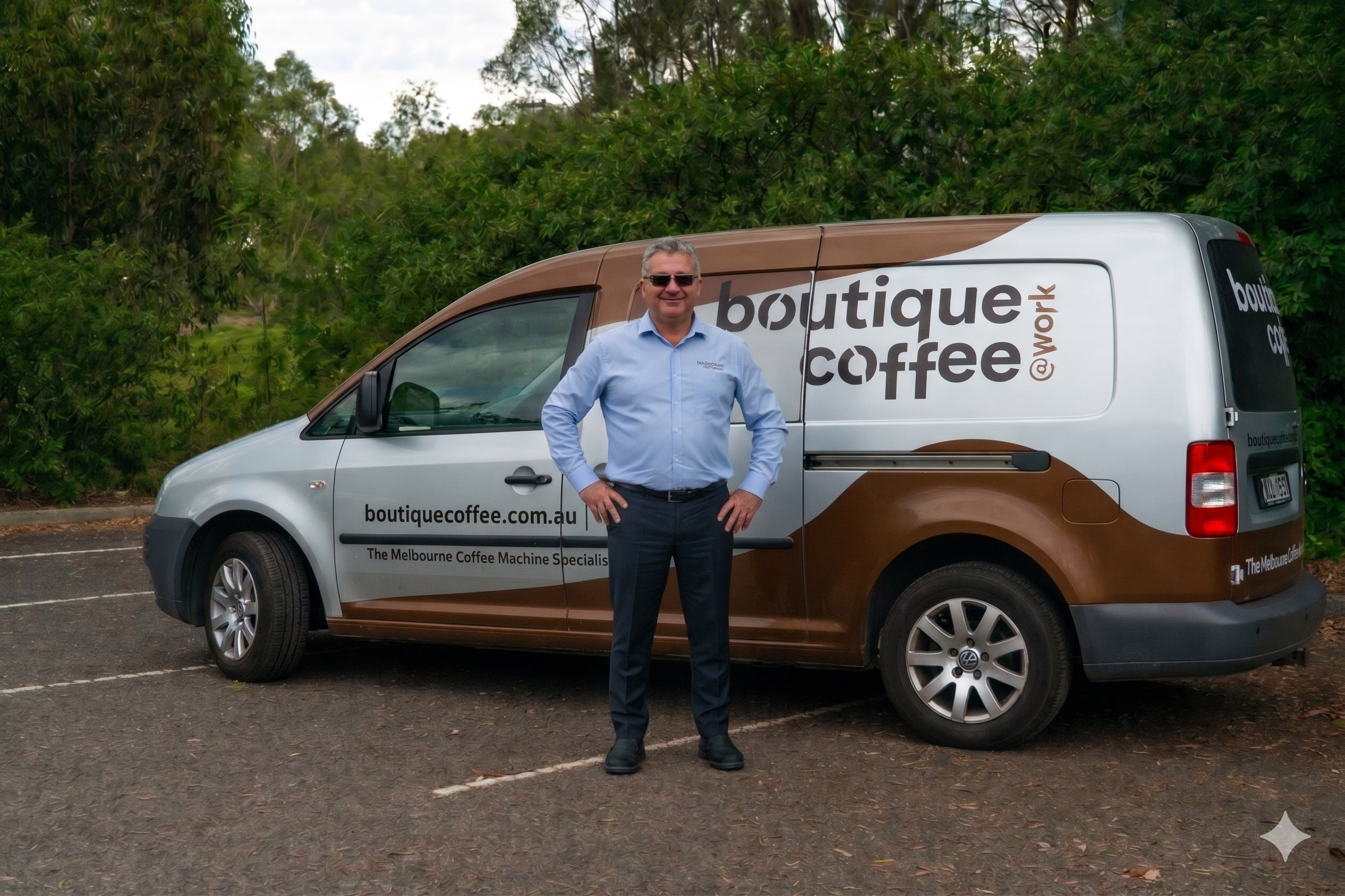
Chris
Chris
Keep reading
Which Melbourne Industries Rent Commercial Coffee Machines (And What Each One Actually Needs)
Melbourne businesses across professional services, medical and allied health, warehousing, manufacturing, education, and creative workplaces all rent…
Types of Office Coffee Machines: Finding the Right System for Your Australian Business
Office coffee machine types fall into four main categories: automatic bean-to-cup, traditional espresso, filter or batch brew, and pod or capsule systems. The…
Plumbed vs Water Tank Office Coffee Machines: Installation, Costs & Which Suits Your Workplace
Introduction If you are deciding between a plumbed office coffee machine and a water tank model, you are really choosing between consistency at scale and…