Commercial coffee machine leasing is a fixed-term arrangement where a finance company buys the machine and your business pays regular instalments over several years. It avoids the upfront cost but commits you to the full term. Month-to-month rental gives you the same café-quality machine with one month's notice to exit.
If you manage an office in Melbourne, you have probably assumed there are only two ways to get a proper coffee machine: buy it or lease it. There is a third option, and it carries far less risk. I'm Chris Prokopiou, founder of Boutique Coffee at Work, and I have spent 17 years doing nothing but workplace coffee in this city.
This article explains how a typical lease works, where it can catch an office out, and how it compares with renting and buying. Boutique Coffee does not offer finance leases, so treat the lease sections as a fair comparison point rather than a pitch. You will also get a checklist of questions to ask any provider before you sign.
Key Takeaways
- A commercial coffee machine lease is usually a fixed multi-year finance agreement with a third party, so you commit to the full term whether or not the machine still suits your team.
- The biggest catches are early exit costs, servicing that may sit with a different company, and a machine sized for the team you had on day one.
- Month-to-month rental removes the term. At Boutique Coffee at Work you give one month's notice and we collect the machine for free.
- Contracts do not create loyalty. Our average client relationship runs 5+ years even though nobody is locked in.
- Who answers the phone when the machine fails matters more than the paperwork. One number and one person beats a ticket system.
- Ask every provider about exit terms, servicing responsibility, response times and what happens if your headcount changes.
Summary Table
| Option | How it works | Best suited to | Main risk |
|---|---|---|---|
| Finance lease | Third-party funder buys the machine, you pay instalments for a fixed term | Businesses with stable headcount and a clear long-term plan | Being tied to a machine and a term that no longer fit |
| Month-to-month rental | Provider supplies, installs and services the machine, you rent with short notice to exit | Offices that want café-quality coffee without a long commitment | Paying a rental rate rather than building equity in a machine |
| Buy outright | You pay for the machine and arrange your own servicing | Businesses with capital to spare and in-house capability | Upfront cost, repair bills and a machine that ages |
What does commercial coffee machine leasing actually mean?
A commercial coffee machine lease is a contract, usually with a finance company rather than the coffee supplier, to pay fixed instalments for a machine over a set term. You use the machine during the term. What happens to ownership at the end depends entirely on the agreement you signed.
There are three moving parts in most lease arrangements.
Fixed terms
Leases run for a fixed period of several years. The instalment is predictable, which is the main selling point. The flip side is that the term is the commitment. Your needs can change in month eight. The contract does not.
Third-party finance
In many cases the party who sells you the machine is not the party who owns it. A finance company, such as SilverChef, which provides equipment finance across Australian hospitality, buys the equipment and you pay them. That is a legitimate and common structure. It does mean there are often two or three companies in the relationship: the machine seller, the funder and whoever services the equipment.
Ownership at the end
There is no single answer here. Some agreements end with you handing the machine back. Some offer a purchase option at a set or residual price. Some roll into another term. Read this clause before anything else, because it decides whether you spent several years paying for a machine you now have to give up or buy again.
On tax, equipment finance can be treated differently depending on the structure and your circumstances. I'm a coffee person, not an accountant. Speak to your accountant about how any lease, rental or purchase should be treated for your business.
What are the hidden catches in a coffee machine lease?
The catches in a lease are rarely hidden in the sense of being illegal. They sit in clauses most people skim: early exit costs, servicing arrangements and rigid sizing. Each one becomes expensive only when your circumstances change, which in a real office they always do.
Early exit costs
If you close an office, move, or simply want out, a fixed-term lease usually expects you to pay for the remaining term or a significant portion of it. The ACCC publishes guidance on unfair contract terms in standard form small business contracts, and it is worth reading if you are looking at an agreement you cannot negotiate. But do not rely on a regulator to rescue you from a term you agreed to. Check the exit clause before signing.
Servicing that sits elsewhere
This is the catch I see most. The machine is financed by one company, sold by another and serviced by a third, or by nobody. When the machine fails on a Monday morning, you start a round of calls to work out whose problem it is. A lease does not automatically include servicing, and where it does, check who actually turns up and how fast.
Consider a busy Melbourne workplace where the coffee machine goes down during the morning peak. If nobody owns the problem, the cost is not just the repair. It is a floor of people queuing at the café downstairs on company time.
A machine that no longer fits
Teams grow and shrink. A machine chosen for 15 people struggles when the office becomes 40. A machine chosen for a large floor is overkill and costly when the team halves. With a lease you are paying for the machine you chose at signing, not the one you need now.
I have a firm view on sizing. A 12-person team does not need a $15,000 Eversys. An 80-person team will break a home-grade Jura within a month. Fit matters, and a long contract locks in your first guess.
Machine age and upgrades
Technology and your own expectations move on. A lease signed for a long term leaves you with ageing equipment late in the term and little room to upgrade without a payout or a rollover into a new term.
Lease vs rent vs buy: how do they compare?
Leasing ties you to a fixed term with a finance company. Renting month-to-month keeps the commitment short and usually bundles servicing. Buying gives you ownership and all the responsibility. The right choice depends on how certain your headcount is and how much you want to manage yourself.
| Factor | Finance lease | Month-to-month rental | Buy outright |
|---|---|---|---|
| Commitment | Fixed multi-year term | Rolling, no fixed term | None after purchase |
| Upfront cost | Low | Low | Highest |
| Servicing | Varies, often separate from the finance | Included with the provider | Your responsibility |
| Upgrade or downsize | Usually requires a payout or new term | Swap the machine as your team changes | Sell and replace at your own cost |
| Exit | Early exit costs are common | Notice only, machine collected | You keep or sell the asset |
| Ownership | Depends on the agreement | Provider owns the machine | You own it |
| Who to call when it breaks | Depends on the contract | One provider | You find a technician |
Buying makes sense if you have a stable team, spare capital and someone who will actually look after the machine. Leasing suits some businesses with predictable headcount and a preference for fixed instalments. Renting suits an office that wants a good machine, wants it looked after, and does not want to guess where it will be in several years.
If you want to see how the daily cost works out for your team, I cover that in a separate guide on the daily cost of a commercial coffee machine, and there is an office coffee machine ROI calculator for running your own numbers.
How does month-to-month coffee machine rental work at Boutique Coffee at Work?
We supply a commercial machine, install it properly, keep the beans and consumables coming, and service it. You rent month-to-month. If you want to leave, you give one month's notice and we collect the machine for free. There is no lock-in, ever.
Here is how a new office gets started. We call it the Six-Step Process, and it is designed to take most Melbourne clients from first call to installed machine in 5 to 7 business days.
- Enquiry. You send basic team details. It takes about 2 minutes.
- Phone call with me. We talk for 15 to 20 minutes. I shortlist machines and give you rough pricing.
- On-site visit. About 30 minutes to check power, plumbing and bench space.
- Install day. About 45 minutes. The machine is connected, the grinder is dialled in and shots are tested.
- First brew and training. About 20 minutes. At least two staff are trained and we leave a cheat sheet.
- Ongoing rhythm. Weekly or fortnightly service visits, with beans and consumables topped up.
Proper installation matters more than most people expect. A machine on the wrong water supply or a poorly placed bench causes problems for years. Our guides on office coffee machine installation and the rental process go into the detail.
Matching beans to your team
We use what we call a Curated Coffee Plan. I ask about your team's drink preferences, such as espresso versus milk-based, strength and any dislikes. We start on a well-matched blend, then adjust based on feedback in the first month. Dialled-in beans are what separate café-quality coffee from a machine that merely works.
Matching the machine to your team
I recommend the machine that fits your actual team size, even when that is the cheaper one. Our work covers everything from small teams to a single client with a team of 400+ people. If the right answer is not one of our machines, I will say so and point you elsewhere.
One mid-size Melbourne office I worked with had a coffee setup that was not meeting the team's expectations. We moved them to a WMF commercial machine with full install, training and ongoing service included in the rental. The site manager told me his staff appreciated the coffee and hot chocolate, and the difference was noticeable across the whole office. That is café-quality, made practical.
If you are wondering whether we cover your suburb, see our service coverage and delivery areas.
Why does one accountable person matter more than the contract?
Because when a machine fails, a contract does not fix it. A person does. Most suppliers route problems through call centres, ticket systems and account managers. I take the opposite view: one number, one person, no escalation paths. Typical service response is 24 hours.
Most faults can be talked through in two minutes when the person answering knows your setup. They know which machine you have, how your water behaves and what the grinder was set to last week. A helpdesk agent working from a script does not.
That is also why same-day or next-day on-site response is possible. There is no internal runaround to get through first. It is a founder-led model, always.
Consider what a broken machine costs in a busy Melbourne workplace. I look after one where the machine used to go down at the worst moments, with real disruption to the team. The fix was not a new contract. It was a reliably maintained machine, regular scheduled servicing and direct personal contact for any issue. The client told me that regular service meant the team always had coffee when they needed it most. Your team never goes without coffee when someone owns the outcome.
This is the core of being a coffee partner, not a supplier. A supplier delivers a box. A partner stays responsible for the result. For more on how service and warranty terms work in general, see our guide to commercial coffee machine service contracts and warranties.
What should you ask any provider before signing?
Ask about exit, servicing, response time, sizing and total cost before you sign anything. The answers tell you whether you are dealing with a supplier hiding behind paperwork or a partner who stands behind the result. Get them in writing, and ask your accountant about the tax treatment.
- What does it cost to leave, and when? Ask for the exact exit clause. Ask what happens after the first year, not just at the end of the term.
- Who services the machine? Get the name of the company and the person. If the finance company and the servicer are different, ask how they coordinate.
- What is the typical response time? Ask for it in hours, and ask what happens when it is missed.
- Who do I call? A single number is a good sign. A ticket portal is a warning.
- What happens if my team grows or shrinks? Ask whether you can change machines without paying out the agreement.
- Who owns the machine at the end? Ask for the purchase price or residual in writing.
- Is installation included? Check plumbing, power and training, not just delivery.
- What is not covered? Ask about descaling, filters, parts, call-outs and after-hours faults.
- Are there price increases during the term? Ask how and when they are applied.
- Will you tell me if a different machine suits me better? The honest answer should sometimes be yes.
What 5+ years with nobody locked in tells you
Most of the industry argues that long contracts protect revenue and are standard practice for equipment rental. I disagree, and I have 17 years of evidence. We have operated exclusively in Melbourne workplace coffee since 2008. Today we look after 200+ active Melbourne workplace clients, and the average relationship lasts 5+ years.
None of those clients are locked in. Every rental is month-to-month, with one month's notice and free machine pickup.
That is the point most leasing comparisons miss. If the contract is the reason a client stays, you do not know whether the service is any good. If the client stays with nothing holding them, you know. In 17 years, the no-lock-in policy has never cost us a client worth keeping. Clients who stay by choice are worth more than clients who stay by contract.
I'm not trying to be the biggest. I would rather have an office that rings me first when something changes, because they trust me to fix it, than one that rings a lawyer to find the exit.
This also changes how I behave. I cannot hide a poor recommendation behind a term. If I put you on the wrong machine, you can leave next month. So I get the fit right the first time.
The lease is not a bad product for every business. A stable team with a clear plan and a funder it trusts may do well from one. But if you are wary of contracts and want café-quality coffee without a long financial commitment, the lower-risk route is to rent month-to-month and keep your options open.
Talk to someone who will look after your office
If you are weighing up commercial coffee machine leasing in Melbourne, call Boutique Coffee at Work and let's talk through a month-to-month rental. There is no lock-in, you give one month's notice to leave, and one person looks after your office from setup onwards.
References
- Australian Competition and Consumer Commission (ACCC), guidance on unfair contract terms for small business: https://www.accc.gov.au/business/business-rights-and-obligations/unfair-contract-terms
- Australian Taxation Office (ATO), business income, deductions and depreciation guidance: https://www.ato.gov.au
- SilverChef, equipment finance and rental for Australian hospitality businesses: https://www.silverchef.com.au
- Boutique Coffee at Work, company data on active clients, relationship length and service response (client's own data, 2026): https://www.boutiquecoffee.com.au/
Frequently asked questions
What is the difference between leasing and renting a commercial coffee machine?
Leasing is usually a fixed multi-year finance agreement with a third party, with early exit costs and servicing that may be separate. Renting month-to-month has no fixed term. At Boutique Coffee at Work you give one month's notice, and servicing and installation come from the same provider.
Can I get a no lock-in coffee machine rental in Melbourne?
Yes. Boutique Coffee at Work rents commercial machines month-to-month to Melbourne workplaces. You give one month's notice to leave, and we collect the machine for free. We have operated this way since 2008, and our average client relationship is 5+ years.
Is it cheaper to lease or buy a commercial coffee machine?
It depends on your team size, your cash position and how long you will keep the machine. Buying costs more upfront and leaves repairs with you. Leasing spreads the cost but commits you to a term. Speak to your accountant about the tax treatment for your business.
Who services a leased coffee machine?
That varies by agreement. In some leases the funder, the seller and the servicer are three different companies, and servicing may not be included at all. Always ask for the servicer's name, the response time and who you call, in writing, before signing.
How long does it take to install an office coffee machine in Melbourne?
Most Boutique Coffee at Work clients go from first call to installed machine in 5 to 7 business days. Install day itself takes about 45 minutes, with training of at least two staff straight after the first brew.
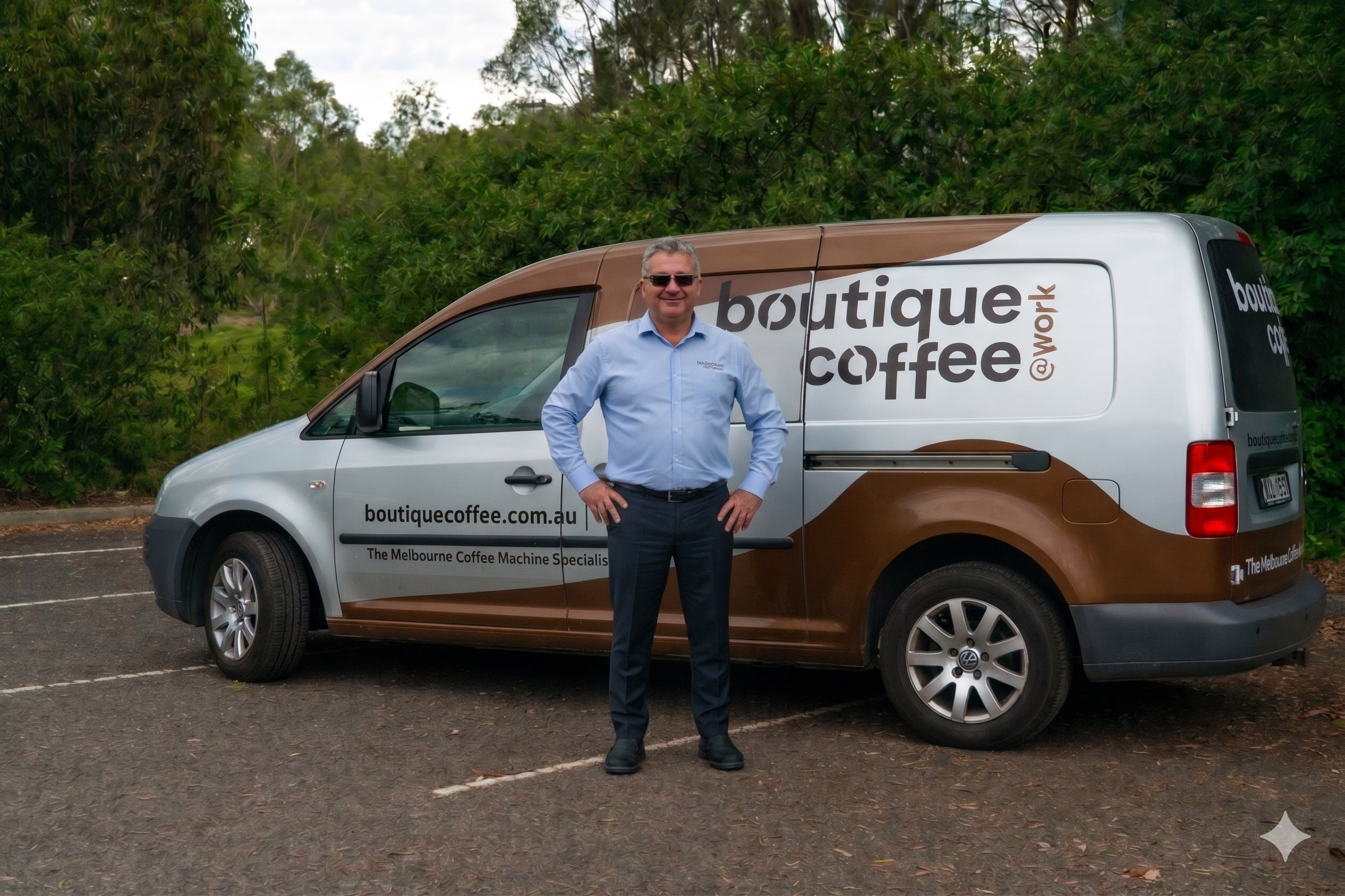
Chris
Chris
Keep reading
Office Coffee Machine Rental Services in Melbourne: How the Process Actually Works
An office coffee machine rental service in Melbourne supplies a commercial-grade machine, installs it properly, trains your staff, and keeps beans and…
Office Coffee Subscriptions in Melbourne: Why a Month-to-Month Machine Rental Beats Pods and Lock-In Contracts
The best office coffee subscription for a Melbourne workplace is a month-to-month commercial machine rental that includes installation, regular servicing and…
Office Coffee Machine Rental FAQs: Straight Answers for Melbourne Workplaces
Office coffee machine rental means paying a monthly fee to use a commercial machine that the supplier installs, services and looks after, rather than buying it…