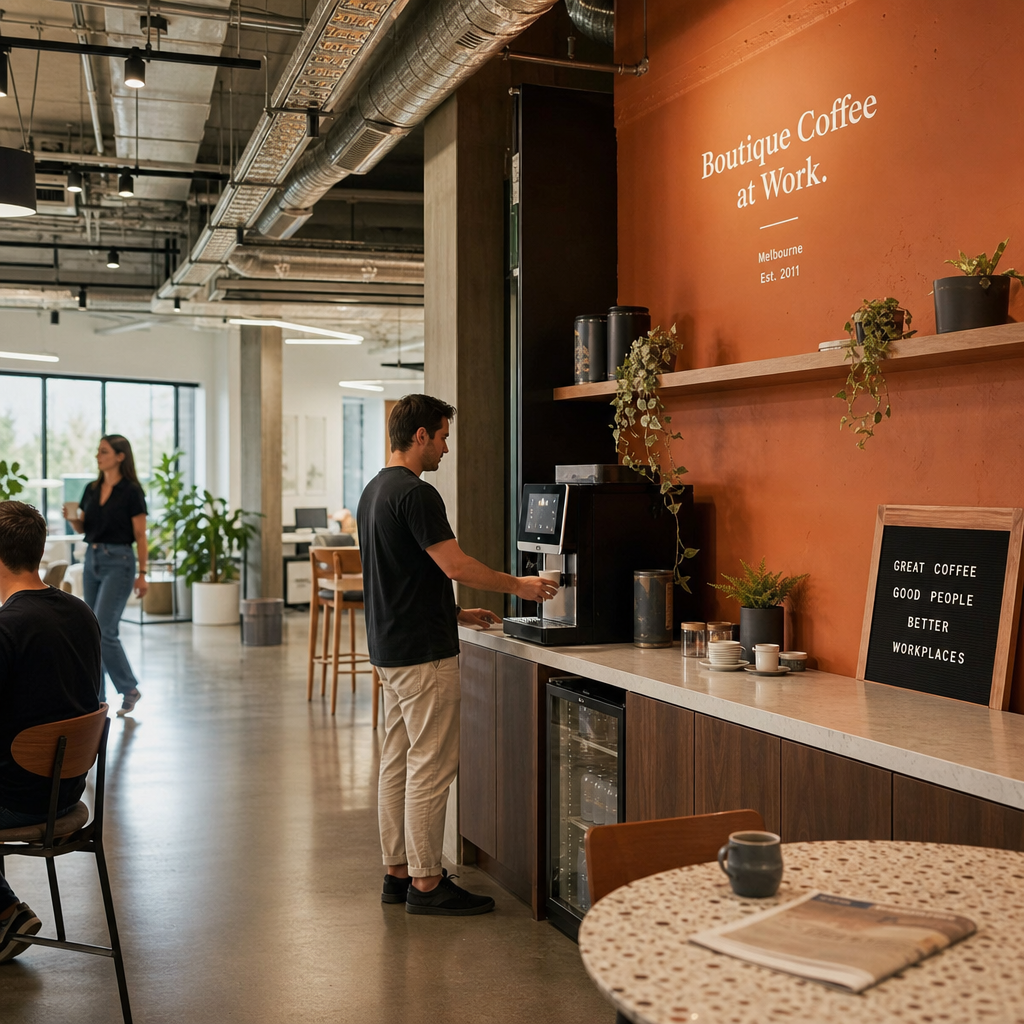
Open-plan offices suit how Australians work, collaborate, and move across a floor. They also expose every sound. A coffee grind at 8.45 am can carry across the entire space and ruin the start of a client call. The brief is simple, pick a quiet office coffee machine, then place it so the noise and traffic never interfere with the work that pays the rent.
I run Boutique Coffee at Work in Melbourne. Since 2008 I have installed, maintained, and personally serviced machines in more than 200 workplaces. I am founder-led, always. No call centres, no corporate runaround. One number, one person. What follows is the way I design coffee machine selection and placement in open-plan offices so your team gets café-quality, made practical, without the noise tax.
At a glance, here is what good looks like when you care about coffee machine noise level in an office:
- Target 45-50 dB at nearby desks during brew cycles, matched to AS/NZS 2107 recommended office sound levels
- Expect grinder spikes of 70-85 dB at 1 metre, the grinder is the noisy part, not the brew pump
- Distance is your friend, every time you double distance, the perceived level drops materially in open spaces
- Use enclosed, bean-to-cup units or silenced grinders for low noise commercial coffee machine setups
- Put machines in breakout zones, not corridors, and never hard up against meeting rooms or phone booths
- Ventilation and odour control matter as much as sound in open plan, do both together
Key Takeaways
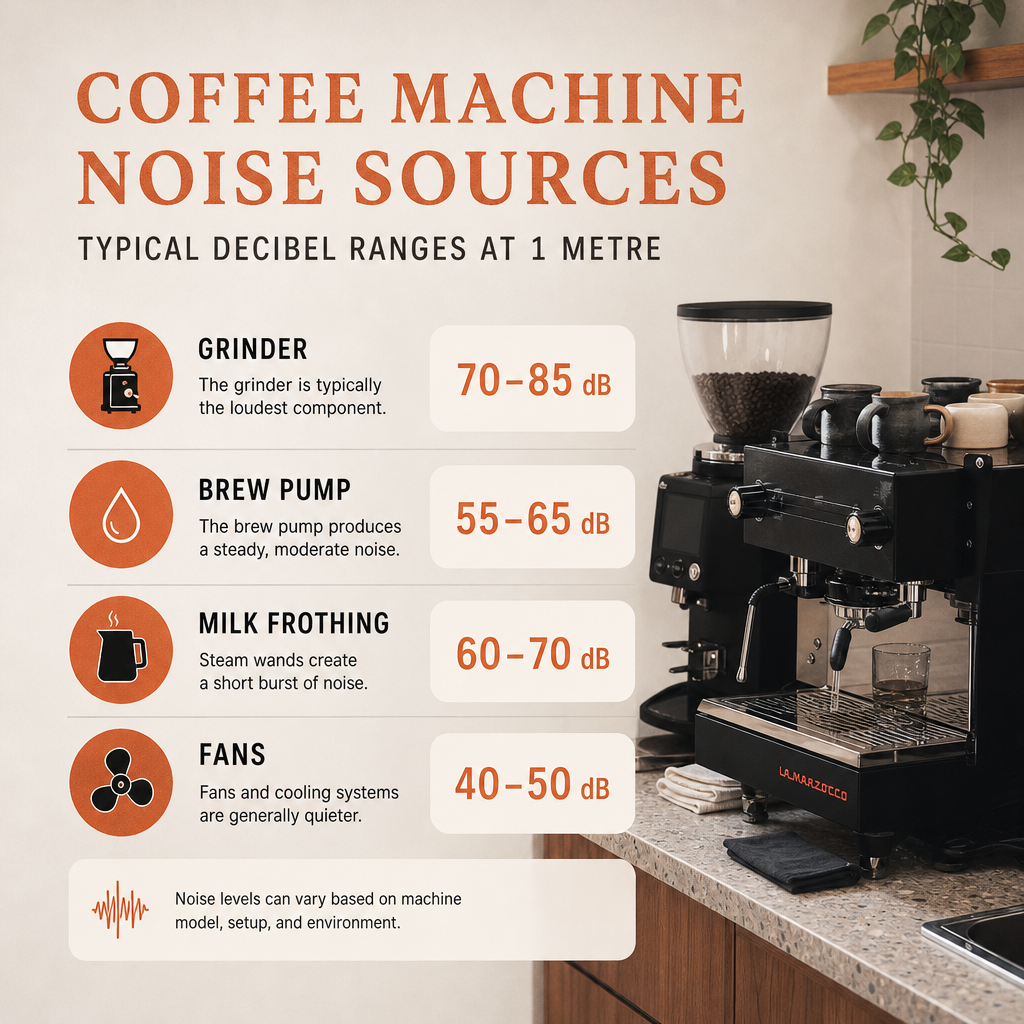
- The grinder dominates machine noise, typically 70-85 dB at 1 metre. Brew pumps and milk systems are usually 55-70 dB.
- Super-automatic bean-to-cup machines with enclosed grinders run quieter on average than traditional espresso rigs with separate grinders.
- Placement beats specification. Distance, doors, and soft finishes reduce perceived noise far more than a minor decibel advantage on a spec sheet.
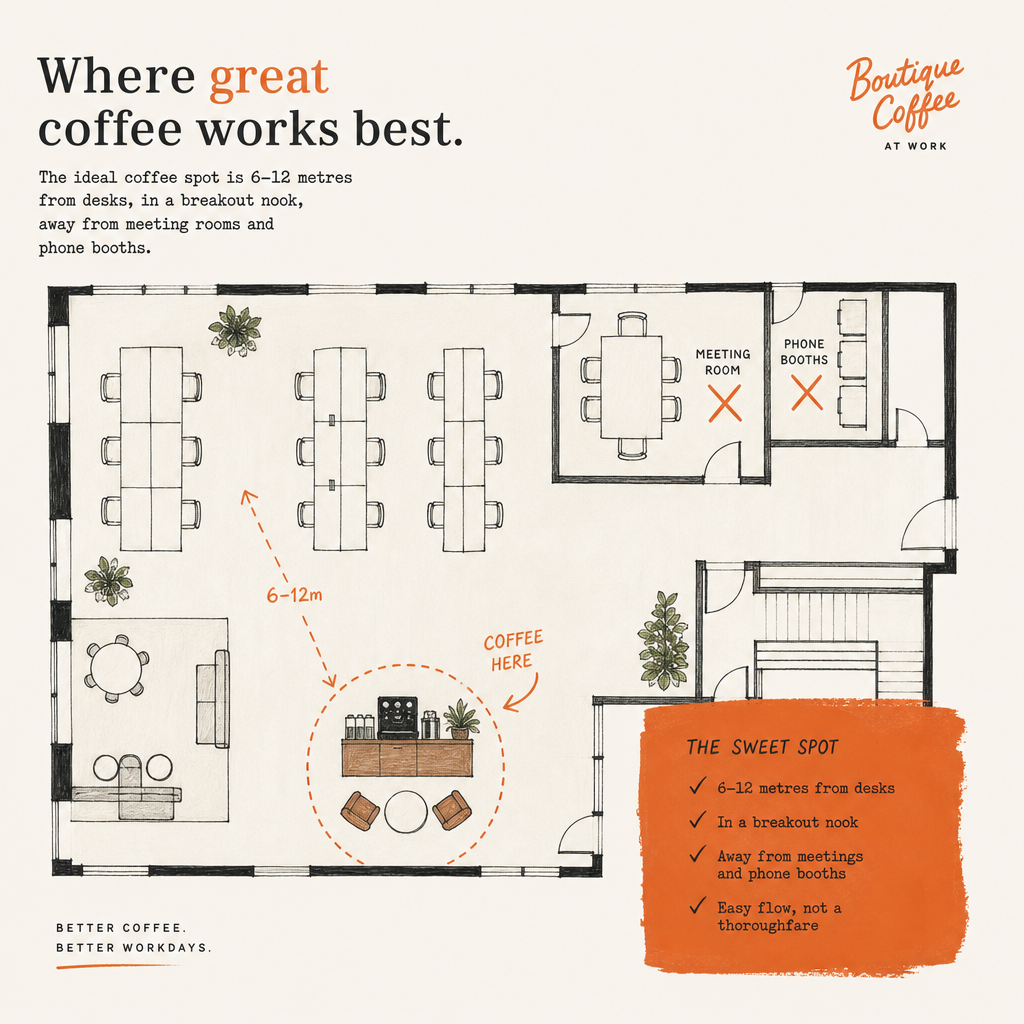
- Create coffee nooks in breakout areas, 6-12 metres from meeting rooms and phone areas, with line of sight from main traffic paths, never in a corridor.
- Treat acoustics, not just equipment. Cabinetry, acoustic panels, anti-vibration mounts, and rubber feet take the edge off grinder spikes.
- Service reliability prevents the loudest problem of all, the queue and the complaints. Design for your true headcount and peak times.
Summary Table: Machine Types vs Noise and Office Fit
| Machine type | Typical noise profile at 1 m | Best team size | Quiet-friendly features | Watch-outs | Placement priority |
|---|---|---|---|---|---|
| Super-automatic bean-to-cup with enclosed grinder | Brew 55-65 dB, Grind 68-78 dB | 15-120 | Enclosed grinder, insulated brew chamber, auto milk | Milk froth can hiss at 65-70 dB, grinder spikes still exist | Breakout nook with soft finishes, 6-12 m from quiet zones |
| Traditional espresso machine + separate grinder | Brew 55-65 dB, Grind 75-85 dB | 30-200 with barista or trained staff | Flexible workflow, high output | Open grinder is the loudest element | Dedicated coffee area with door or deep alcove, not near meeting rooms |
| Capsule pod machine (prosumer) | Brew 45-55 dB, No grinding | 1-10 | Low mechanical noise, small footprint | Not café-quality, higher waste and per-cup cost | Small quiet corner or kitchen bench, still isolate from calls |
| Batch brewer + hot water tower + separate grinder | Brew 50-60 dB, Grind 75-85 dB | 30-150 | Quiet brew, high throughput | Grinder noise during batch prep | Back-of-house or pantry with door, batch early to avoid peaks |
| Vending-style bean-to-cup with internal grinder | Brew 55-65 dB, Grind 70-80 dB | 20-80 | Enclosed mechanism, consistent output | Cup drop noises and fans around 50-55 dB | Alcove or cabinet recess, isolate from thoroughfares |
How loud is an office coffee machine, really?
Let us separate the parts that make noise, then set expectations.
- Grinder: This is the main source. Most commercial conical or flat burr grinders land around 70-85 dB measured at 1 metre when grinding a standard dose. Ceramic conical grinders inside super-automatics are usually on the lower end because the cabinet adds passive damping. Open, café-style grinders sit at the upper end. That is the sound of metal burrs crushing beans, there is no silent way to do physics.
- Brew pump cycle: Vibration or rotary pumps usually sit around 55-65 dB during extraction. The tone is a soft hum, much less intrusive than grinding.
- Milk frothing: Automatic frothers and manual steam wands typically sit at 60-70 dB, with a hiss that carries in reflective rooms. Frothing 150-200 ml of milk takes 10-20 seconds, so the exposure is short.
- Fans and cup warmers: 40-50 dB, continuous but low. Still worth noting in quiet rooms.
In open plan, what you hear at a desk 6-10 metres away is not the same as the reading at 1 metre. As distance increases, perceived loudness drops. In free field you see roughly a 6 dB reduction per doubling of distance. Offices have reflections and soft furnishings that alter that. The practical rule I use on site, if you can put a solid corner, a door, or 6-12 metres between the grinder and the nearest desk, most teams stop noticing the noise, even at peak times.
Two more truths from the field:
- A slightly louder machine, placed well, beats a quiet machine placed badly. I have moved a grinder 8 metres and around a corner to cut complaints to zero, without changing the hardware.
- Maintenance affects perceived noise. A poorly aligned grinder burr or loose panel adds rattles that sound louder than the dB meter suggests. Tight machines sound quieter.
On compliance, Safe Work Australia sets the workplace noise exposure standard at LAeq,8h 85 dB with a peak of 140 dB. A coffee machine will never approach that exposure for an office worker. The issue is not hearing loss risk, it is distraction and speech privacy in open plan. AS/NZS 2107 points to design sound levels of about 40-50 dB for open-plan offices. That is your reference point for placement, not safety exposure.
Machine types ranked by quietness in practice
There is a lot of forum talk about the quietest grinder or a specific brand. I focus on categories and features that consistently test quieter in offices.
- Super-automatic bean-to-cup with enclosed grinder
- Why they are quieter: The grinder sits inside a cabinet, often with rubber isolation and thicker panels. The brew group is insulated. Pumps run shorter cycles. The enclosure dampens the sharpest high-frequency components of the grind.
- What to look for: Ceramic conical grinder, adjustable grind with calibration access, double-wall casing, auto milk with insulated lines, and a proper waste bin. Models with two grinders let you run decaf without emptying hoppers, which reduces handling noise.
- Where they fit: 15-120 people. They produce consistent espresso and milk drinks at the touch of a button, with a noise profile that blends into a breakout zone.
- Traditional espresso machine with a separate grinder
- Why they read louder: The grinder is fully exposed. Many offices run café-grade flat burrs to keep up with volume, which spin faster and produce a sharper grind tone. The machine itself is not the problem, the grinder is.
- What I do in offices that insist on a traditional setup: Put the grinder in a damped cabinet bay, fit anti-vibration mats under both units, specify a lower RPM conical grinder where suitable, and create a nook with acoustic panels. Done right, this becomes viable for 30-200 headcount in a space with a door or deep alcove.
- Capsule machines
- They are quiet and simple, but they are not café-quality and the per-cup cost is high. Waste streams are messy. I rarely specify them beyond very small teams or temporary spaces. If you pick pods because they are quiet, you have solved the wrong problem. Placement would have solved it without dropping drink quality.
- Batch brewer with a hot water tower and a separate grinder
- Brew is whisper quiet, around 50-60 dB, and you can serve twenty coffees in minutes. The catch is the grinder you use for batch prep. It is as loud as any café grinder. Do the grinding early, away from calls, and you get a very quiet service period when the team is actually pouring coffee.
- Vending-style bean-to-cup
- Many have internal mechanisms that damp sound, similar to super-automatics. The output is consistent. The compromises are small fan noises and occasional cup drop clunks around 50-55 dB. Place them in an alcove and they work.
If you need the quietest possible setup without falling back to pods, a modern super-automatic with an enclosed ceramic conical grinder is the play. If you need the highest output and you love the theatre of a traditional machine, plan the space to control the grinder noise. Either way, the machine must be chosen on purpose for your headcount and floor plan.
Placement fundamentals for open-plan offices
Where to put the office coffee machine is the single biggest decision you control. Get the location right and you will never think about noise again. Here is the checklist I use on site.
- Distance from quiet work and calls: 6-12 metres to the nearest desk, 10-15 metres to phone booths and focus rooms. Use corners and doors to break line of sight. Sound behaves like light in many ways, if you cannot see the grinder, you will hear less of it.
- Hard vs soft finishes: Avoid placing machines in a hard, tiled corridor. Benchtops and tiles scatter grinder hiss through the space. Put the machine in a recess with carpet or rugs, acoustic ceiling tiles above, and soft wall panels on at least one adjacent surface.
- Doors and partial screens: A standard door or 1.8 metre acoustic screen will knock down perceived grinder spikes. Even a 1 metre return panel on a kitchenette bench makes a material difference.
- Traffic flow: The coffee area should sit on a natural traffic line from the main entry to the breakout zone, not on the direct path to meeting rooms. Queues in corridors create both noise and congestion.
- Odour and ventilation: Fresh coffee smells great. Burnt milk does not. If your coffee point shares air with a meeting room return vent, the smell will drift in. Use mechanical ventilation that complies with AS 1668.2 and put coffee zones on exhaust runs, not only on return air paths. Keep bins sealed and emptied daily.
- Power, water, and drainage: If you are plumbing in, give me a 15 mm cold water line with an isolation valve, a compliant backflow device, and a nearby waste connection. Machines with drain trays reduce spill risk and cleaning noise. Under-spec plumbing leads to cavitation noise and poor extraction.
- Benchtop stability and height: Solid, level benches stop resonance. A flimsy 30 mm top vibrates when the grinder runs and adds a buzz. Standard 900 mm height works for most offices. If you have a lot of taller staff, 950 mm reduces awkward reach and avoids cup drops.
- Lighting and visibility: Keep the area well lit. People work faster and more quietly when they can see what they are doing. Fewer fumbles, fewer cup clinks.
- Waste and consumables: Under-bench knock boxes and waste chutes reduce the impact sound of puck knocks. For super-automatics, internal dregs bins avoid open-bin slaps. Store milk and beans within arm's reach to avoid traffic into other parts of the kitchen.
Acoustic strategies that work
You do not need a recording studio. A few proven tactics, applied together, will cut coffee noise to background levels.
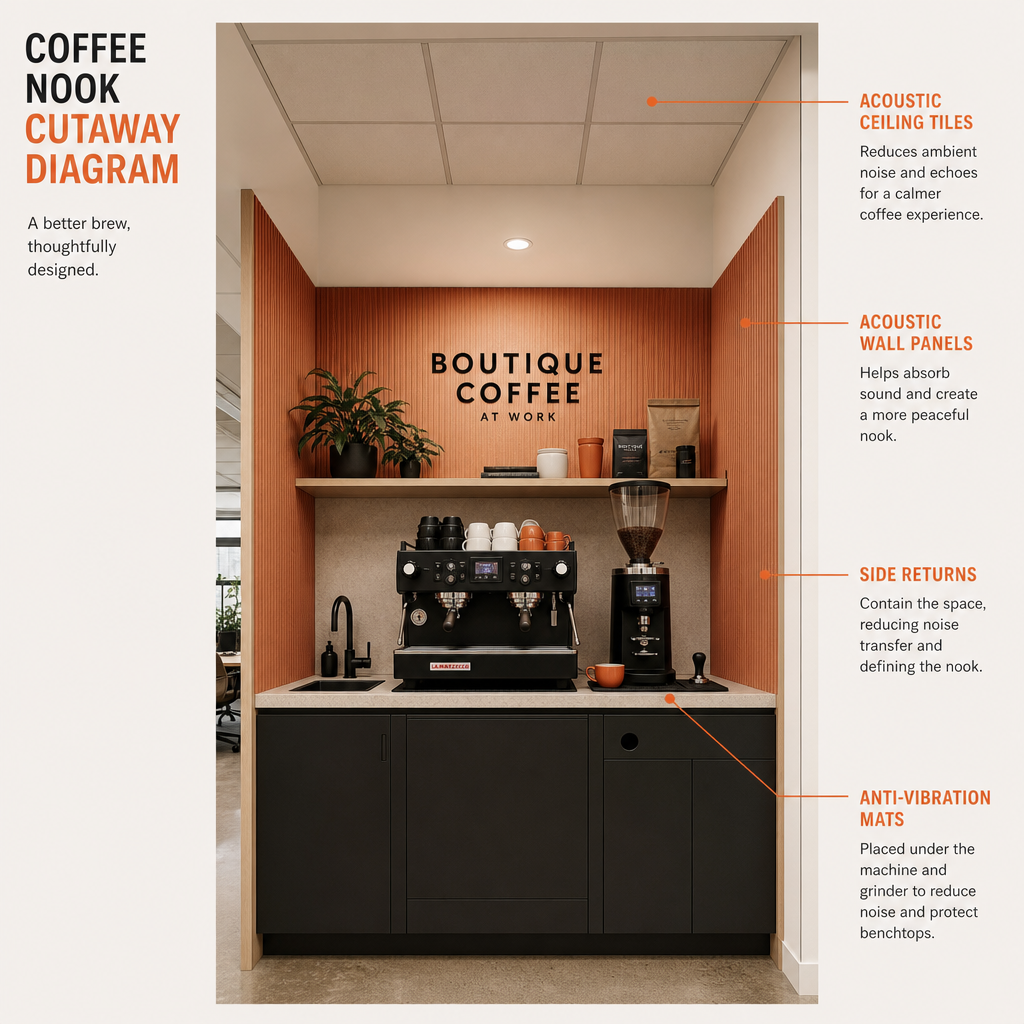
- Build a coffee nook: A 1.6-2.0 metre wide alcove with side returns and a ceiling bulkhead creates a semi-enclosed space. Line the inside faces with acoustic panels. You will hear the grinder in the nook, but not at the desks.
- Specify acoustic finishes: NRC 0.7 or better wall panels on at least one wall near the machine. Acoustic ceiling tiles above the coffee area. Carpet tiles with acoustic underlay in the immediate zone.
- Isolate vibration: Rubber feet for the machine and grinder, anti-vibration mats under both, and securing loose panels. This reduces rattles and the low-frequency hum that carries.
- Add a soft close knock box: The slam of a puck knock is one of the sharpest sounds in a traditional setup. Use damped knock boxes or under-bench chutes to remove that impulse noise.
- Use cabinetry wisely: Enclose the grinder base in a cabinet bay with a front opening and ventilation slots. Do not box in the grinder completely, heat kills burrs. The goal is partial screening that breaks direct sound paths.
- Sound masking: If your office already runs a sound masking system, keep the coffee area within that coverage. A low, broadband mask helps the grinder spikes blend into the room sound.
- Maintain the kit: Dull burrs run longer and often louder. Loose hoppers rattle. Worn pump mounts buzz. A well-maintained machine sounds quieter even at the same measured dB.
A practical placement framework for common floor plans
You do not need an architect to make a good call. Use this simple framework I apply across Melbourne tenancies.
- Small tenancy, 10-20 people
- Machine: Super-automatic bean-to-cup or a compact traditional with a quiet conical grinder.
- Placement: In the kitchenette, but not on the bench that backs onto the quietest desks. If the kitchenette opens to the floor, install a 1 metre return panel to create a pocket. Keep 6 metres to the nearest desk.
- Acoustic add-ons: One wall panel, rubber feet, and an anti-vibration mat under the grinder.
- Expectation: 20-30 drinks in the morning peak. Queue length 2-3 people max if the unit is specified correctly.
- Mid-size floor, 30-60 people
- Machine: Super-automatic with internal milk and an enclosed grinder. Two hoppers help with decaf or alt-bean.
- Placement: Create a coffee nook off the breakout area. At least 8 metres from the nearest focus room and 10 metres from phone booths. Avoid corridors.
- Acoustic add-ons: Alcove with side returns, acoustic ceiling tiles above, two wall panels, and a soft close knock box if using a traditional setup.
- Expectation: 50-100 drinks in the morning. Queue length 3-5 people for 15 minutes around 9 am. Consider a second unit if peaks regularly exceed 5 people.
- Large single floor, 80-150 people
- Machine: Two super-automatics side by side or a traditional two-group with a high-capacity grinder plus a super-automatic for self-serve. If you push all volume through a single domestic unit, you will break it and your queue will create the loudest noise of all.
- Placement: Two coffee points. Primary in the main breakout with a proper coffee nook. Secondary near the far end of the floor to split traffic. Keep 10-12 metres to meeting rooms and phone areas.
- Acoustic add-ons: Full coffee alcove, compliant mechanical exhaust for odour, carpet under the queue area, and sound masking coverage.
- Expectation: 120-250 drinks in the morning. Queues manageable because flow is split.
- Multi-floor tenancy, 200+ people
- Machine: One super-automatic per 60-80 regular coffee drinkers per floor. Or a traditional barista station in the main hub plus super-automatics near team zones. If you choose traditional, design a real bar with a door and a service counter.
- Placement: One main coffee hub with seating and acoustic treatment, plus satellite points. Do not make everyone ride the lift for a coffee. The travel time becomes the productivity cost.
- Acoustic add-ons: Proper acoustic package, including panels, ceiling tiles, and soft finishes throughout the hub. Mechanical exhaust that meets AS 1668.2. Under-bench waste and chilled storage.
- Expectation: Peaks are smoothed by proximity. The hub is social, satellites are functional.
Real Melbourne case studies
Case study 1: Mid-size office, grinder hiss inside a hard kitchenette
- Context: A 45-person engineering office in Melbourne was using a traditional machine with an open flat burr grinder on a stone bench that backed onto desks. Staff on calls complained about the hiss and clatter during the 8.30-9.00 am peak.
- Intervention: I moved the setup 7 metres into a breakout nook, added rubber feet and an anti-vibration mat, enclosed the grinder base in a ventilated cabinet bay, and added two acoustic panels on the return walls. No machine change, just smart placement and minor treatments.
- Outcome: Measured LAeq at the nearest desk during grinding dropped from 56 dB to 50 dB. Complaints on morning calls fell to zero within a week. Queue flow improved because the coffee line was no longer blocking a corridor.
Case study 2: Pepperl+Fuchs Australia, upgrading for quality and calm
- Context: Pepperl+Fuchs Australia ran an existing setup that was not meeting expectations. The coffee was average and the setup created small disruptions in the morning rush.
- Intervention: I upgraded the office to a WMF commercial machine, did a full install, dialled-in beans, trained staff, and set a servicing rhythm. The work included rethinking the placement to a breakout nook with soft finishes.
- Outcome: The change was noticeable across the whole office. Paul Bruno told me daily use was easy and the quality of both coffee and hot chocolate lifted. Service has been consistent for years, which matters because quiet is also about reliability. When a machine goes down, the scramble gets loud.
Testimonial
- "Reliable, regular service means we always have coffee when we need it most. If the machine goes down in a busy office it creates havoc, so having Chris we can call directly is brilliant.", Chrissie Straw, AJM-JV
Another note from a retail environment that doubles as a workplace
- Context: A Melbourne business serving staff and customers needed consistently great coffee daily.
- Intervention: I supplied fresh beans and a fully maintained machine, managing supply and upkeep personally.
- Outcome: Michael May credits attention to detail for uninterrupted service. The lesson for offices, when your coffee partner keeps the kit tuned, the sound stays in the background and your team never goes without coffee.
Ongoing service, ownership, and accountability
Noise, queues, and downtime are often symptoms of the same root issue, the wrong machine in the wrong place, and support that disappears when you need it. My model is simple, a coffee partner, not a supplier.
- One number, one person: You call me. Most fixes are handled in two minutes because I know your setup. If I need to be on site, I am there the same or next day. Our typical response is 24 hours across our active base.
- No lock-in, ever: Month-to-month rentals with one month's notice and free pickup. In 17 years that policy has never cost a client worth keeping. Long-term clients retained by choice are worth more than clients retained by contract.
- Honest fit, not upsell: A 12-person team does not need a $15,000 showpiece. An 80-person team will break a home-grade unit in a month. My job is to match the machine to reality, designed around your culture and budget.
- The Six-Step Process: From first call to installed machine in 5-7 business days.
- Enquiry, 2 minutes, you share team size and habits.
- Phone call with me, 15-20 minutes, shortlist and rough pricing.
- On-site visit, 30 minutes, I assess power, plumbing, bench space, and the best location to control noise.
- Install day, 45 minutes, connect, calibrate, and test.
- First brew and training, 20 minutes, at least two team members trained, a cheat sheet left.
- Ongoing rhythm, weekly or fortnightly service visits, beans and consumables topped up.
- Curated Coffee Plan: We ask what your team drinks, start on a blend that fits, then adjust based on feedback in the first month. Dialled-in beans are as important as quiet mechanics.
- Scale in Melbourne only: I am not trying to be the biggest. We work across 200+ active clients with an average relationship length of 5+ years. Founder-led, always.
Common mistakes to avoid
- Parking the machine against a meeting room wall: Sound bleeds through, then every 9 am client call starts with grinder hiss.
- Chasing the quietest spec sheet number: Lab dB does not predict the lived experience. Placement and finishes do.
- Under-specifying for headcount: Long queues are loud. Two machines for 120 people are calmer than one high-end machine that runs flat out.
- Over-specifying a domestic unit for a big team: It will break, create downtime, and generate the loudest noise of all, complaints.
- Ignoring ventilation: Odour spreads faster than you think. Burnt milk and stale dregs make people avoid the area.
- Skipping maintenance: Dull burrs run longer and louder. Loose parts rattle. A noisy fortnight is often a maintenance miss.
Budgeting and ROI, the quiet way
Noise and coffee quality both affect productivity. A sensible design pays back fast.
- Travel time vs proximity: If 100 people walk an extra 1 minute to a distant coffee point twice a day, you have 200 minutes of lost time daily, roughly 3.3 hours. At a blended cost of $70 per hour, that is $231 a day. Bring coffee points closer, without putting them beside calls, and you reclaim time.
- Queue tax: If a single machine adds a 4-person queue during peak, and each wait adds 2 minutes, that is 8 minutes every 5 minutes of peak. Add a second machine or batch brewer and you smooth the peak. The payback is in reduced wait and lower noise.
- Acoustic finishes: A basic acoustic pack for a coffee nook, panels and mats, often lands under $1,500-$2,500 ex GST. The effect on perceived noise is larger than a more expensive machine swap in many offices.
- Machine choice and rental: A properly specified commercial unit on a month-to-month rental keeps capex low and accountability high. If it is not working, we change it, not on a 5-year contract but next month.
How we help you choose, trial, and place the right kit
If you want a quiet office coffee machine chosen for your specific floor, I will walk the space, test the bench, look at your plans, and recommend a setup that works. Café-quality, made practical. We back it up with month-to-month rentals and direct service, so your team never goes without coffee.
- Explore options tailored to your headcount and layout: Workplace coffee solutions
- Try it with your team on site: Free trial
- Ready for a quick call or site visit: Contact Chris
References
- Safe Work Australia. Managing noise and preventing hearing loss at work, Code of Practice. safeworkaustralia.gov.au
- AS/NZS 2107:2016. Acoustics, Recommended design sound levels and reverberation times for building interiors. Standards Australia.
- AS 1668.2-2012. The use of ventilation and airconditioning in buildings, Part 2, Mechanical ventilation in buildings. Standards Australia.
- International WELL Building Institute. WELL Building Standard v2, Sound Concept. wellcertified.com
- Quiet Mark. Certified quiet coffee machines. quietmark.com
Frequently asked questions
What decibel level should I expect from a quiet office coffee machine?
Expect roughly 55-65 dB during brewing and 68-78 dB during grinding at 1 metre for a super-automatic with an enclosed grinder. Traditional grinders can spike 75-85 dB. At desks 6-12 metres away in a well-designed nook, the perceived level typically blends into the 45-50 dB background of an open-plan office.
Which coffee machine type is the quietest for offices without dropping quality?
A modern super-automatic bean-to-cup with an enclosed ceramic conical grinder is usually the quietest commercial option while still delivering café-quality espresso and milk drinks. The enclosure dampens grinder noise and the brew cycle is already relatively quiet.
Where should I put the office coffee machine in an open-plan layout?
Use a breakout nook, 6-12 metres from the nearest desks, and 10-15 metres from meeting rooms and phone booths. Avoid corridors and backs of meeting room walls. Add acoustic panels on at least one wall, carpet under the queue area, and an acoustic ceiling tile above the machine.
Can I make a traditional espresso machine quiet enough for open plan?
Yes. Enclose the grinder base in a ventilated cabinet bay, add anti-vibration mats and rubber feet, and place the setup in a treated nook away from quiet rooms. Consider a lower RPM conical grinder and keep burrs sharp to reduce noise and time per grind.
How do odour and ventilation factor into placement?
Coffee odours can drift into meeting rooms via return air. Follow AS 1668.2 for mechanical ventilation, place coffee zones on exhaust runs, and keep dregs bins sealed and emptied daily to avoid stale smells.
How many machines do we need to avoid noisy queues?
Plan on one super-automatic per 60-80 regular coffee drinkers. For 120 people, use two units or complement a traditional bar with a self-serve super-automatic to split demand and reduce queues.
What about scheduling milk steaming or grinding to off-peak times?
Batch noisy steps where possible, such as grinding for batch brew before peak. For super-automatics, focus on smart placement and acoustic treatment, since they grind per cup by design.
Do we need a door on the coffee nook?
A door helps but is optional. Side returns, a ceiling bulkhead, acoustic panels, and adequate distance deliver most of the benefit. If the nook backs onto sensitive rooms, a door is a simple high-impact upgrade.

Chris
Chris
Keep reading
The Real Cost of Commercial Coffee Machine Cleaning & Maintenance in Australia
Coffee machine cleaning cost depends on the machine, usage, water quality, labour, replacement parts and service arrangement. Owners pay these expenses…
Office Coffee in Melbourne: The Complete Workplace Guide to Machines, Costs, Beans and Service
The best office coffee in Melbourne comes from a commercial bean-to-cup or espresso machine sized to your headcount, rented month-to-month with installation,…
Office Coffee Machine Rental in Melbourne: Find Your Next Step by the Question You're Asking
Office coffee machine rental in Melbourne means paying a monthly fee for a commercial machine that comes installed, serviced and supplied with beans by one…