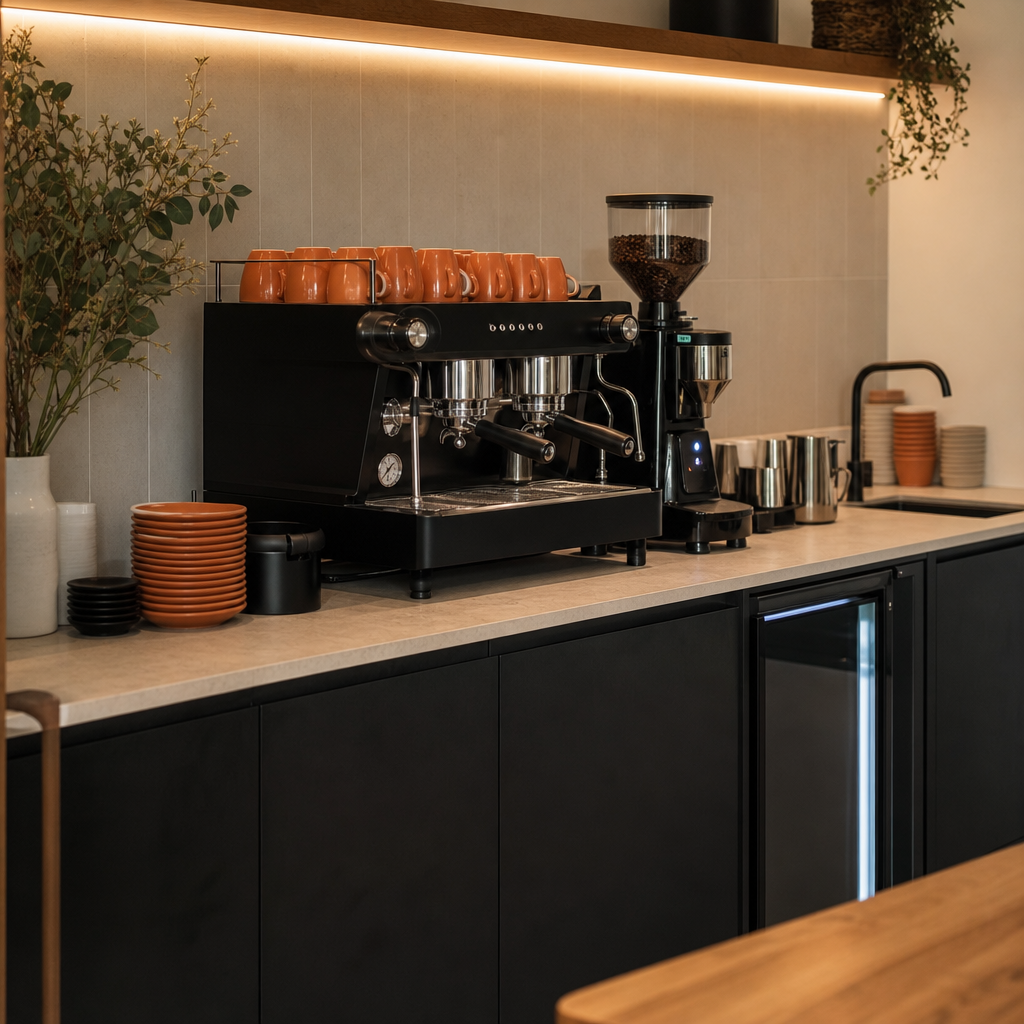
Installing an office coffee machine starts with matching the equipment to your team, then confirming power, potable water, drainage, bench space, ventilation and service access. A commercial installer should inspect the site, follow the machine manufacturer's requirements, test every connection, dial in the coffee and train staff before handing over the machine.
A proper installation prevents nuisance power trips, leaking fittings, poor coffee and avoidable downtime. It also makes daily cleaning and future servicing much easier.
This office coffee machine installation guide explains what Australian businesses should check before installation, what qualified trades may be required, and how the machine should be commissioned. It reflects how we approach commercial coffee machine setup across Melbourne: one person remains accountable from the initial site visit through to ongoing service.
| Boutique Coffee at Work snapshot | Result | Source |
|---|---|---|
| Active Melbourne workplace rental clients | 200+ | Boutique Coffee at Work business data, 2026 |
| Average active client relationship | 5+ years | Boutique Coffee at Work business data, 2026 |
| Typical service call response | 24 hours | Boutique Coffee at Work business data, 2026 |
| Largest workplace team supported | 400+ people | Boutique Coffee at Work business data, 2026 |
Key takeaways
A successful installation is determined before the machine arrives. Confirming the equipment specification, utility connections, physical access and service responsibilities early removes most installation-day surprises. The objective is not simply to switch on a machine. It is to create a safe, practical coffee station that remains reliable during normal workplace use.
- Select the machine for actual team demand rather than buying the highest specification available.
- Check the manufacturer's electrical rating before approving the power connection or circuit.
- Use potable cold water, suitable filtration and an accessible isolation valve.
- Confirm whether the machine needs a plumbed waste connection, pump-out system or manual drip-tray management.
- Leave enough clearance for ventilation, bean hoppers, cleaning and technician access.
- Treat training, coffee calibration and ongoing servicing as part of installation, not optional extras.
Office coffee machine installation summary
The table below separates the key installation areas, the checks your workplace should complete and the people normally responsible. Exact requirements vary by machine, building and site, so the manufacturer's installation manual and advice from appropriately qualified trades must take priority.
| Installation area | What to confirm | Typical responsibility | Common warning sign |
|---|---|---|---|
| Machine selection | Team demand, drink preferences and peak usage | Coffee provider and workplace contact | Machine chosen mainly on price or appearance |
| Electrical | Rating plate, circuit suitability, outlet position and protection | Licensed electrician where electrical work is required | Power boards, adapters or distant outlets |
| Water supply | Potable water, pressure, flow, isolation and filtration | Coffee installer and licensed plumber where required | No accessible shut-off valve |
| Drainage | Waste connection, fall, air gap and cabinet route | Installer and plumber where required | Waste hose rising or becoming kinked |
| Bench space | Machine footprint, grinder, fridge and consumables | Workplace contact and installer | No room to refill or service equipment |
| Ventilation | Manufacturer clearances and heat dispersal | Installer and facilities team | Machine enclosed tightly inside cabinetry |
| Commissioning | Leak tests, heating, grinder adjustment and training | Coffee provider | Machine left running without coffee calibration |
| Ongoing support | Cleaning, servicing, stock and fault contact | Coffee provider and nominated staff | Nobody owns the issue after installation |
Pre-installation checklist
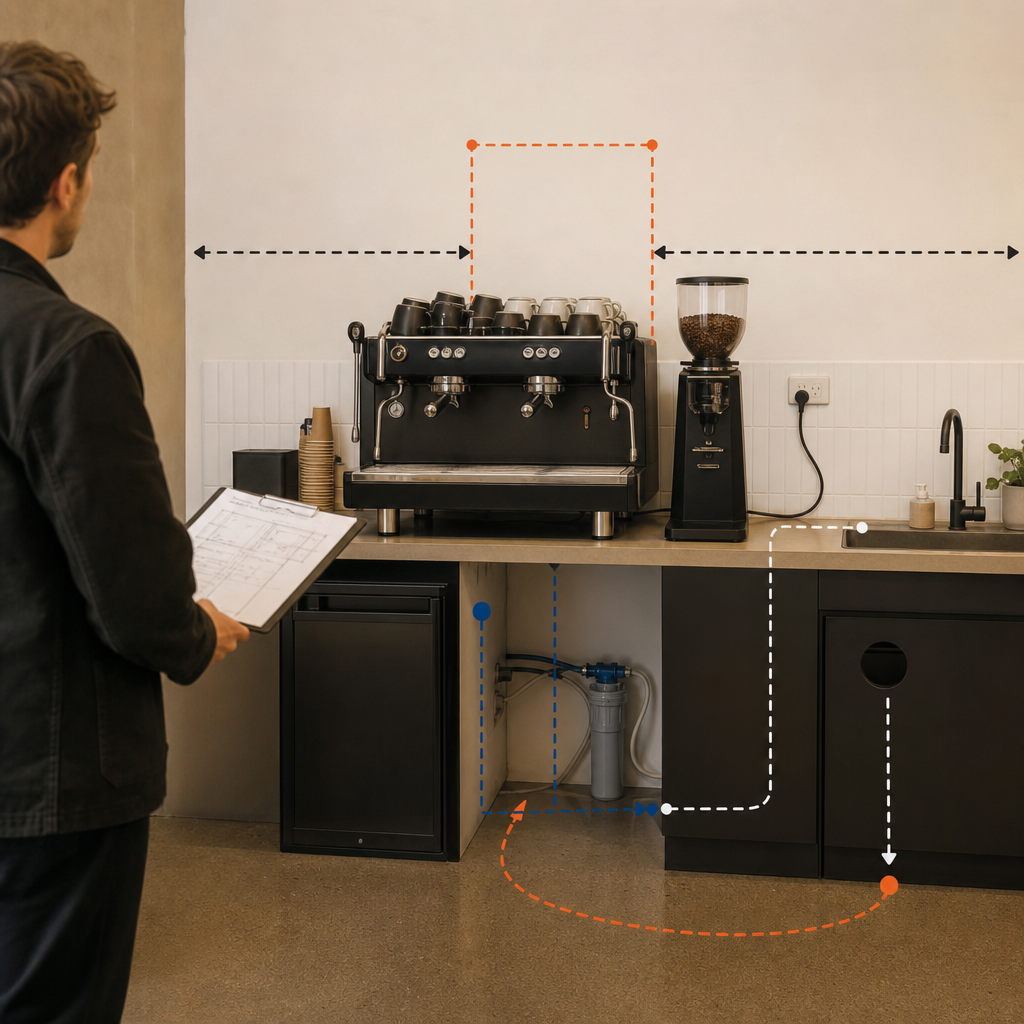
Before installing an office espresso machine, document the machine specification, workplace demand, proposed location, building access and available utilities. Arrange a site inspection whenever plumbing or electrical suitability is uncertain. The installer should know the route from the loading area to the bench and confirm who can approve building work before arrival.
Match the machine to the real workplace
Start with how the office actually drinks coffee. Consider team size, attendance patterns, peak demand, espresso versus milk-based preferences, guest use and whether staff will operate the machine confidently.
I do not believe in upselling equipment for hypothetical growth. A small team does not need an expensive high-output machine simply because it looks impressive. A large office should not rely on domestic-grade equipment that cannot cope with repeated workplace use.
The right machine is chosen on purpose. It should handle busy periods without creating unnecessary cleaning, maintenance or capital costs. Explore the available workplace coffee solutions before deciding which equipment format suits your team.
Collect the technical documents
Obtain the current installation manual and specification sheet for the exact model. Do not rely on requirements from a similar model in the same range.
Record:
- Overall dimensions and operating clearances
- Electrical rating and plug or connection type
- Water inlet specification
- Permitted water pressure and flow requirements
- Drainage requirements
- Filtration recommendations
- Machine weight and bench-loading considerations
- Access required for filling, cleaning and servicing
The machine's rating plate and installation manual are the primary technical references. If the site cannot satisfy them, change the location, modify the services through qualified trades or select another machine.
Inspect access and approvals
Commercial buildings often introduce practical constraints that have nothing to do with coffee. Confirm loading access, lift dimensions, security procedures, contractor induction, parking, work-hour restrictions and protection for finished floors.
Ask the building manager whether plumbing penetrations, electrical work or alterations inside cabinets need approval. Clarify whether trades must provide licences, insurance evidence or safe work documents before attending.
Also inspect the route beneath and behind the bench. A location can look suitable from the front while hiding an inaccessible cupboard, fixed shelving or a solid wall that blocks water and waste lines.
Use a clear installation process
Our Six-Step Process is designed to take most Melbourne clients from first contact to an installed machine in 5-7 business days, based on Boutique Coffee at Work's service process. It includes:
- Enquiry, with basic workplace details submitted in about 2 minutes.
- A 15-20 minute phone call with Chris to discuss machine options and rough pricing.
- A 30-minute site visit covering power, plumbing and bench space.
- A 45-minute installation, including connection, grinder adjustment and coffee testing.
- A 20-minute first brew and training session for at least two staff members.
- Weekly or fortnightly service visits, with beans and consumables replenished.
These timings are Boutique Coffee at Work's own operating benchmarks, not guarantees for every building. Restricted access, trade work or landlord approvals can extend the process. The important point is that responsibility remains clear throughout.
Power and electrical requirements
The machine must connect to a supply that meets its manufacturer's electrical specification and Australian electrical safety requirements. Never assume an existing kitchen outlet is suitable because the plug fits. Confirm the rating plate, circuit capacity, outlet location and protective devices before installation, using a licensed electrician whenever new electrical work or verification is required.
Check the exact machine load
Commercial coffee machines use electricity for boilers, pumps, control systems and, depending on the model, cup warming or refrigeration. The grinder and milk fridge may also need separate outlets.
Provide the electrician with the exact model specification rather than a general description such as "commercial coffee machine". Different machines can have materially different connection requirements.
Safe Work Australia identifies electricity as a workplace hazard that must be managed through safe systems, suitable equipment and competent work. Energy Safe Victoria also publishes guidance for electrical installations in Victoria. These obligations are more important than convenience or installation speed.
Avoid temporary power arrangements
Do not plan a permanent coffee station around an extension lead, double adapter or overloaded power board. These arrangements can create trip hazards, expose connections to water and encourage multiple heat-producing appliances to share one supply.
The outlet should be accessible enough to isolate the machine safely, but positioned to reduce exposure to spills. Cables should not cross sinks, hot surfaces, cupboard hinges or cleaning areas.
If the machine requires a dedicated circuit, hard-wired connection or different outlet, arrange this before installation day. Only appropriately licensed people should perform regulated electrical work.
Test the complete station
Assess the machine, grinder, fridge, dishwasher, kettle and other nearby appliances as one operating area. A circuit that appears adequate while the kitchen is quiet may behave differently when several appliances heat simultaneously.
The installer should confirm that the machine powers up normally and does not produce immediate faults. Circuit suitability and electrical testing remain matters for a qualified electrician, not a coffee technician guessing from experience.
Water supply and drainage
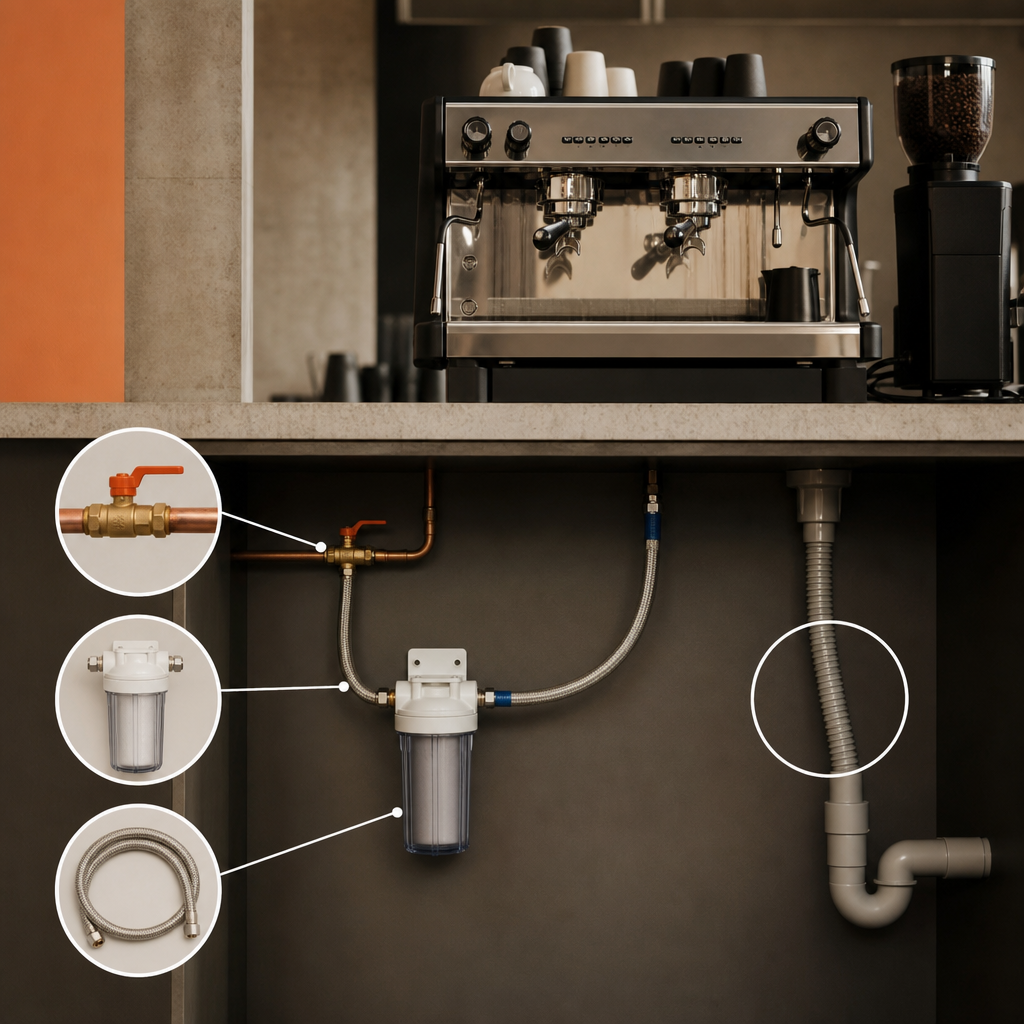
A plumbed office coffee machine needs a potable cold-water connection, suitable isolation, compliant components and a drainage arrangement that cannot kink, back up or leak into cabinetry. Water pressure, filtration and waste requirements must follow the exact machine manual. Plumbing work should be completed by an appropriately licensed plumber where Australian or local rules require it.
Provide an accessible water connection
The installer should be able to isolate the machine without shutting down an entire office kitchen. An accessible stop valve makes filter changes, servicing and emergency response much simpler.
Water lines should be protected from crushing, sharp cabinet edges and hot equipment. Avoid loose hoses running across storage areas where staff can pull or damage them while retrieving supplies.
Australian plumbing products that fall within the WaterMark scheme must satisfy the applicable certification requirements before installation. The National Construction Code and local plumbing requirements also affect how water services, backflow protection and sanitary drainage are handled.
Treat filtration as equipment protection
Filtration should be selected for the source water and the machine manufacturer's requirements. Its purpose may include managing sediment, unwanted taste and minerals that contribute to scale.
Do not choose a filter from appearance alone. The wrong cartridge can restrict flow, fail to address local water conditions or alter the coffee in an unhelpful way. The installer should also place the filter where it can be replaced without dismantling the coffee station.
A filter does not remove the need for maintenance. Replacement schedules depend on cartridge capacity, local conditions and consumption. Record the installation date and make filter servicing part of the ongoing maintenance plan.
Build drainage for gravity and access
Where a machine has a plumbed waste outlet, the hose should follow the manufacturer's instructions and maintain a practical route to the approved waste connection. Poor routing creates low points, kinks and blockages from coffee residue.
The waste connection may require particular backflow protection, air gaps or tundish arrangements depending on the installation. That determination belongs with the machine documentation and qualified plumber.
A drip tray is not a substitute for drainage planning. Even when a machine uses a manual tray, the workplace must assign responsibility for checking and emptying it. Overflow inside joinery can damage cabinetry before anyone notices the problem.
Before handover, inspect every fitting while the machine is filling, brewing and rinsing. Check inside cabinets as well as around the bench. A dry connection during idle time is not proof that it remains dry under operation.
Space and ventilation considerations
Allow space for the machine, grinder, milk fridge, cups, cleaning supplies and the people preparing drinks. The coffee station also needs manufacturer-specified ventilation and service clearances. A machine squeezed tightly beneath cabinets may fit physically but remain difficult to refill, clean, cool or repair without partially dismantling the surrounding workspace.
Measure operating space, not just the footprint
Bench dimensions are only the starting point. Check whether staff can lift bean-hopper lids, remove water tanks, access grounds drawers, open fridge doors and use the steam wand without hitting a wall.
Consider the workflow around the machine:
- Where clean cups are stored
- Where used cups are placed
- How milk reaches the fridge
- Where coffee beans and chocolate are kept
- Where staff empty grounds or waste
- Whether queues obstruct a doorway or thoroughfare
A logical layout reduces spills and stops staff from reaching across hot components. It also makes daily cleaning more likely because the required tools and supplies remain accessible.
Protect ventilation and service access
Commercial machines generate heat and moisture. Follow the manufacturer's stated clearances rather than assuming an open front provides enough ventilation.
Avoid enclosing the equipment in tight joinery unless the cabinetry has been designed around the machine's requirements. Heat accumulation can affect reliability, nearby refrigeration and stored consumables.
Technicians need access to panels, water connections, filters and waste hoses. If the machine must be lifted out or surrounding shelves removed for every service, simple maintenance becomes slower and more disruptive.
Choose a suitable bench and location
The bench must be stable, level and capable of supporting the complete operating setup. Consider the filled machine, grinder, fridge, cups and consumables rather than the empty machine alone.
Keep the station away from busy door swings, exposed edges and areas where cleaning chemicals may contaminate cups or beans. Staff should have enough light to see controls, spills and milk residue clearly.
Noise also matters. Grinding, rinsing and milk preparation can interrupt calls if the station is placed directly beside quiet work areas. Moving it a short distance may improve workplace use without compromising convenience.
Post-installation and initial setup

Commissioning should verify the electrical, water and drainage connections before calibrating the grinder and testing every drink function. The installer should inspect for leaks, allow the machine to reach operating condition, flush relevant systems, dial in the coffee, explain cleaning tasks and train nominated staff before the machine enters general workplace use.
Commission the machine methodically
Installation is not complete when the display illuminates. The installer should:
- Confirm the machine is stable and level
- Check supply and waste connections under operation
- Confirm normal filling, heating and rinse behaviour
- Test espresso, hot water, milk and chocolate functions where fitted
- Adjust the grinder for the selected beans
- Taste the resulting coffee rather than relying only on machine settings
- Check cup positioning and user workflow
- Explain shutdown, cleaning and basic fault responses
Coffee calibration matters because grind settings move with bean age, roast, humidity and grinder behaviour. Dialled-in beans are part of commissioning, not a detail to leave for employees to solve later.
Our Curated Coffee Plan starts with the team's preferences. We ask whether staff mainly drink espresso or milk-based coffee, how strong they prefer it and what they dislike. We then select a suitable blend and adjust it from team feedback during the first month.
Train staff for normal use and common faults
At least two nominated staff members should understand daily operation, cleaning and who to call for support. Training should cover what users can safely resolve and what requires a technician.
A short cheat sheet near the machine can explain routine cleaning, refilling and common prompts. It should not encourage staff to open service panels, bypass safety controls or modify grinder settings without guidance.
Keep cleaning products labelled and separate from coffee ingredients. Use only products and procedures approved for the equipment. Incorrect chemicals can damage seals, leave residues or create avoidable service faults.
Businesses considering the complete rental and support process can review how workplace coffee installation works or arrange a free workplace coffee trial.
Case study: upgrading a mid-size Melbourne office
A mid-size Melbourne technology office had an existing coffee setup that no longer met team expectations. We upgraded the workplace to a WMF commercial machine, with installation, training and ongoing service included in the rental.
The preparation was straightforward because machine selection, site installation, staff training and servicing remained under one point of responsibility. The site manager later reported easy daily use, strong coffee and hot chocolate quality, and consistent service maintained over several years.
Client testimonial summary: The site manager said staff appreciated having great coffee available and valued how reliably the machine and service were maintained.
Case study: a setup designed around uptime
A busy Melbourne workplace had experienced significant disruption whenever its coffee machine failed during peak office use. Supplying another machine was not enough. The setup needed clear maintenance ownership and a direct response path.
We provided a reliably maintained machine, scheduled servicing and direct personal contact for faults. The workplace contact reported that regular service meant the team had coffee when it mattered, avoiding the havoc previously caused by breakdowns.
This is why installation planning must include the support model. A technically correct connection does not help if faults disappear into a ticket queue.
Installation is an accountability test
The most overlooked workplace coffee machine requirement is not power, water or bench space. It is ownership. One person should remain accountable for equipment selection, installation, coffee calibration, training and service. Splitting those duties across sales teams, contractors and call centres creates gaps that become obvious when the machine stops during a busy morning.
My position is simple: one number, one person. No call centres, no corporate runaround.
Most small problems can be discussed quickly when the person answering already knows the machine, installation and workplace. If a visit is needed, there is no internal escalation path delaying the response. Boutique Coffee at Work's typical service-call response is 24 hours across its active client base, according to the business's 2026 operating data.
The same principle applies to machine selection. I would rather recommend the cheaper machine that suits the team than inflate an invoice with capacity the workplace will never use. Long-term relationships are more valuable than an oversized first sale.
Our rentals are month-to-month, with one month's notice to exit and free machine pickup. That is Boutique Coffee at Work's current rental policy. No lock-in, ever. After 17 years focused exclusively on workplace coffee, according to our 2026 business profile, clients retained by choice remain the better measure of fit.
That is the difference between a coffee partner, not a supplier. The installation is not a handover point where responsibility ends. It is where accountability becomes visible.
Plan your office coffee machine installation
A reliable installation starts with an honest machine recommendation and a proper site assessment. If you want café-quality coffee made practical for your Melbourne workplace, we can assess the power, plumbing, drainage and space before recommending equipment. Contact Boutique Coffee at Work to discuss your office and arrange the next step.
References
- Safe Work Australia, Electrical safety
- Energy Safe Victoria, Electrical installations
- Australian Building Codes Board, WaterMark Certification Scheme
- Australian Building Codes Board, National Construction Code
- Boutique Coffee at Work business data and service process, 2026.
Frequently asked questions
Does an office coffee machine need a plumber?
A plumber may be required when installing or altering fixed water, drainage or backflow connections. The exact requirement depends on the machine, building and local plumbing rules. Bench-top machines with manual water tanks may not need plumbing, while plumbed commercial machines usually require the water and waste arrangement to be assessed properly.
Does a commercial coffee machine need a dedicated power circuit?
Some commercial machines require a dedicated circuit or specific electrical connection, while others can use a suitable existing outlet. Check the exact model's rating plate and installation manual. A licensed electrician should verify circuit suitability or complete any new electrical work.
Can an office coffee machine operate without drainage?
Some machines use a removable drip tray or internal waste container, while others require a fixed waste connection. Manual systems need regular monitoring and emptying. The installation must follow the manufacturer's instructions and applicable plumbing requirements.
How much bench space does an office coffee machine need?
Allow for the machine, grinder, milk fridge, cup storage, consumables, ventilation clearances and room to refill and clean the equipment. Staff must also be able to prepare drinks safely without blocking doors or reaching across hot components.
What should happen immediately after installation?
The installer should test electrical operation, water filling, drainage, leaks and every drink function. The grinder should be calibrated, drinks tasted, cleaning procedures demonstrated and nominated staff trained before general workplace use.
How long does office coffee machine installation take?
The physical connection may be quick when services are ready, but the complete process includes inspection, commissioning, calibration and training. Boutique Coffee at Work aims to move most Melbourne clients from first contact to installation in 5-7 business days, subject to approvals and trade work.

Chris
Chris
Keep reading
Understanding the Daily Cost of a Commercial Coffee Machine in an Australian Office
The cost of a commercial coffee machine per day equals daily beans, milk, electricity, water filtration, cleaning, rental or equipment ownership, and…
Comprehensive Corporate Coffee Solutions: Elevating Australian Workplace Experiences
Corporate coffee machine solutions combine commercial equipment, installation, fresh beans, staff training, maintenance and responsive support in one workplace…
Office Coffee Machine Troubleshooting: Common Errors & Quick Fixes
Office coffee machine troubleshooting should start with basic checks: confirm power, water, beans, waste levels and removable parts. Follow the displayed…