The cost of a commercial coffee machine per day equals daily beans, milk, electricity, water filtration, cleaning, rental or equipment ownership, and maintenance. The only reliable calculation uses your office's actual drink volume, supplier invoices, energy tariff and service agreement. Machine price alone rarely reveals the true daily operational cost.
Boutique Coffee at Work, 2026: 200+ active Melbourne workplace rentals | 5+ year average client relationship | 24-hour typical service response | 17 years focused exclusively on workplace coffee
Source: Boutique Coffee at Work's own 2026 active client and operating data.
Introduction
Daily coffee costs are easy to underestimate because the expenses arrive through different invoices. Beans may come fortnightly, milk through an office order, electricity through the building account and repairs as irregular surprises. A proper daily figure brings every recurring and avoidable cost into the same calculation.
The goal is not to chase the lowest possible figure. It is to understand what the office receives for its spend, where waste occurs and whether the machine suits actual demand. This guide provides a practical Australian office calculation without pretending there is one universal daily price.
Key takeaways
A useful daily cost calculation starts with consumption, not the advertised machine price. Count the coffee made, measure the ingredients consumed and convert every recurring invoice to the same business-day basis. Keep bundled costs separate so maintenance, filters or beans are not accidentally counted twice.
- Bean and milk consumption usually moves directly with drink volume and beverage preferences.
- Electricity should be measured in kilowatt-hours and multiplied by the tariff shown on the relevant business energy bill.
- Rental, servicing and filter costs must be converted to a daily amount using actual invoiced charges.
- A cheap machine can become expensive when it is undersized, unreliable or poorly maintained.
- Purchase depreciation and cash repayments answer different financial questions and should not be mixed.
- Cost per available drink is more useful than machine cost alone when comparing workplace coffee options.
Summary table
The following framework captures the main components of daily operational cost without relying on generic industry averages. Each organisation should replace the inputs with its own invoices, meter readings and observed consumption. This produces a defensible comparison between rental, purchase and alternative workplace coffee arrangements.
| Cost component | Best calculation method | Evidence to use | Common mistake |
|---|---|---|---|
| Coffee beans | Beans consumed multiplied by invoiced cost per kilogram | Grinder data, stock movement and bean invoices | Using drinks made without checking the grinder dose or wastage |
| Milk | Litres consumed multiplied by invoiced cost per litre | Milk invoices and opening-to-closing stock checks | Ignoring discarded milk and alternative milk |
| Electricity | Measured kilowatt-hours multiplied by the applicable tariff | Plug-in energy logger, building meter or machine monitoring | Multiplying maximum rated power by every operating hour |
| Water filtration | Cartridge cost divided across its actual service life | Filter invoice, water usage and replacement records | Assuming every cartridge lasts for the same period |
| Cleaning consumables | Products consumed across the measurement period | Supplier invoices and cleaning records | Omitting tablets, powders and milk-system cleaner |
| Rental | Rental invoice converted to a business-day amount | Current agreement and invoice | Counting bundled servicing again |
| Purchased equipment | Agreed management allocation or accounting treatment | Purchase records and accountant-approved asset schedule | Treating depreciation and loan repayments as the same cost |
| Maintenance | Service and repair costs not already included elsewhere | Service agreement and repair invoices | Ignoring downtime and staff time spent chasing support |
Components of the daily cost of a commercial coffee machine
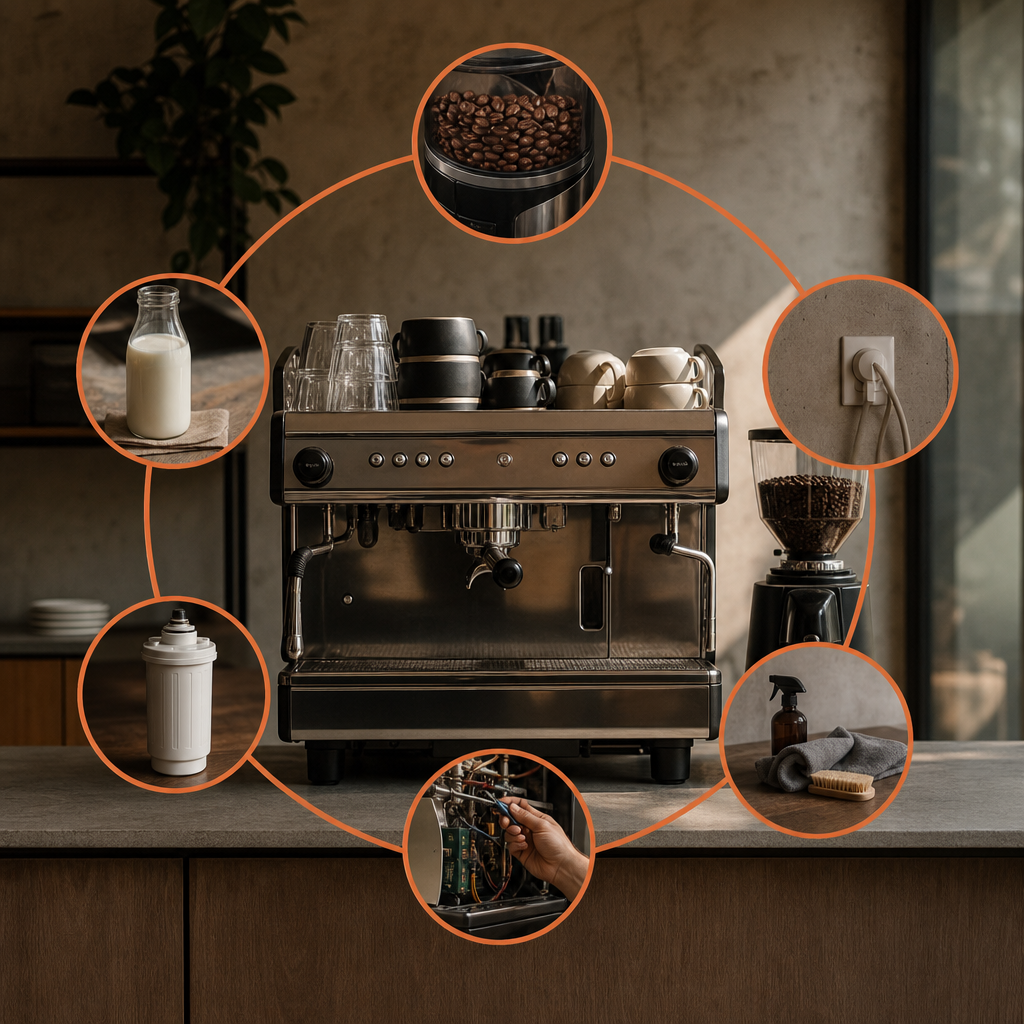
The daily cost has variable, fixed and disruption-related components. Beans, milk and some cleaning products rise with usage. Rental and scheduled servicing are relatively fixed. Downtime, wasted ingredients and staff time are less visible, but they often explain why two apparently similar coffee arrangements deliver different value.
A useful starting formula is:
Daily operating cost = beans + milk + electricity + water filtration + cleaning + rental or ownership allocation + maintenance not already included
For management reporting, I also recommend tracking:
Cost per available drink = total daily operating cost divided by usable drinks produced
The word "usable" matters. Grinder calibration shots, failed drinks, abandoned cups and cleaning cycles can consume ingredients without producing coffee for the team.
Variable costs
Variable costs change as consumption changes. Coffee beans are the clearest example, but milk, drinking chocolate and alternative milk can be just as important in an office dominated by milk-based drinks.
Do not estimate these costs from headcount alone. A team may include regular café-style coffee drinkers, occasional users, tea drinkers and staff working remotely. Attendance patterns also change during the week.
Measure what leaves the storeroom and what the machine produces. If the machine has reliable beverage counters, record them alongside stock movement. The relationship between those records helps expose over-dosing, spills and unrecorded wastage.
Fixed and semi-fixed costs
Rental is usually fixed for the invoice period. Maintenance may be fixed when included in the rental, partly fixed under a service plan or irregular when the office owns the equipment.
Water filter costs are semi-fixed. A cartridge might be changed because it reaches its rated capacity, because local water conditions require it or because the scheduled service interval arrives. The correct daily amount comes from the cartridge's actual replacement history, not a generic assumption.
Disruption costs
Downtime does not appear on a coffee invoice. It still has a cost.
Staff may leave the office to buy coffee, reception may handle complaints and an office manager may spend time navigating a supplier's support system. These costs are difficult to allocate precisely, so I keep them separate from the core operational calculation. They should still influence the supplier decision.
My view is simple: one number, one person. Most faults can be diagnosed quickly when the person answering already knows the machine, plumbing, grinder and service history. No call centres, no corporate runaround.
Calculating energy consumption
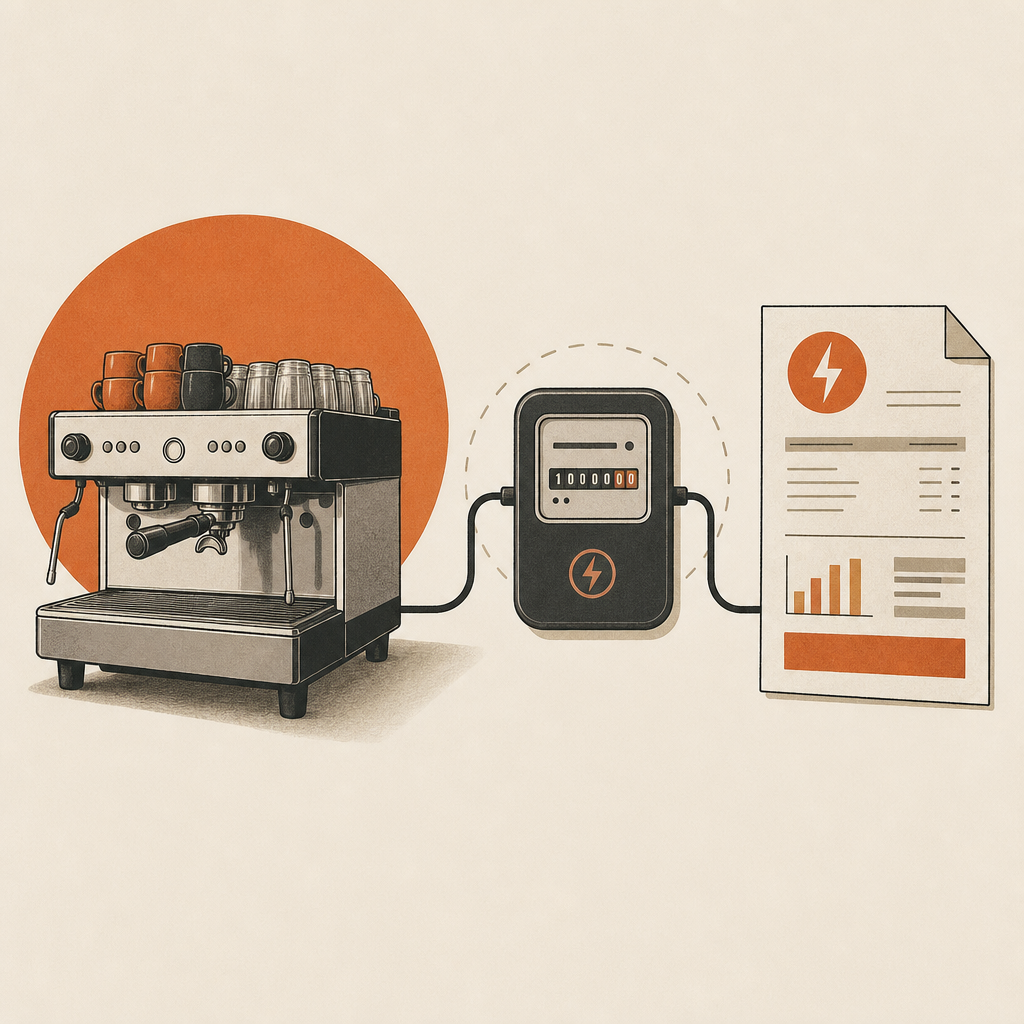
Calculate energy cost from measured kilowatt-hours rather than the machine's maximum power rating. Commercial machines cycle boilers, enter standby modes and respond to demand throughout the day. Record real consumption during representative office conditions, then multiply it by the applicable electricity tariff from the organisation's bill.
The calculation is:
Daily electricity cost = measured daily kilowatt-hours multiplied by electricity cost per kilowatt-hour
Use the tariff actually paid by the business. Do not copy a residential rate from an online article. Victorian offers and charges differ by retailer, plan, location and meter arrangement. Victorian Energy Compare provides an official comparison service, but the current business invoice remains the best source for an existing site's applied rates.
Why the machine nameplate is not enough
A machine's rated wattage identifies its maximum electrical demand. It does not prove that the machine draws that amount continuously.
Boilers heat, stop and reheat. Grinders run briefly. Refrigeration and milk systems may cycle independently. Automatic cleaning can add consumption outside normal serving periods. Office demand also clusters around arrival time, meetings and meal breaks.
Multiplying maximum kilowatts by every powered-on hour usually produces a poor estimate. Direct measurement is better.
A practical measurement method
Use a suitably rated energy logger installed by a competent person, or use consumption data available through the building or machine monitoring system. Record a representative operating period rather than an unusually quiet office day.
Document:
- Machine switch-on and switch-off behaviour
- Standby settings
- Drink count over the same period
- Cleaning cycles included in the reading
- Public holidays, remote-work days or events that affected attendance
- The tariff and GST treatment used in the calculation
Then convert the result to an average business day. Keep GST treatment consistent across electricity, ingredients, rental and servicing. Mixing GST-inclusive retail prices with GST-exclusive business invoices distorts the comparison.
Reducing energy use without disrupting coffee service
Start with scheduling. A machine does not need to maintain full operating temperature through long periods when the office is empty. Use the manufacturer's automatic on, off and standby functions where appropriate.
Do not switch equipment off in a way that conflicts with cleaning requirements or creates unacceptable warm-up delays. The right schedule depends on the machine, office opening pattern and first expected drink.
Machine size also matters. Oversized boilers can create unnecessary standing energy use. Undersized machines may struggle at peak periods and wear faster. This is why I assess power, plumbing, bench space and actual team demand during the on-site visit rather than recommending equipment from a catalogue alone.
Bean and milk usage
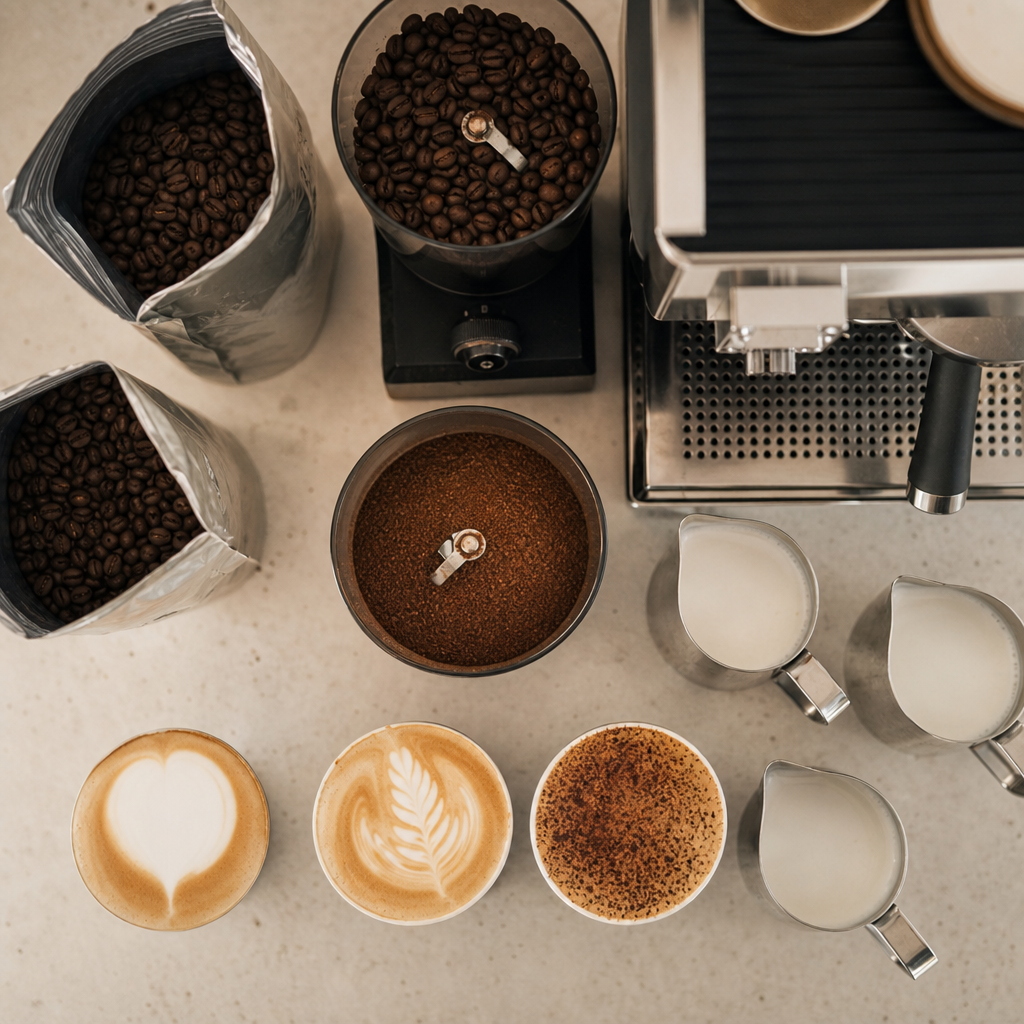
Bean and milk costs should be measured from actual stock consumption and verified against machine drink counts. Headcount-based estimates miss attendance, drink preferences, grinder dose, rejected drinks and milk waste. A short stock audit provides a far more accurate daily cost and identifies quality problems that purchasing data alone cannot show.
Calculating bean cost
Use this formula:
Daily bean cost = kilograms of beans consumed during the measurement period multiplied by invoiced cost per kilogram, divided by business days measured
Then calculate:
Bean cost per usable drink = total bean cost divided by usable drinks produced
The grinder dose must be checked. A grinder that has drifted away from its intended setting can use more coffee while producing worse extraction. Staff may compensate by adding shots, remaking weak drinks or changing settings without recording the reason.
Dialled-in beans are not only a quality issue. They are a cost-control measure. Correct grind, dose and extraction reduce remakes and make stock consumption more predictable.
Allowing for waste
Compare three records:
- Beans issued from storage
- Machine or grinder counters
- Drinks actually served or accepted
The records will not match perfectly. Calibration, cleaning, spillage and abandoned drinks create differences. The goal is to understand the gap and keep the measurement method consistent.
Do not reduce the assumed dose merely to make the spreadsheet look better. If a lower dose produces poor coffee, staff will remake drinks or return to the café outside. Cost control that damages adoption is false economy.
Calculating milk cost
Milk cost is best calculated through stock movement:
Daily milk cost = litres consumed multiplied by invoiced cost per litre, divided by business days measured
Track dairy and alternative milk separately when their purchase prices differ. Include milk discarded during cleaning, left unrefrigerated or poured but unused. Those losses are part of the real running cost.
Office drink preference matters. A team choosing mostly espresso will use less milk than a team choosing flat whites, cappuccinos and hot chocolate. That is why our Curated Coffee Plan starts by asking about espresso versus milk-based drinks, preferred strength and dislikes. We select a suitable blend, then adjust it from team feedback during the first month.
This process is chosen on purpose. A roast that works well as espresso may disappear in a large milk drink. Matching the coffee to actual behaviour supports quality without relying on excessive doses.
Stock control without rationing
Good control does not mean making staff request every bag of beans. Keep enough stock to avoid outages, but use a regular replenishment rhythm and record what is delivered.
Compare supplier deliveries with machine counters and workplace attendance. Investigate sudden changes rather than imposing arbitrary limits. A jump may reflect an office event, increased attendance, grinder drift, unreported waste or genuine growth in adoption.
Maintenance, filters and consumables
Maintenance costs should include scheduled servicing, repairs, cleaning products, water filters and any labour or parts excluded from the rental agreement. Read the agreement before adding each item. When servicing and filters are bundled, counting them again creates an inflated daily figure and an unfair comparison with ownership.
What to check in a rental proposal
A low rental figure tells you little unless the inclusions are clear. Ask whether the quoted amount covers:
- Delivery and installation
- Plumbing coordination
- Initial grinder setup
- Staff training
- Scheduled servicing
- Breakdown labour
- Replacement parts
- Water filter replacement
- Cleaning products
- Temporary replacement equipment
- Machine collection when the arrangement ends
The purpose is not to demand that every item be included. It is to make proposals comparable.
Our approach is month-to-month, with one month's notice to exit and free machine pickup. This is Boutique Coffee at Work's operating policy, not an industry-wide claim. No lock-in, ever. In my experience, long-term relationships should be retained through service rather than a contract that makes leaving difficult.
You can review the broader financial considerations in our guide to renting versus buying a commercial coffee machine.
Water filters
A filter protects drink quality and helps manage scale or other water-related issues, but filter selection should follow the machine manufacturer's requirements and local water conditions. The Australian Drinking Water Guidelines published by the National Health and Medical Research Council provide the national framework for drinking water quality. They do not replace machine-specific filtration advice.
Calculate daily filtration cost from the invoiced cartridge and its actual service life:
Daily filter cost = installed filter cost divided by business days in service
If installation labour is charged separately, include it once. Do not allocate the same labour through both maintenance and filter cost.
Cleaning consumables and staff time
Commercial machines need regular cleaning to protect hygiene, taste and reliability. Depending on the equipment, consumables may include cleaning tablets, group-head cleaner, milk-system cleaner and sanitising products approved for the machine.
Use invoices and stock movement rather than a guessed monthly allowance. If cleaning products are supplied under the rental, mark them as bundled.
Staff cleaning time can be recorded as an operational consideration. Keep it separate from direct machine expenditure unless the organisation routinely assigns labour costs to office tasks. Consistency matters more than creating an artificial precision.
Purchased equipment and depreciation
For a purchased machine, decide whether the calculation is intended to show cash flow, management cost or accounting expense.
Loan repayments show cash commitments. A management allocation spreads the purchase across an expected useful period. Tax depreciation follows applicable Australian tax rules. These are not interchangeable calculations.
The Australian Taxation Office explains that depreciating assets can decline in value over time and that the applicable treatment depends on the asset and taxpayer circumstances. Use the organisation's accountant-approved asset schedule rather than inventing a daily depreciation rate.
Daily cost scenarios for different office sizes
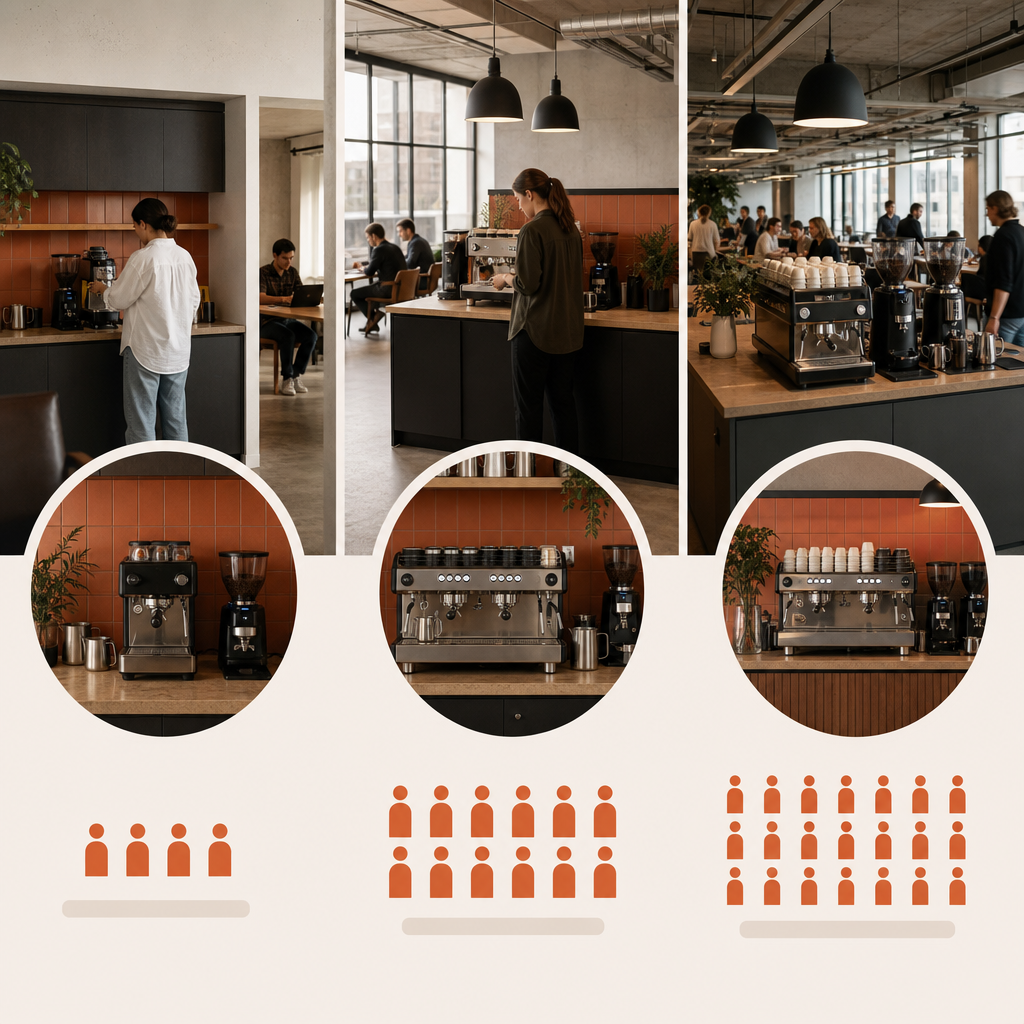
Office size changes machine requirements, peak demand and consumption, but it does not create a reliable standard daily price. The correct scenario model combines attendance, drinks produced, ingredient use, measured energy and the actual service arrangement. The examples below show how I would structure the calculation without fabricating market averages.
| Workplace scenario | Cost model to prioritise | Main risk | Source for office-size context |
|---|---|---|---|
| 12-person team | Ingredient stock audit plus rental and measured power | Paying for capacity the team will not use | Boutique Coffee at Work's supplied machine-fit example |
| 80-person team | Peak-period capacity, drink counters, milk volume and service coverage | Undersized equipment failing under sustained demand | Boutique Coffee at Work's supplied machine-fit example |
| 400+ person workplace | Zoned demand, replenishment logistics, redundancy and response planning | A single failure interrupting a large workforce | Boutique Coffee at Work's largest installed team tier, 2026 business data |
Smaller office scenario
Consider a 12-person team. I would not start by recommending a premium machine designed for a major corporate floor. The first questions concern office attendance, preferred drinks, bench space, plumbing and expected peak use.
The daily worksheet would contain:
- Beans consumed during the measurement period
- Dairy and alternative milk consumed
- Measured electricity use
- Filter and cleaning allocation
- Rental or ownership allocation
- Unbundled service costs
- Usable drink count
The key risk is overcapitalisation. A 12-person team does not need a $15,000 Eversys, based on the supplied Boutique Coffee at Work machine-fit example. That amount is not presented as a general market benchmark. It illustrates why honest sizing matters.
Medium workplace scenario
For an 80-person workplace, average daily consumption is only part of the picture. The machine must handle demand when staff arrive, return from meetings or take breaks at similar times.
An undersized unit may look economical on a purchase comparison but create queues, repeated refilling and premature wear. Boutique Coffee at Work's supplied experience is that an 80-person team can break a home-grade Jura within a month. This is a first-hand machine-fit observation, not a universal product-life guarantee.
The calculation should therefore include service coverage and operational resilience. A commercial unit selected for actual throughput may carry a higher fixed daily allocation while producing a lower cost per available drink and fewer interruptions.
Large workplace scenario
Boutique Coffee at Work's largest installed office tier covers more than 400 people, according to the business's 2026 data. At that scale, replenishment, peak demand and fault response become central planning issues.
A simple total-cost spreadsheet is not enough. Map where staff work, how they move through the office and whether one machine creates a queue or a single point of failure. Track costs by machine or service zone where possible.
The right question becomes: what does it cost to provide reliable coffee at the places and times staff need it? That is different from asking which machine has the lowest advertised rental.
Case study: matching a Melbourne office with the right setup
A mid-size Melbourne office operated by Pepperl+Fuchs Australia had an existing coffee arrangement that was not meeting team expectations. I upgraded the office to a WMF commercial machine and included installation, training and ongoing service within the rental arrangement.
The cost efficiency came from consolidating equipment, setup and ongoing support into a maintained arrangement suited to the workplace. It reduced the risk of paying separately for avoidable setup errors or unmanaged maintenance. No verified before-and-after dollar data was supplied, so I will not manufacture a savings figure.
Paul Bruno reported that the machine was easy to use, the coffee and hot chocolate were well received, and service remained consistent over the following years. He also told his staff, "No problem, just keep doing what you're doing." For me, that feedback captured the value of coffee that works without becoming another facilities problem.
Case study: reducing the cost of disruption
AJM-JV experienced workplace disruption whenever its coffee machine failed during peak office hours. I supplied a reliably maintained machine, scheduled regular servicing and remained the direct contact for issues.
The efficiency was operational rather than a claimed percentage reduction. Regular maintenance and direct support reduced the exposure to breakdown-related disruption, staff complaints and time spent escalating service requests. Chrissie Straw's feedback was that reliable, regular service meant the team had coffee when needed and avoided the havoc caused by a failed machine.
Again, there is no supplied dollar baseline for downtime, so the outcome should not be presented as a fabricated financial saving. It is a clear example of why reliability belongs in a commercial coffee cost assessment.
The cheapest daily figure can be the wrong target
My view is that the best commercial coffee decision minimises waste and disruption while meeting real demand. It does not simply minimise rental. A correctly sized, properly installed and accountable service can cost more on one invoice while delivering a better cost per usable drink and fewer operational problems.
This is where many comparisons go wrong. They place a rental quote beside a purchase price but ignore whether either machine can handle the office. They also assume every service promise has equal practical value.
I am not trying to be the biggest. The model is founder-led, always. One person stays accountable from the initial conversation through installation and ongoing service. Across Boutique Coffee at Work's active client base, the average relationship exceeds five years, according to the business's 2026 data. That retention is by choice, not long-term lock-in.
Right-sizing is a cost-control decision
Upselling a larger machine can increase the initial deal value. It can also burden a smaller workplace with unnecessary equipment, power demand and complexity.
The opposite mistake is equally expensive. Putting home-grade equipment into a busy office can lead to queues, component wear and repeated service issues. Equipment should be selected for peak demand, not merely total headcount or the cheapest catalogue price.
Accountability changes the real running cost
Most supplier comparisons treat service as a checkbox. I treat it as part of the operating model.
Boutique Coffee at Work's typical response time on service calls is 24 hours across the active client base, based on the business's 2026 operating data. Many issues can be talked through quickly because I know the client's setup. If a visit is required, there is no internal escalation path to navigate.
This is what I mean by a coffee partner, not a supplier. Reliable coffee depends on equipment, ingredients and someone remaining responsible after installation.
A better procurement scorecard
Compare proposals across these questions:
- Is the machine sized for peak demand?
- Are beans matched to actual drink preferences?
- Which maintenance and consumable costs are included?
- Who answers when the machine stops?
- Is the response commitment clear?
- Can the organisation leave without a punitive contract?
- Does the supplier measure adoption and adjust the setup?
- Will the arrangement still work if office attendance changes?
This scorecard provides information that a daily dollar figure cannot show alone. It also exposes where a low quote transfers cost and responsibility back to the office manager.
How to build your office's daily cost worksheet
Build the worksheet from source documents, not assumptions. Use supplier invoices, energy readings, machine counters, attendance context and the service agreement. Measure all components across the same representative period, apply consistent GST treatment and note every bundled item before calculating daily and per-drink costs.
Create separate fields for beans, dairy milk, alternative milk, chocolate, electricity, filtration, cleaning, rental, unbundled maintenance and ownership allocation. Add a notes field for unusual events or office closures.
The basic workflow is:
- Define the representative measurement period.
- Record opening ingredient stock.
- Capture machine drink counters and energy readings.
- Record deliveries, waste and closing stock.
- Enter invoiced unit costs.
- Convert fixed invoices to the same business-day basis.
- Remove costs already bundled into another charge.
- Calculate total daily cost and cost per usable drink.
- Review unexpected variances before making a purchasing decision.
If the office is assessing a new arrangement, our Six-Step Process covers enquiry, direct consultation, an on-site assessment, installation, training and ongoing replenishment. Boutique Coffee at Work's supplied process is designed to take most Melbourne clients from the first call to installation within 5-7 business days.
Get a site-specific daily cost
The most useful next step is a calculation based on your office, not an online average. Boutique Coffee at Work can assess team size, peak demand, plumbing, power, drink preferences and service requirements before recommending a machine designed around your culture and budget.
You can request a free workplace coffee trial or contact Boutique Coffee at Work to discuss a Melbourne office setup. The recommendation will fit the actual team rather than the most expensive machine available.
References
These sources support the Australian energy, asset and water-quality principles used in this guide. Pricing inputs should still come from the organisation's own current invoices and agreements. Boutique Coffee at Work figures and case-study details are identified separately as supplied business data rather than external benchmarks.
- Victorian Government, Victorian Energy Compare
- Australian Taxation Office, Depreciation and capital expenses and allowances
- National Health and Medical Research Council, Australian Drinking Water Guidelines
- Australian Competition and Consumer Commission, Consumer rights and guarantees
Frequently asked questions
How much does a commercial coffee machine cost per day in Australia?
There is no reliable universal daily amount. Add actual beans, milk, electricity, filtration, cleaning, rental or ownership allocation, and unbundled maintenance. Divide costs across the same number of business days. The result varies with attendance, drink preferences, machine size, energy tariff and service agreement.
How do I calculate a commercial coffee machine's electricity cost?
Measure the machine's kilowatt-hour consumption under representative office conditions and multiply it by the applicable electricity tariff on the business bill. Include standby and cleaning activity where relevant rather than assuming the machine draws its maximum rated power continuously.
Is renting cheaper than buying a commercial coffee machine?
It depends on the comparison period, finance costs, maintenance exposure and rental inclusions. Renting can make costs predictable when servicing, installation and support are included. Buying provides ownership but leaves the business responsible for depreciation, repairs and eventual replacement.
How should bean usage be estimated for an office?
Record bean stock at the beginning and end of a representative period, add deliveries and compare consumption with grinder or machine counters. Apply the invoiced cost per kilogram. This captures grinder dose, calibration use and waste more accurately than a headcount estimate.
Are water filters part of the running cost?
Yes. Allocate the installed filter cost across its actual service life unless filtration is already included in the rental or service plan. Replacement timing should reflect filter specifications, machine requirements, water conditions and measured usage.
What should a commercial coffee machine rental include?
Confirm whether rental includes delivery, installation, plumbing coordination, grinder setup, training, scheduled servicing, breakdown labour, replacement parts, filters, cleaning supplies and collection. Compare complete inclusions rather than headline rental prices.

Chris
Chris
Keep reading
Office Coffee Machine Installation Guide: What Australian Businesses Need to Know
Installing an office coffee machine starts with matching the equipment to your team, then confirming power, potable water, drainage, bench space, ventilation…
Comprehensive Corporate Coffee Solutions: Elevating Australian Workplace Experiences
Corporate coffee machine solutions combine commercial equipment, installation, fresh beans, staff training, maintenance and responsive support in one workplace…
Office Coffee Machine Troubleshooting: Common Errors & Quick Fixes
Office coffee machine troubleshooting should start with basic checks: confirm power, water, beans, waste levels and removable parts. Follow the displayed…