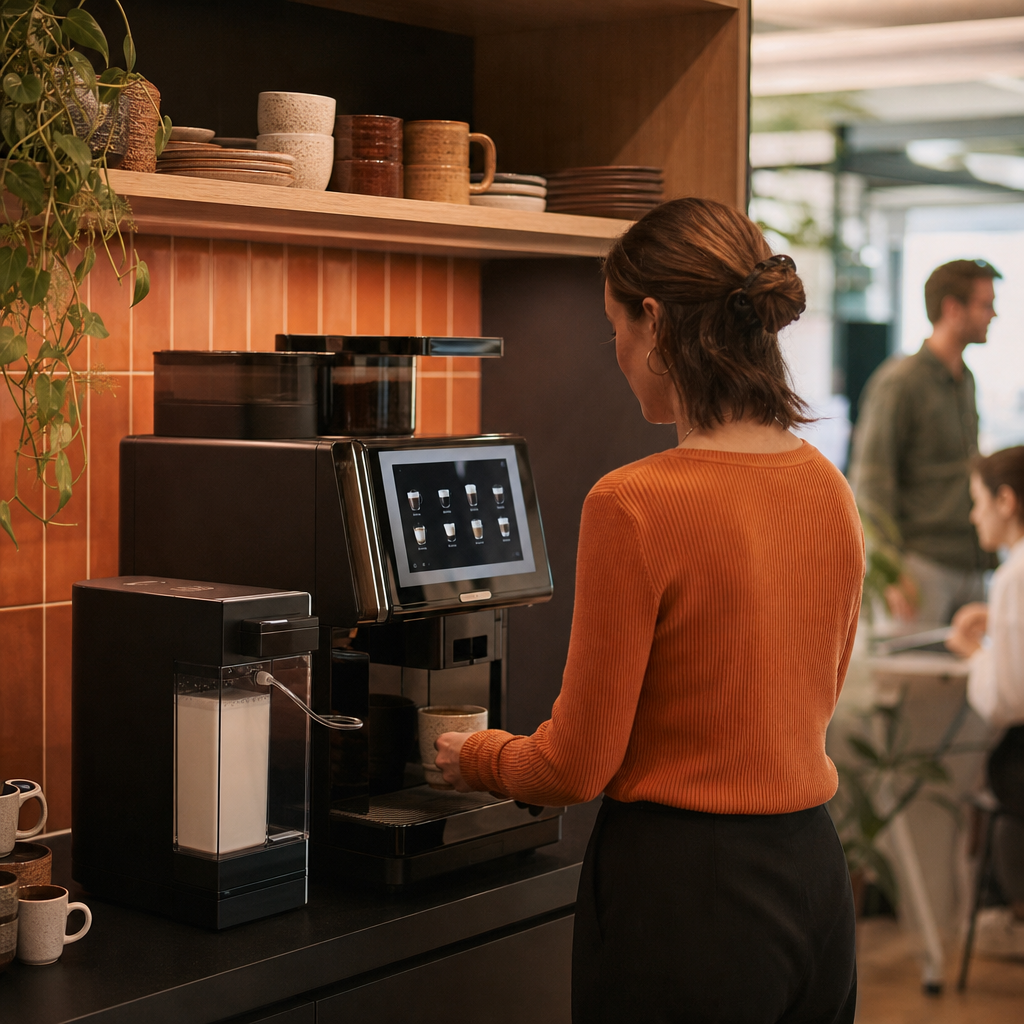
The essential office coffee machine features are consistent drink quality, useful beverage customisation, a practical milk system, sufficient peak-hour capacity, simple cleaning, durable components and responsive servicing. Australian businesses should match these features to actual team behaviour, available space and operational support, rather than buying the machine with the longest specification list.
A commercial coffee machine affects more than the quality of the morning flat white. The wrong machine creates queues, cleaning problems, inconsistent drinks and repeated service calls. The right one makes café-quality coffee practical for the people using it every day.
I have focused exclusively on Melbourne workplace coffee since 2008. This guide explains how I assess commercial espresso machine features, where specifications can mislead buyers and which operational details matter after installation.
Key takeaways
- Match capacity to peak demand, not simply the total number of employees.
- Prioritise repeatable coffee settings over a long menu nobody will use.
- Choose a milk system based on drink preferences, cleaning responsibility and required speed.
- Treat daily cleaning and scheduled servicing as part of the machine specification.
- Check plumbing, power, drainage and bench space before approving a model.
- Assess the supplier's accountability alongside the machine's durability and connectivity.
Boutique Coffee at Work: service snapshot
The figures below come from Boutique Coffee at Work's internal active-client records and operating data as of 2026.
| 200+ active clients | 5+ year average relationship | 24-hour typical service response | 400+ people at the largest installed workplace |
|---|---|---|---|
| Melbourne workplaces currently renting | Across the active client base | Across active service calls | Single large-office installation |
Summary table: office coffee machine features to compare
| Feature | What to assess | Why it matters | Common buying mistake |
|---|---|---|---|
| Drink customisation | Strength, volume, grind, temperature and saved recipes | Keeps drinks consistent while supporting different preferences | Choosing dozens of recipes without checking whether staff will use them |
| Milk system | Fresh milk, powdered milk, manual steaming and cleaning cycle | Affects taste, speed, hygiene and staff effort | Selecting on taste alone and ignoring daily cleaning |
| Capacity | Peak demand, grinder speed, boiler recovery, waste capacity and refill frequency | Prevents queues and premature wear | Sizing from headcount alone |
| User interface | Clear labels, one-touch drinks and permission controls | Reduces errors and dependence on trained operators | Buying a complicated café machine for an unattended kitchen |
| Cleaning | Guided rinsing, removable parts and accessible waste trays | Protects drink quality and machine reliability | Assuming automatic cleaning means no human involvement |
| Connectivity | Usage data, alerts, fault reporting and remote settings | Can support replenishment and fault diagnosis | Paying for telemetry without defining who will monitor it |
| Efficiency | Standby controls, insulation, warm-up behaviour and consumable waste | Reduces unnecessary operating demand | Comparing headline power ratings without studying real usage |
| Service model | Preventive maintenance, response process, parts and direct support | Determines how quickly the workplace recovers from a fault | Treating servicing as separate from the machine decision |
Customisation and beverage range
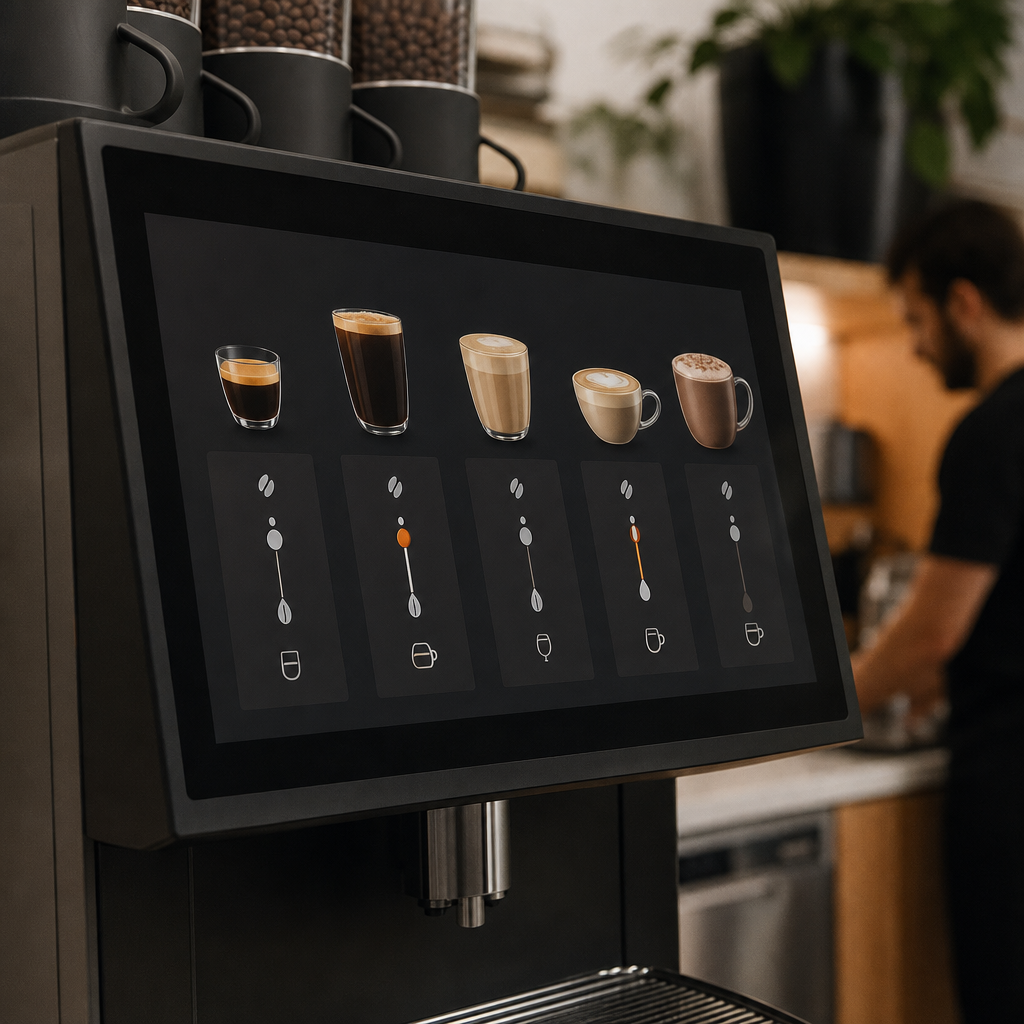
The most useful customisation features control coffee strength, drink volume, milk ratio, temperature and recipe access without making the interface confusing. A workplace machine should produce the drinks the team actually orders, consistently and with minimal training. More menu options are only valuable when they reflect real preferences and remain easy to maintain.
Start with drinking behaviour, not the brochure
Before comparing models, find out what people drink. A team dominated by flat whites and cappuccinos needs different equipment from one that mostly drinks long blacks. Decaffeinated demand, hot chocolate use and alternative milk preferences also affect the setup.
A practical needs review should establish:
- which drinks are ordered most often
- whether users prefer mild, medium or stronger coffee
- how often milk-based drinks are made
- whether separate decaffeinated coffee is required
- whether hot water or hot chocolate is important
- who will adjust recipes when feedback changes
This is the basis of our Curated Coffee Plan. We ask about espresso and milk-based preferences, choose a suitable starting blend, then adjust it from team feedback within the first month. The beans, grinder and programmed recipe must work together. A premium machine cannot rescue stale beans or a poorly adjusted grind.
You can review Boutique Coffee's available workplace coffee options, but the blend should still be chosen on purpose for the team.
Which settings should be adjustable?
For a fully automatic machine, useful controls include dose, grinder setting, water volume, milk quantity and drink sequence. Some models also allow separate temperature settings or user profiles. The important question is whether these settings can be locked after commissioning.
Open access can create inconsistency. One person increases the dose, another changes the volume, and the next coffee tastes completely different. Administrator controls let the supplier or workplace coordinator preserve core recipes while leaving simple choices, such as strength, available to users.
A traditional commercial espresso machine offers much deeper manual control. That control is valuable in a staffed café because a trained operator can adjust the grind, dose and extraction throughout the day. In an unattended office, it often creates unnecessary variability. Skill-dependent equipment only performs well when the relevant skill is consistently available.
Beverage range should remain operationally realistic
A screen containing an extensive drink catalogue may look impressive during a demonstration. It can also slow decisions, complicate cleaning and create ingredient waste. I would rather configure a shorter menu that produces the office favourites properly.
Consider how every additional drink is made. A chocolate beverage may require a powder hopper, manual addition or separate dispenser. Alternative milk may need to be added manually to avoid cross-contact and cleaning complications. Decaffeinated coffee may require a second grinder, a bypass chute or an entirely separate process.
Ask the supplier to demonstrate the complete workflow, not just the final cup. Watch how beans are changed, milk is connected, recipes are selected and waste is emptied. A feature is only useful if the team can operate it on a busy morning.
Real case study: correcting a poor fit in a Melbourne office
A mid-size Melbourne office had an existing coffee setup that was not meeting staff expectations. We changed it to a WMF commercial machine and included installation, drink setup, training and ongoing service within the rental arrangement.
The improvement was not based on adding novelty drinks. The value came from easy daily operation, dependable recipes and coffee and hot chocolate that the team genuinely enjoyed. The site manager's feedback was that use remained simple and service stayed consistent over the following years.
Client testimonial, paraphrased from supplied feedback: The site manager reported that staff appreciated having great coffee, while the machine remained easy to use and the coffee and hot chocolate quality stayed consistent.
That outcome illustrates a key attribute of an office coffee machine: repeatability matters more than theoretical capability.
Milk system innovations
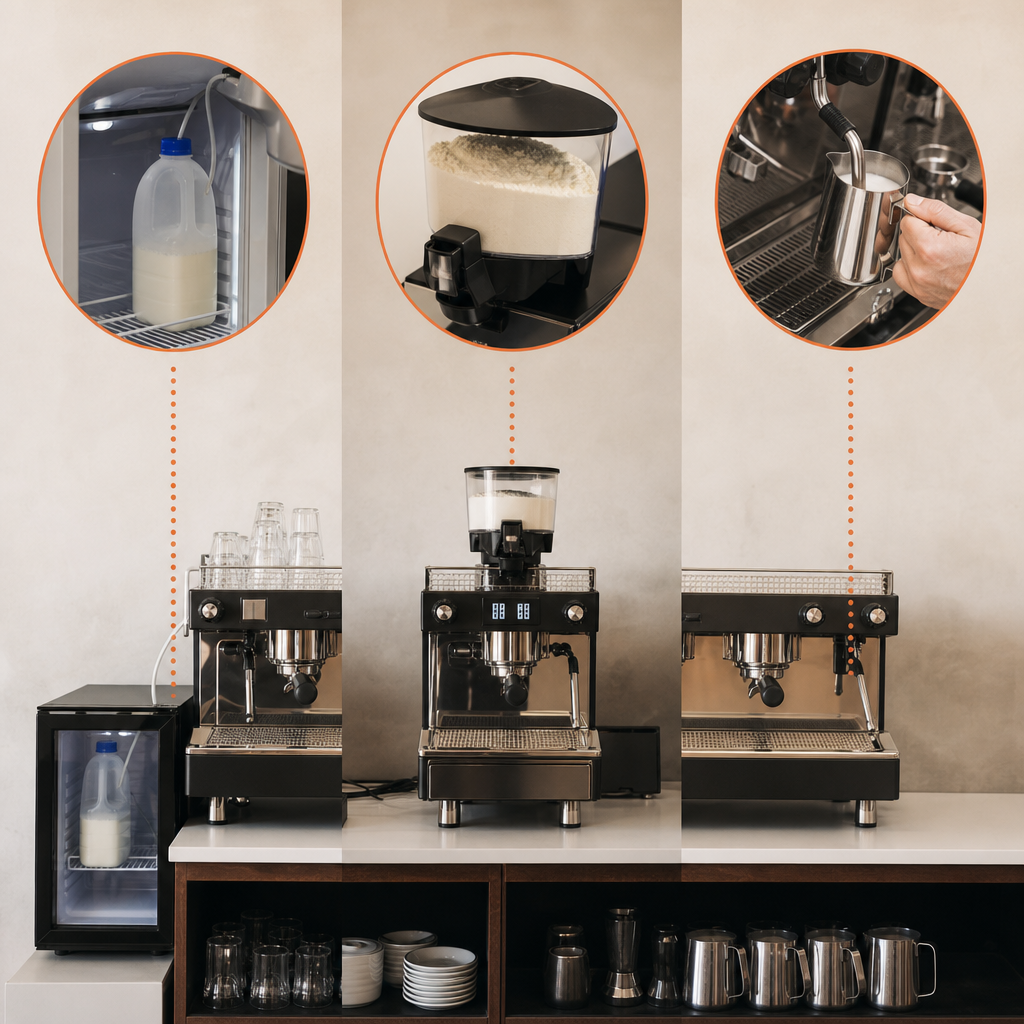
The right milk system balances drink quality, serving speed, refrigeration and cleaning effort. Fresh-milk systems generally suit workplaces that value café-style drinks, while powdered systems favour simplicity and storage convenience. Manual steam wands provide control but require skill. The best choice depends on who prepares drinks and who accepts responsibility for cleaning.
Fresh milk systems
Fresh milk can produce the familiar texture expected in Melbourne cafés when the machine is correctly configured. Fully automatic systems draw milk from a refrigerated container, heat or texture it, then dispense it into the cup according to the programmed recipe.
When comparing fresh-milk machines, examine:
- whether refrigeration is built in or separate
- how the milk hose and connectors are removed
- whether the machine prompts each cleaning stage
- whether milk and coffee can dispense together
- how different milk types would be managed
- how easily staff can see remaining milk
The hidden issue is ownership. Someone must refill the container, return milk to refrigeration where required and complete the cleaning process. An automatic rinse is not necessarily a complete clean. Buyers should ask the supplier to show every part that contacts milk and explain what happens daily.
Food Standards Australia New Zealand provides general cleaning and sanitising guidance. Workplace procedures should also follow the machine manufacturer's instructions and any applicable food safety obligations.
Powdered milk systems
Powdered systems avoid fresh-milk refrigeration and can be simpler to replenish. They may suit sites where unattended availability and straightforward storage take priority over café-style milk texture.
The trade-off is the cup result. The flavour and mouthfeel differ from fresh milk, which can be noticeable in a workplace surrounded by good cafés. Powder also creates its own cleaning requirements. Hoppers, mixing bowls and dispensing paths must remain dry and clean to avoid clumping and inconsistent delivery.
Do not assume powdered means maintenance-free. It changes the maintenance task rather than removing it.
Manual steam wands
A steam wand gives a capable operator control over milk texture and temperature. It also introduces training, wiping, purging and supervision requirements. In a workplace kitchen, those steps are often performed inconsistently.
A manual system can work where there is a staffed hospitality area or a small group of confident users. It is usually a poor fit for a large self-service office. The result depends too heavily on technique, and the wand needs attention after each use.
Alternative milk and cross-contact
Alternative milk demand should be discussed before installation. A machine with one automatic milk path may not support several milk types without flushing, changing containers or using separate equipment. Users may also have allergy or dietary concerns that require a documented workplace process.
The practical options include dedicating the automatic system to the most common milk, providing separate chilled alternatives for manual use or selecting equipment with independent milk pathways. The correct approach depends on demand and risk. Do not promise complete separation unless the equipment and operating procedure genuinely provide it.
Capacity and speed
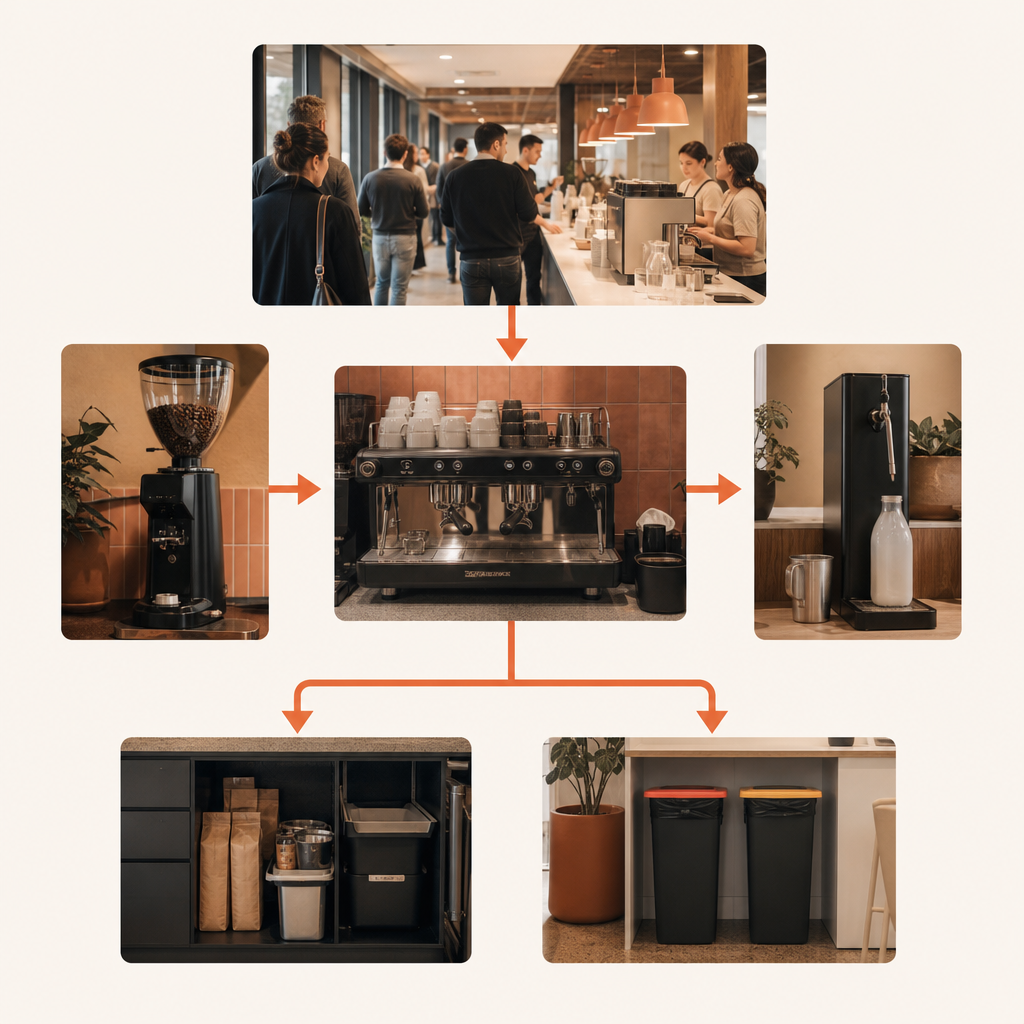
Office coffee machine capacity should be calculated from drinks required during the busiest period, drink mix and refill workload. Total headcount alone is not enough. Boiler recovery, grinder output, simultaneous dispensing, bean storage, milk storage, waste capacity and cleaning interruptions collectively determine whether the machine can keep up without excessive queues or wear.
Measure the peak window
Imagine two offices with the same headcount. One has flexible start times and steady coffee use. The other has most employees arriving together before a regular meeting. Their daily totals may be similar, but the second office places far greater pressure on the machine.
Ask these questions before accepting a capacity recommendation:
- When does the largest queue form?
- How many people usually want coffee at once?
- Are most drinks espresso-based or milk-based?
- Does the machine need to serve visitors as well as staff?
- Who refills beans, milk and chocolate during busy periods?
- Is a second dispensing point more useful than one larger machine?
A supplier should translate those answers into a realistic shortlist. Published output figures can help compare machines, but they are rarely the whole answer. Test conditions may not reflect large milk drinks, user hesitation, refilling or rinse cycles.
Understand the components behind speed
A fast interface does not guarantee fast delivery. Look at the complete brewing path:
Grinder capacity: The grinder must dose consistently under repeated use. A second grinder can support decaffeinated coffee or another blend, although it adds cost and cleaning.
Brewing system: The brew unit must handle the expected workload without losing consistency. Its rated capability should align with the supplier's recommended duty cycle.
Heating and recovery: Milk drinks place different demand on heating systems than espresso. Ask the supplier to demonstrate repeated preparation of the team's most common drink.
Simultaneous functions: Some machines can prepare coffee and milk at the same time. Others perform each step sequentially. This changes real queue speed.
Hopper and waste capacity: A machine that brews quickly but repeatedly stops for beans, water or waste is not operationally fast.
Plumbed versus tank-fed machines
A plumbed connection removes routine water refilling and usually makes sense for busier workplaces. It requires a suitable water point, drainage arrangement and professional installation. Water treatment may also be necessary to protect taste and internal components.
A tank-fed machine offers placement flexibility but someone must keep it filled. The filled tank also needs to be handled safely, and repeated empty-tank interruptions can frustrate users. For a smaller office without convenient plumbing, that compromise may still be sensible.
This decision should be made after inspecting the site. Guessing from photos can miss cabinet access, drainage fall, power location and the clearance needed to refill or service the machine.
Do not oversize as a substitute for planning
Upselling a machine for hypothetical future growth is common. I take the opposite view. The right model fits the team that will use it, with reasonable allowance for known change. An oversized machine consumes bench space and budget without necessarily improving the coffee.
Our field position is deliberately direct: a small team does not need a high-cost machine designed for a major site, while a large workplace will quickly expose equipment built for domestic demand. Honest sizing protects reliability and the relationship.
Boutique Coffee at Work has installed for workplaces ranging up to more than 400 people, according to our 2026 client records. At that scale, placement, redundancy and servicing are just as important as nominal machine output.
Ease of use and maintenance
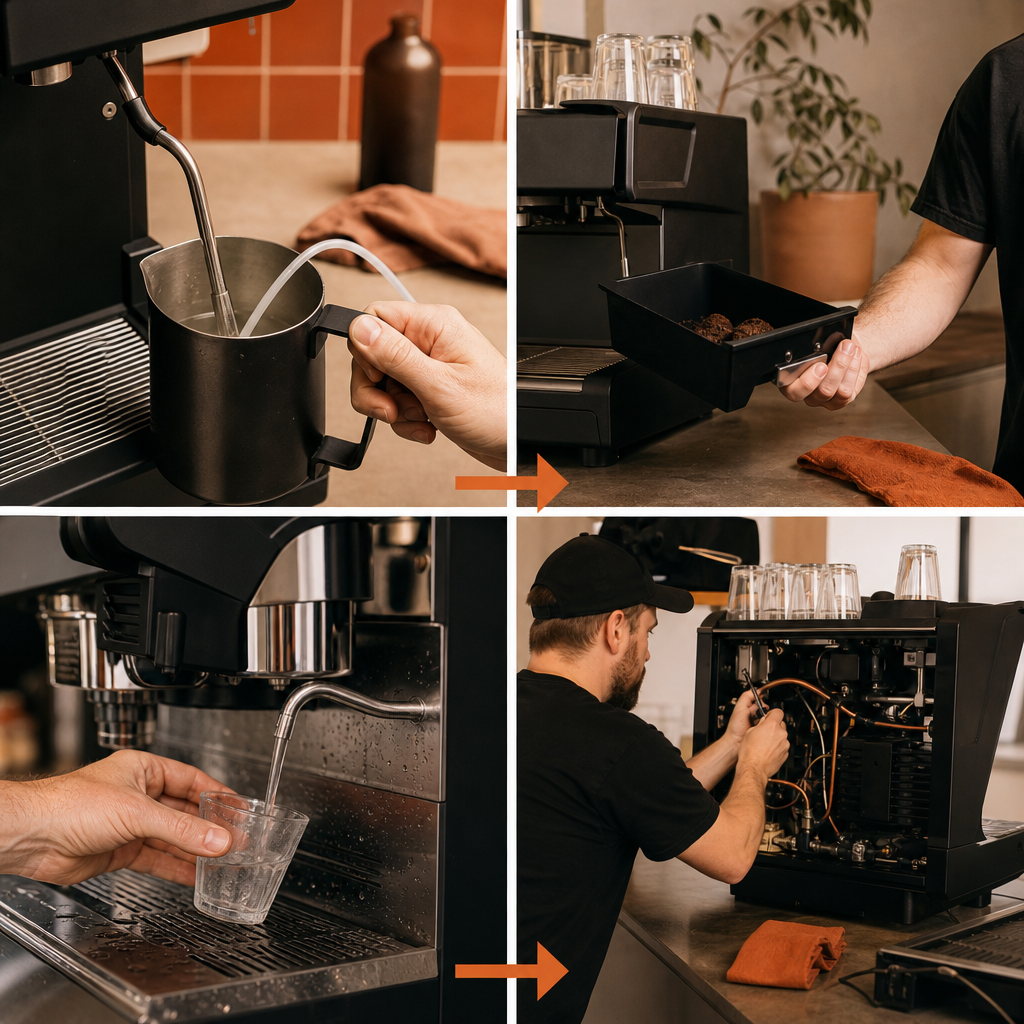
An office coffee machine should guide untrained users through drink selection, refilling and routine cleaning without allowing accidental changes to core settings. Maintenance must be divided clearly between staff and supplier. If daily tasks are confusing, inaccessible or easy to postpone, drink quality and reliability will deteriorate regardless of the machine's purchase price.
The interface must suit self-service use
A workplace interface should use recognisable drink names, clear prompts and a short path from selection to cup. Touchscreens can make instructions easier to display, but screen size alone says little about usability.
During a demonstration, ask someone unfamiliar with the machine to make a drink. Watch where they hesitate. Check whether the screen explains an empty hopper, full waste bin or required rinse in plain language. Confirm that administrator menus cannot be opened accidentally.
Physical details matter too. Cup clearance should suit the mugs used in the office. Drip trays and waste containers should be removable without spilling. Bean hoppers should be reachable without climbing or moving the machine.
Accessibility also deserves consideration. Screen height, visual clarity, reach and the force needed to remove components affect who can use the machine independently. Assess these points in the actual kitchen, not only in a showroom.
Automatic cleaning does not mean no cleaning
Most commercial automatic machines include rinse or cleaning programmes. These programmes improve consistency, but they still require human action. A user may need to add cleaning product, connect a milk hose, empty a tray or confirm each stage.
Ask for a written division of responsibility:
| Task type | Workplace responsibility | Supplier responsibility |
|---|---|---|
| Routine operation | Refill ingredients, empty waste and respond to prompts | Provide training and operating instructions |
| Daily cleaning | Complete the manufacturer's required user cycle | Configure the process and explain it clearly |
| Preventive maintenance | Provide access and report changes in performance | Inspect, service and replace scheduled components |
| Fault response | Record the message and contact support | Diagnose, attend and restore operation |
| Recipe quality | Report taste or volume concerns | Adjust grind, recipes and ingredients where required |
This table contains no universal maintenance interval because intervals differ by machine, water conditions and workload. The manufacturer's schedule and the supplier's site-specific plan should control the programme.
Cleaning features worth checking
Look for guided on-screen instructions, removable milk components, an accessible brew area, automatic rinse functions and cleaning prompts that cannot be ignored indefinitely. Confirm the availability and ongoing cost of approved cleaning products.
Inspect the design for hidden effort. A waste bin may be large but awkward to remove beneath a low shelf. A milk container may fit the refrigerator yet be difficult to wash. A machine may claim self-cleaning while still requiring several small parts to be dismantled.
The best test is to perform the complete end-of-day process during the demonstration. Time is not the only concern. Count the decisions, loose parts and opportunities to complete a step incorrectly.
Installation and training prevent avoidable faults
The machine should not arrive as a boxed appliance left for the office manager. Correct installation includes checking power, plumbing, drainage, ventilation, bench strength and access. The grinder then needs to be dialled in for the beans and recipes tested in the cups the workplace uses.
Our Six-Step Process records the practical sequence used for new Melbourne clients. According to Boutique Coffee at Work's operating process, it is designed to take most clients from first contact to installation in 5-7 business days:
- Enquiry, with basic team details submitted in about 2 minutes.
- A 15-20 minute phone call with me to discuss a shortlist and rough pricing.
- A 30-minute site visit to assess power, plumbing and bench space.
- A 45-minute installation, including connection, grinder adjustment and shot testing.
- A 20-minute first brew and training session, with at least two staff trained and a cheat sheet left onsite.
- An ongoing weekly or fortnightly service rhythm, including beans and consumables.
These timings are Boutique Coffee at Work's own process estimates, not universal industry benchmarks. Site access and installation requirements can change them.
Safe Work Australia's model code on managing risks of plant in the workplace provides broader guidance relevant to installing, using and maintaining workplace equipment.
Reliability, connectivity and efficiency
Reliability depends on correct sizing, commercial-grade construction, water management, preventive servicing and access to parts. Energy controls and remote connectivity can improve operation, but neither compensates for poor maintenance. Businesses should compare the complete support arrangement, expected consumables and fault process rather than treating durability as a brand claim printed on a specification sheet.
What commercial-grade durability looks like
The term commercial is used loosely. A machine intended for repeated workplace demand should have a duty recommendation appropriate to the site, serviceable internal components and parts support from an established supplier.
Ask what happens when a grinder, valve, seal or display fails. Can the supplier diagnose it? Are common parts held locally? Is labour included in the rental or service plan? Is a replacement machine available when repair cannot be completed promptly?
Materials matter, but visible metal does not prove internal durability. A polished exterior may surround components designed for lighter demand. Conversely, a practical automatic machine may look understated while being easier to service. Examine the intended workload and maintenance model, not just external finish.
Energy efficiency needs operational context
Compare standby modes, scheduled shutdown, boiler insulation, warm-up behaviour and the ability to disable unused functions. A machine that remains fully heated outside working hours can consume energy without producing value.
The Australian Government's standby power guidance explains the broader issue of electricity used while products are not performing their primary function. For a workplace machine, the practical response is to configure energy-saving settings around actual office hours while allowing adequate start-up time.
Do not compare efficiency using headline wattage alone. Maximum input describes an electrical requirement, not total workplace consumption. Usage patterns, heating design, shutdown settings and drink mix all affect the result.
Efficiency also includes consumables. Oversized hoppers can leave beans exposed for too long. Poorly configured milk quantities create waste. Unnecessary rinsing into a small tray increases emptying. Correct setup often removes more waste than an impressive environmental claim.
Connectivity should solve a defined problem
Connected machines may provide fault alerts, usage reporting, recipe management or replenishment data. These tools can help when someone actively monitors them. They add little if alerts enter an unattended dashboard.
Before paying for connectivity, ask:
- What information does the machine collect?
- Who receives and acts on alerts?
- Can faults be diagnosed remotely?
- Can settings be changed without local approval?
- How is the machine connected to the workplace network?
- What happens if connectivity is unavailable?
- How are software updates handled?
If usage data can be linked to identifiable users, privacy implications may arise. The Office of the Australian Information Commissioner provides guidance on privacy and business. In many offices, aggregated machine-level reporting is enough. There is rarely a sound operational reason to track an individual's coffee choices.
Real case study: preventing peak-hour disruption
A busy Melbourne workplace was experiencing serious disruption whenever its coffee machine failed during peak office hours. The problem was not a missing beverage button. It was unreliable availability and a support path that did not protect the coffee moments that mattered.
We provided a correctly maintained machine, scheduled servicing and direct personal contact for issues. The client's feedback was that regular, reliable service kept coffee available when the team needed it and removed the havoc caused by breakdowns.
The machine feature that mattered most was serviceability supported by accountability. Preventive visits identified routine needs, while direct contact reduced the delay between reporting a problem and acting on it.
Across Boutique Coffee at Work's active client base, the typical service-call response time is 24 hours, based on the business's 2026 operating data. That result comes from keeping responsibility close to the client rather than routing each fault through several departments.
The most overlooked feature is supplier accountability
A machine cannot organise its own maintenance, interpret every fault or make sure beans arrive before they run out. The overlooked feature is the operating model around it. My view is simple: one person should remain accountable from site assessment through installation, recipe setup, supply and ongoing service. Hardware and responsibility must be assessed together.
Most comparison pages separate equipment features from supplier behaviour. I do not. If your support request enters a call centre, moves through a ticket system and reaches someone unfamiliar with the site, a theoretically repairable fault can still create prolonged disruption.
Our model is one number, one person. Many minor problems can be discussed quickly when the person answering already knows the machine, layout and history. When an onsite visit is required, there is no corporate runaround before it can be organised.
This is also why I do not support overselling. Boutique Coffee at Work recommends the machine that fits the actual team, even when the cheaper model is the honest answer. The business's 2026 records show more than 200 active Melbourne workplace rentals and an average active-client relationship exceeding 5 years. Long relationships are built by correct fit and reliable follow-through.
Service terms reveal supplier confidence
Long contracts can make a poor machine or service arrangement expensive to escape. Our rentals are month-to-month, with one month's notice and free machine pickup. No lock-in, ever.
That approach has remained viable throughout the business's 17 years of exclusive workplace coffee operation, based on Boutique Coffee at Work's 2026 company profile. Clients should remain because the machine, coffee and service continue to work, not because an exit clause makes leaving difficult.
When comparing rental arrangements, examine:
- minimum term and notice requirements
- installation and removal charges
- inclusions for labour, parts and scheduled servicing
- required bean or consumable purchases
- responsibility for accidental damage
- replacement arrangements during major repairs
- price review clauses
- ownership of connected-machine data
The ACCC publishes guidance on unfair contract terms. Businesses should read proposed terms carefully and obtain professional advice when obligations or exit costs are unclear.
Calculate operational fit, not just machine cost
Purchase price or monthly rental is only one part of the decision. Include beans, milk handling, chocolate, cleaning products, filters, servicing, parts, staff time and likely disruption when the machine is unavailable.
A lower-priced machine may be poor value if staff regularly refill it, clean a complicated milk path or wait for repairs. A more capable machine may also be wasteful when a smaller option would handle actual demand. Total cost should be evaluated against the workplace process it creates.
The useful question is not, "Which machine has the most features?" It is, "Which setup will reliably produce the drinks our team wants, with the least avoidable work and disruption?"
How to choose your office coffee machine
Choose by documenting drink preferences, peak demand, site constraints, cleaning ownership and support expectations before comparing models. Then test shortlisted machines using realistic drinks and cups. A site inspection should confirm power, water, drainage, ventilation and access. Finalise the service arrangement only when responsibilities, response paths and exit terms are clear.
Use this practical evaluation sequence:
- Profile the team by preferred drinks, milk use and likely peak periods.
- Decide whether fully automatic or operator-controlled equipment suits the workplace.
- Inspect the proposed location and confirm utilities, clearance and workflow.
- Compare a short list based on realistic output and maintenance effort.
- Make the team's common drinks during the demonstration.
- Perform or observe the complete cleaning process.
- Confirm servicing, consumables, fault response and replacement arrangements in writing.
- Review rental or purchase terms, including exit conditions.
- Train more than one staff member at installation.
- Review recipes and bean choice after the team has used the machine.
Boutique Coffee at Work provides workplace coffee solutions designed around team size, culture and budget. Melbourne businesses can also arrange a free workplace trial before committing to a setup.
If you want a practical recommendation rather than an oversized specification list, contact Boutique Coffee at Work. We will assess your team, kitchen and coffee preferences, then tell you honestly whether we are the right fit.
References
These sources support the article's guidance on cleaning, workplace equipment, standby energy, privacy and contract terms. Machine capacity, cleaning procedures and installation requirements still vary by model and site. Manufacturer instructions, a physical site assessment and written supplier responsibilities should take precedence when they are more specific to the selected equipment.
- Food Standards Australia New Zealand: Cleaning and sanitising
- Safe Work Australia: Model Code of Practice, Managing risks of plant in the workplace
- Australian Government Energy Rating: Standby power
- Office of the Australian Information Commissioner: Privacy and your business
- Australian Competition and Consumer Commission: Unfair contract terms
FAQ_SCHEMA_JSON
Frequently asked questions
What are the must-have office coffee machine features?
The must-have features are consistent brewing, adjustable drink recipes, a milk system suited to the team, adequate peak capacity, intuitive controls, guided cleaning and commercial serviceability. Energy-saving settings and useful fault alerts are also valuable. The supplier should provide installation, training, preventive servicing and a clear response process.
How do I choose the right capacity for an office coffee machine?
Assess how many drinks are required during the busiest period, which drinks take longest and how often ingredients or waste containers need attention. Do not size from total headcount alone. Ask the supplier to demonstrate repeated preparation of your team's most common drinks and confirm that the model suits the intended workload.
Is a fully automatic machine better than a traditional espresso machine for an office?
A fully automatic machine is usually more practical for an unattended office because it produces repeatable drinks with limited training. A traditional espresso machine can deliver excellent results when a skilled operator controls grinding, extraction and milk texturing. Without that skill, its additional control often creates inconsistency and more cleaning work.
Should an office coffee machine be plumbed in?
A plumbed machine is generally preferable where demand is steady and a suitable water and drainage connection is available. It removes manual water refilling and reduces interruptions. A tank-fed machine may suit a smaller workplace or restricted site, but somebody must monitor, refill and clean the water container.
How often does a commercial office coffee machine need cleaning?
Cleaning frequency and tasks depend on the model, milk system, workload and manufacturer's instructions. User cleaning may include rinsing, milk-path cleaning, emptying waste and washing removable parts. Preventive servicing remains a separate supplier responsibility. Ask for a written schedule that identifies each task, responsible person and required cleaning product.
Is it better to rent or buy an office coffee machine?
Renting can bundle installation, servicing and ongoing support while avoiding a large equipment purchase. Buying may suit an organisation prepared to manage maintenance, parts and replacement risk. Compare total operating obligations, not only monthly cost. Check the rental term, inclusions, exit notice and machine pickup conditions before signing.

Chris
Chris
Keep reading
Service coverage and delivery areas
Boutique Coffee supplies, installs and services commercial workplace coffee machines across Melbourne. Coverage includes machine rental, installation, staff…
Commercial Coffee Machine Service Contracts & Warranties: Protecting Your Australian Investment
An office coffee machine service contract should define maintenance, repairs, call-outs, parts, response targets and supplier responsibilities. A commercial…
How to Choose an Office Coffee Machine: A Step-by-Step Guide for Australian Businesses
To choose an office coffee machine, assess daily drink demand, peak usage, preferred drinks, available space, plumbing and staff expectations. Then compare…