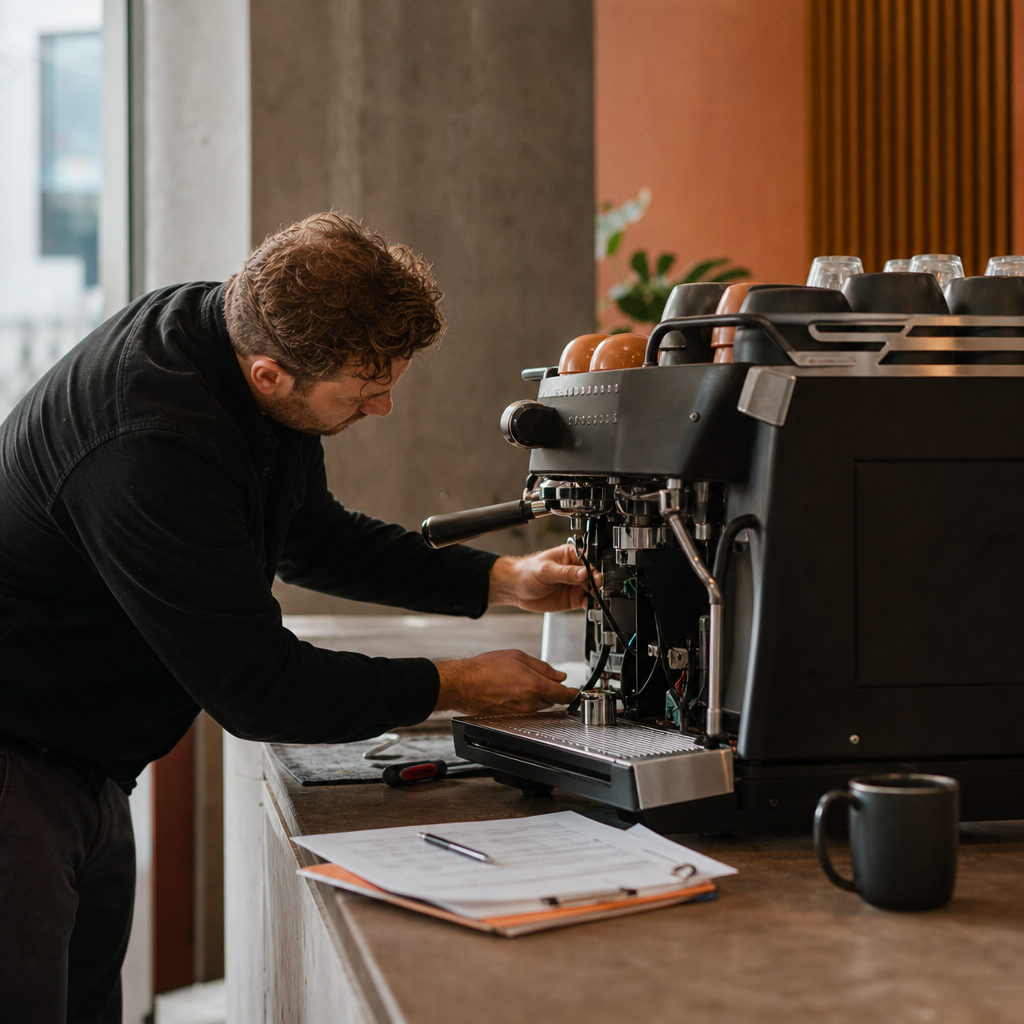
An office coffee machine service contract should define maintenance, repairs, call-outs, parts, response targets and supplier responsibilities. A commercial warranty covers eligible equipment faults, but rarely covers every service need. Australian businesses should assess both documents together, because reliable coffee depends on preventative care and accountable local support, not warranty wording alone.
A commercial coffee machine is used repeatedly by people with different skill levels. Beans, milk residue, water quality, grinder settings and cleaning habits all affect its performance. When something fails, the practical question is not simply whether the machine has a warranty. It is who will respond, what they will do and what the interruption will cost your workplace.
At Boutique Coffee at Work, our position is straightforward. The machine, coffee supply and service model must be designed as one operating system. That is how café-quality coffee becomes practical inside a Melbourne workplace.
Boutique Coffee at Work service snapshot
| Measure | Boutique Coffee at Work data | Source |
|---|---|---|
| Active Melbourne workplace clients renting | 200+ | Boutique Coffee at Work client records, 2026 |
| Average active client relationship | 5+ years | Boutique Coffee at Work active client base, 2026 |
| Typical response time for a service call | 24 hours | Boutique Coffee at Work service records, 2026 |
| Largest team supported at one site | 400+ people | Boutique Coffee at Work installation records, 2026 |
| Specialist operating history | 17 years | Boutique Coffee at Work business records, 2026 |
Key takeaways
- A warranty and a service agreement solve different problems. You usually need to assess both.
- The agreement should clearly allocate maintenance, cleaning, call-outs, labour, parts and consumable responsibilities.
- Preventative maintenance protects coffee quality as well as machine reliability.
- Response time means little unless the agreement also identifies who takes ownership of the issue.
- Machine selection must reflect actual team size, drink demand and site conditions.
- Month-to-month support can provide stronger accountability than a long lock-in contract.
Summary table
| Area | What it should address | Main risk if unclear |
|---|---|---|
| Manufacturer or supplier warranty | Eligible defects, exclusions, claim process and warranty period | Assuming every breakdown is covered |
| Preventative maintenance | Scheduled inspection, cleaning, calibration and wear assessment | Gradual decline in quality and reliability |
| Reactive repairs | Fault diagnosis, labour, parts and technician attendance | Unexpected invoices or prolonged downtime |
| Emergency call-outs | Contact method, response target and escalation responsibility | Nobody owns an urgent problem |
| Consumables | Beans, chocolate, cleaning products, filters and delivery | Stock shortages or inconsistent care |
| Staff training | Daily cleaning, correct use and basic troubleshooting | Avoidable faults and poor coffee |
| Exit terms | Notice, collection, outstanding charges and equipment condition | Being trapped in an unsuitable arrangement |
Understanding office coffee machine service contracts
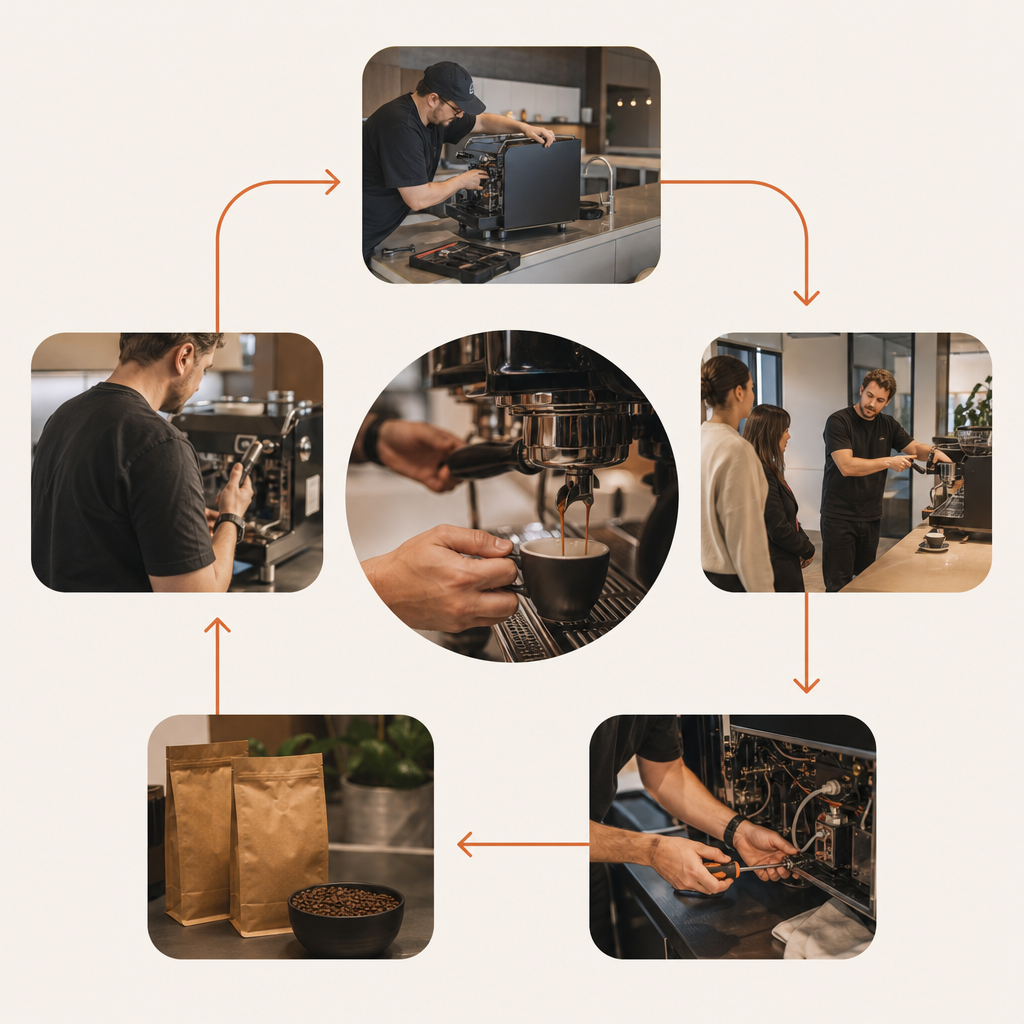
An office coffee machine service contract sets out how the equipment will be maintained and supported after installation. It should explain scheduled servicing, breakdown response, labour, replacement parts, cleaning responsibilities, consumables and exclusions. The strongest agreement also names an accountable contact, rather than sending every fault into an anonymous support queue.
A service contract may sit alongside a purchase, finance arrangement or rental. It does not need to be a long fixed-term commitment. Boutique Coffee at Work rentals are month-to-month, with one month's notice to exit and free machine pickup. The support obligations still need to be clear even when the commercial arrangement is flexible.
What a commercial espresso machine service agreement usually covers
A useful agreement should address the machine throughout its working life, not only when it stops completely. Look for clear language covering:
- Installation and commissioning
- Grinder setup and coffee calibration
- Planned preventative maintenance
- Fault diagnosis and repair labour
- Parts included or charged separately
- Technician travel and call-out fees
- Water filtration responsibilities
- Cleaning products and consumables
- Staff training and operating instructions
- Remote troubleshooting
- Response targets for urgent faults
- Temporary or replacement equipment, where offered
- Conditions that can invalidate support
- Notice and equipment collection terms
The agreement should also define who performs each task. Daily cleaning may remain the workplace's responsibility, while internal maintenance and repairs sit with the supplier. If that boundary is vague, each side can assume the other is handling an important task.
The difference between a service contract and a coffee supply arrangement
Coffee supply and equipment support are related, but they are not identical. A bean delivery plan may only cover scheduled product deliveries. A service agreement may only cover the machine. An integrated rental can combine equipment, installation, coffee supply, training and ongoing care.
Read the inclusions rather than relying on labels such as "fully managed" or "all-inclusive". Ask whether the quoted price includes technician attendance, labour and routine parts. Confirm how coffee and cleaning products are replenished. Check whether delivery quantities can change as workplace attendance changes.
Our workplace coffee solutions are based on matching the whole setup to the team. A machine chosen in isolation can be technically impressive and still be wrong for the office.
Installation should be part of the service conversation
Poor installation creates faults that no warranty wording can prevent. The supplier should inspect power, plumbing, drainage, bench space, access and expected usage before confirming the machine.
Boutique Coffee at Work uses the Six-Step Process for new Melbourne clients. According to our operating process, it includes a two-minute enquiry, a 15 to 20-minute call with Chris, a 30-minute site visit, a 45-minute installation and a 20-minute first-brew training session. Ongoing weekly or fortnightly visits then maintain supply and machine performance.
These timings are our own typical process, not a promise that every site will be identical. Difficult plumbing, building access or electrical work can change the installation plan. The important point is that those conditions are checked before the machine arrives.
Commercial coffee machine warranty essentials

A commercial coffee machine warranty generally covers specified faults in materials or manufacture, subject to its written conditions. It may exclude wear, misuse, poor cleaning, unsuitable water, unauthorised repairs and consumable parts. A warranty is therefore a limited fault remedy, not a complete maintenance programme or uptime guarantee.
The exact warranty depends on the machine, supplier and transaction. Never assume that a general statement such as "commercial warranty included" answers the practical questions. Request the complete terms before signing or paying.
What to confirm in a commercial warranty
Review the warranty for:
- The party providing the warranty
- The equipment and components covered
- When coverage begins
- Events that end or suspend coverage
- Labour and technician travel inclusions
- Freight or machine removal costs
- Requirements for authorised servicing
- Water treatment and cleaning conditions
- Wear-part and consumable exclusions
- Claim notification procedures
- Repair, replacement or refund remedies
- Whether business interruption is excluded
The party selling the machine, the manufacturer and the service provider may have different responsibilities. If the machine was imported, ask who holds parts locally and who is authorised to perform repairs. A warranty has limited practical value if nobody can diagnose the fault promptly.
Australian Consumer Law and business purchases
Australian Consumer Law consumer guarantees operate separately from an express warranty. According to the Australian Competition and Consumer Commission, a business can qualify as a consumer in certain transactions, including where goods or services cost less than $100,000. Other eligibility tests can also apply.
Consumer guarantees cannot simply be displaced by a manufacturer's written warranty. Depending on the transaction, goods must be of acceptable quality, match descriptions and be fit for disclosed purposes. Services must be provided with due care and skill and be fit for their stated purpose.
This does not mean every commercial machine problem creates an automatic right to a free repair. Eligibility, the nature of the fault, maintenance history and the seriousness of the failure all matter. Businesses should obtain legal advice for a disputed or high-value claim.
The ACCC also distinguishes consumer guarantees from voluntary warranties. A supplier should not present a written warranty as the limit of rights that Australian Consumer Law provides.
Common warranty exclusions that deserve attention
Water quality is a frequent source of disagreement. Scale, sediment and unsuitable filtration can damage boilers, valves and internal pathways. The agreement should identify the required filtration system, who changes filters and what records must be retained.
Cleaning is another common boundary. Milk systems, brew groups, grinders and waste containers require routine attention. If the supplier provides cleaning products and training, the workplace must still complete the assigned daily tasks. A warranty is unlikely to protect equipment from neglect.
Commercial usage conditions matter too. A machine intended for light workplace use may not be suitable for a busy office producing drinks continuously. Matching capacity to demand is part of protecting the warranty and the investment.
My view is blunt: a 12-person team does not need a $15,000 Eversys, while an 80-person team can overwhelm a home-grade Jura within a month. Those figures come from Boutique Coffee at Work's machine-matching experience and supplied business examples. Honest sizing is safer than either upselling or underspecifying.
Preventative maintenance versus reactive repairs
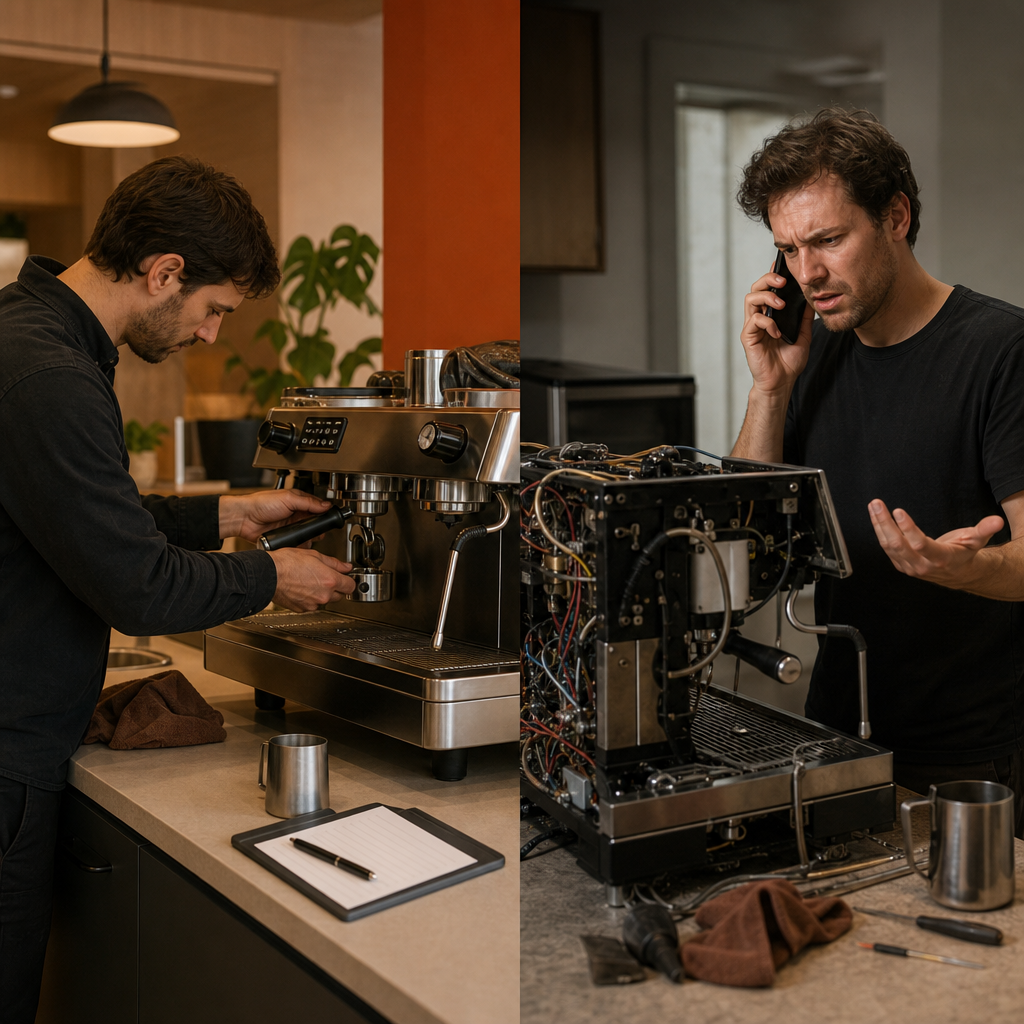
Preventative maintenance finds wear, contamination and calibration problems before they become disruptive failures. Reactive repair begins after a fault affects operation. Both are necessary, but relying on reactive work alone usually creates more downtime, less consistent coffee and greater uncertainty around repair costs and responsibility.
A coffee machine can continue dispensing drinks while its performance declines. Shots may run too quickly, milk temperature may vary, the grinder may drift, or scale may restrict flow. Staff often adjust their behaviour around these symptoms until the machine eventually stops.
What preventative maintenance should include
The exact work depends on the machine type and volume. A service visit may include:
- Reviewing fault logs and error messages
- Inspecting seals, valves and moving components
- Checking for leaks or unusual noises
- Cleaning internal coffee pathways
- Assessing the grinder and burr condition
- Dialling in the grinder and testing extraction
- Testing milk or chocolate systems
- Inspecting filters and water connections
- Confirming cleaning routines with staff
- Replenishing agreed beans and consumables
- Recording work completed and issues identified
Maintenance frequency should follow actual use, not a generic calendar alone. A large hybrid workplace can have concentrated demand on attendance days. A smaller office may make fewer coffees but neglect cleaning because responsibility is unclear.
Why coffee quality belongs in the maintenance plan
Reliability is not merely whether the machine turns on. The machine, grinder, beans, recipe and cleaning routine determine what lands in the cup.
Fresh beans will not compensate for an incorrectly set grinder. A premium machine will not produce consistent milk drinks through a dirty system. Preventative service should therefore include coffee testing, not only a mechanical inspection.
Boutique Coffee at Work uses a Curated Coffee Plan during onboarding. We ask about espresso and milk-based preferences, desired strength and dislikes. We select a suitable blend, then adjust it using team feedback during the first month. This process is based on our own operating model. It keeps the beans chosen on purpose rather than treated as a generic consumable.
Real Melbourne case study: replacing an unsuitable setup
A mid-size Melbourne office had an existing coffee setup that was not meeting the team's expectations. We installed a WMF commercial machine, connected it properly, trained staff and included ongoing service within the rental.
The improvement was broader than changing the equipment. Easy daily operation, consistent coffee and hot chocolate, and regular service made the setup dependable over the following years. The site manager told me that staff appreciated having good coffee. When they thanked him, he replied, "No problem, just keep doing what you're doing."
That comment is a useful workplace coffee testimonial because it captures the actual value. People notice when a daily amenity works well. Management does not need to manage the machine, and the supplier remains responsible for keeping it operating.
Reactive repair still needs a clear process
Even a well-maintained commercial machine can experience a fault. The agreement should explain what happens next:
- Which phone number the workplace calls
- What information staff should provide
- Whether remote troubleshooting happens first
- Who decides if a technician is required
- The stated response target
- What charges can apply
- Whether parts are carried locally
- What happens if the machine cannot be repaired immediately
Remote diagnosis is useful when handled by somebody who knows the site. A blocked waste tray, displaced component or cleaning alert may be resolved quickly over the phone. More serious faults need a technician, not repeated scripts from a call centre.
The value of comprehensive support
Comprehensive support protects workplace continuity by joining equipment, coffee, maintenance, training and fault response under clear ownership. Its value is not the length of the inclusions list. It is whether the responsible person understands the site, responds promptly and can make decisions without passing the client between departments.
This is where many service offers become weak. The sales contact disappears after installation. Support moves to a ticketing platform. The account manager cannot diagnose equipment. The technician knows the machine but not the original expectations.
Our model is "one number, one person". It is founder-led, always. The same accountable contact can understand the machine, bean supply, staff feedback and service history. According to Boutique Coffee at Work's active client records for 2026, our typical service-call response time is 24 hours.
Real Melbourne case study: avoiding peak-hour disruption
A busy Melbourne workplace was experiencing havoc when its coffee machine failed during peak office hours. The issue was not that coffee was the organisation's most critical system. The problem was that a popular shared amenity disappeared exactly when many people expected to use it.
We provided a reliably maintained machine, scheduled regular servicing and gave the workplace direct personal contact for faults. The client's workplace contact reported that dependable service meant the team had coffee when it mattered, without recurring disruption from an unmanaged breakdown.
The lesson is not that equipment never fails. No credible supplier should promise that. The lesson is that maintenance and direct ownership reduce uncertainty. Staff know whom to call, and the person answering already understands the setup.
Support should cover people, not only equipment
Office machines are shared by users with different habits. Staff change. New starters may never have seen the original training. Cleaning duties can quietly become nobody's responsibility.
A good supplier leaves practical instructions and retrains when necessary. At least two staff members are trained during Boutique Coffee at Work's installation process, according to our Six-Step Process. We also leave a cheat sheet. That creates basic internal coverage without expecting an office manager to become a coffee technician.
Support should also adapt when attendance, team size or drink preferences change. A supplier focused on long-term fit will review the setup rather than defend the original sale.
The commercial value of a coffee partner
The strongest support model removes small but repeated management tasks. Beans arrive before they run out. Filters are tracked. The grinder remains dialled in. Problems have a clear owner. Staff do not spend time searching for manuals or contacting multiple providers.
This is what I mean by a coffee partner, not a supplier. I am not trying to be the biggest. Boutique Coffee at Work remains Melbourne-only because direct responsibility is central to the service.
Our 2026 active client base includes more than 200 renting workplaces, with an average relationship of more than five years, according to our own client records. Those relationships are maintained without long lock-in terms. Retention by choice is a better test of support than retention through an exit penalty.
What to look for in an office coffee machine service agreement
Choose an agreement that makes responsibility, cost and response procedures easy to understand. Confirm machine suitability, maintenance scope, warranty interaction, exclusions, call-out terms, consumables, training and exit conditions. Then test the operating model by asking who personally owns a fault from the first call until the machine works again.
Start with machine fit
Ask the supplier to explain why the recommended machine suits your workplace. The answer should consider:
- Team size and attendance patterns
- Expected drinks during busy periods
- Espresso, milk and chocolate preferences
- Available plumbing and drainage
- Power and bench requirements
- Staff willingness to complete cleaning
- Desired drink customisation
- Planned workplace growth
- Accessibility and user experience
Avoid accepting a model recommendation based only on total headcount. Hybrid attendance can concentrate demand. Customer-facing sites may make drinks outside ordinary staff patterns. A site visit exposes these details.
You can review how Boutique Coffee at Work approaches installation and support before comparing proposals.
Make inclusions and exclusions specific
Words such as "regular servicing" are too vague on their own. Ask what triggers a visit, what work is completed and whether service records are provided. Confirm whether labour, travel and routine replacement parts are included.
Ask direct questions about exclusions:
- Is accidental damage charged separately?
- What happens if staff miss required cleaning?
- Who pays for water-related damage?
- Are grinder burrs, seals or filters treated as consumables?
- Does an after-hours request attract a different charge?
- Can another technician work on the machine without affecting coverage?
- What happens when a required part is unavailable?
The objective is not to eliminate every exclusion. Some exclusions are reasonable. The objective is to avoid discovering them only after a breakdown.
Examine the response commitment
A response commitment should distinguish acknowledgment, remote diagnosis and on-site attendance. An automated email is technically a response, but it does not restore coffee service.
Ask who answers the phone and whether that person can approve a visit. Ask where technicians and parts are based. Ask what information helps prioritise the issue. A supplier with no call centres and no corporate runaround can often make a faster practical decision because there is no internal escalation path.
Boutique Coffee at Work records a typical 24-hour response across its active client base in 2026. Site access, fault complexity and part availability can still affect final repair timing. A transparent supplier should explain those caveats rather than promise impossible uptime.
Read the exit terms before the inclusions
Long agreements can make a weak service model expensive to leave. Check the notice period, collection process, early termination fees, equipment condition requirements and treatment of unused consumables.
Our position is "no lock-in, ever". Rentals operate month-to-month, require one month's notice and include free machine pickup. In Boutique Coffee at Work's supplied operating history, that approach has not cost a client worth keeping. A supplier should earn the next month through fit and service.
Use a practical agreement checklist
Before approval, make sure you can answer each of these questions:
- Who owns the machine?
- Who provides the warranty?
- Who performs maintenance and repairs?
- Which parts and labour charges are included?
- What daily tasks belong to staff?
- What water filtration is required?
- Who replenishes beans and cleaning products?
- How is an urgent fault reported?
- What response has the supplier committed to?
- What happens if the machine remains unavailable?
- Can the plan adjust with team demand?
- How can the business leave the arrangement?
If the proposal does not answer these points, request written clarification. Verbal assurances are difficult to rely on when staff or account managers change.
Why accountability matters more than contract length
The best protection is not the longest warranty or service contract. It is a supplier structure that keeps one person accountable for equipment fit, installation, coffee quality, stock and repairs. Clear ownership prevents small issues from circulating between sales, support and technical teams while the workplace waits for an answer.
This is the point many comparison articles miss. They compare warranty periods, servicing lists and machine specifications as separate line items. In practice, workplace coffee fails at the handovers between those items.
Consider a grinder problem. The equipment technician may say the beans are responsible. The coffee supplier may blame calibration. The office manager is then left coordinating the diagnosis. An integrated provider cannot pass the problem elsewhere. They must assess the beans, grinder, recipe and machine together.
That accountability also changes the sales conversation. If the same person must service the machine for years, oversizing and undersizing both create future problems. The rational choice is the machine that fits the actual team and site.
This is why Boutique Coffee at Work combines direct contact with month-to-month terms. The client has a simple exit, so the service must remain useful. Our average active client relationship exceeds five years according to our 2026 client records, but those relationships continue by choice rather than contractual pressure.
For Melbourne businesses comparing options, the next step should be a site-specific discussion, not a generic online quote. You can request a free workplace trial or contact Boutique Coffee at Work to discuss machine fit, installation, coffee supply and ongoing service.
References
These sources explain the Australian legal framework relevant to warranties, consumer guarantees and commercial supply arrangements. Machine-specific warranty and service rights still depend on the applicable documents, transaction details and equipment use, so businesses should obtain professional advice where a dispute or material investment is involved.
- Australian Competition and Consumer Commission, Consumer rights and guarantees
- Australian Competition and Consumer Commission, Warranties
- Federal Register of Legislation, Competition and Consumer Act 2010
- Boutique Coffee at Work client, service and installation records, 2026
Frequently asked questions
What does an office coffee machine service contract cover?
It commonly covers planned maintenance, fault diagnosis, repair labour, technician call-outs and specified parts. It may also include installation, grinder calibration, training, water filters, cleaning products and coffee supply. Coverage varies, so check the inclusions, exclusions and workplace responsibilities in writing.
Is a commercial coffee machine warranty the same as a service agreement?
No. A warranty usually addresses eligible defects during its stated coverage period. A service agreement manages ongoing maintenance and fault response, including issues that may fall outside the warranty. Some rental plans combine these functions, but the documents should still explain each responsibility.
How often should a workplace coffee machine be serviced?
Service frequency should reflect machine design, drink volume, water conditions and cleaning performance. A busy workplace may need closer attention than a lightly used site. Ask the supplier to set and review the schedule using actual machine usage rather than applying one timetable to every office.
Who pays when an office coffee machine breaks down?
Payment depends on ownership, warranty coverage, service inclusions and the cause of the fault. The supplier may cover labour and eligible parts under a managed rental. Damage, neglect or excluded consumables may be charged separately. The agreement should state this before installation.
Can an Australian business have consumer guarantee rights?
Yes, in some circumstances. The ACCC explains that a business can qualify as a consumer for certain purchases, including goods or services costing less than $100,000. Other eligibility rules and transaction details matter. Consumer guarantees exist separately from voluntary warranties.
Should I choose a fixed-term or month-to-month coffee machine agreement?
Choose based on total fit, service accountability, exit costs and equipment responsibility rather than term length alone. A month-to-month model reduces lock-in and requires the supplier to retain the relationship through service. A fixed term may suit some purchases, but its obligations and exit charges need careful review.

Chris
Chris
Keep reading
Essential Features of a Commercial Office Coffee Machine: What to Look For in Australia
The essential office coffee machine features are consistent drink quality, useful beverage customisation, a practical milk system, sufficient peak-hour…
How to Choose an Office Coffee Machine: A Step-by-Step Guide for Australian Businesses
To choose an office coffee machine, assess daily drink demand, peak usage, preferred drinks, available space, plumbing and staff expectations. Then compare…
Service coverage and delivery areas
Boutique Coffee supplies, installs and services commercial workplace coffee machines across Melbourne. Coverage includes machine rental, installation, staff…