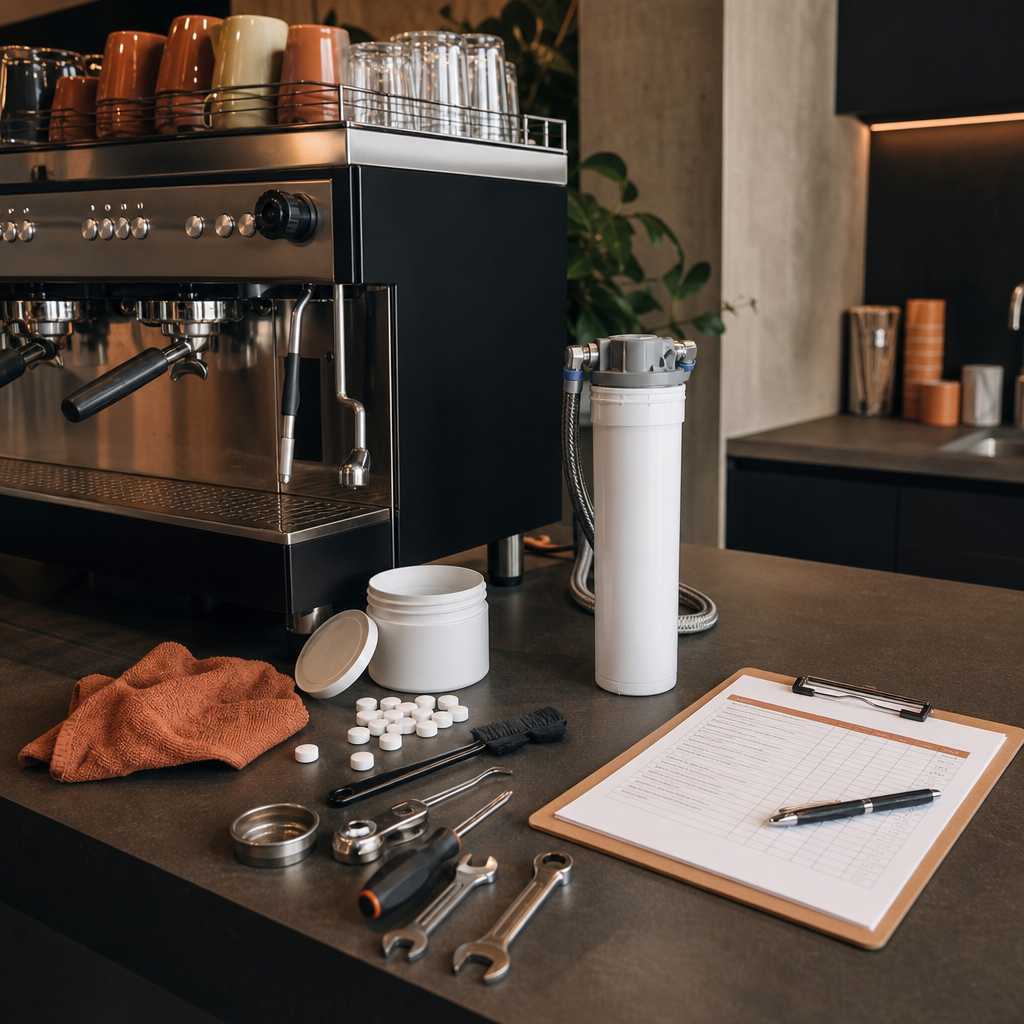
Coffee machine cleaning cost depends on the machine, usage, water quality, labour, replacement parts and service arrangement. Owners pay these expenses separately and carry breakdown risk. A serviced rental usually combines scheduled maintenance, repairs and support into a predictable payment, although businesses should confirm exactly what their agreement includes.
Commercial coffee machines need more than a wipe-down and occasional descaling. Daily cleaning, water filtration, preventive servicing and prompt repairs all affect the true office coffee machine maintenance cost.
This guide explains where the money goes, which tasks staff can safely handle, and how to compare ownership with a fully serviced rental. It also shows why downtime and internal administration belong in the calculation.
2026 Melbourne service snapshot: Boutique Coffee supports 200+ active workplace rental clients, with a typical service-call response time of 24 hours and an average active client relationship exceeding 5 years. These figures come from Boutique Coffee's own client records.
Key takeaways
- Cleaning cost includes staff time, chemicals, water filters and waste, not only technician invoices.
- Preventive maintenance is usually easier to budget than breakdown repairs.
- Daily operator cleaning and technical servicing are separate responsibilities.
- Owners carry parts, repair, coordination and equipment replacement risk.
- A serviced rental can simplify budgeting, but inclusions and response arrangements must be checked.
- Machine selection matters. An underspecified machine can create recurring failures regardless of cleaning effort.
Summary table
| Cost area | Owner-maintained machine | Serviced rental | What to confirm |
|---|---|---|---|
| Daily cleaning | Completed by workplace staff | Usually completed by workplace staff | Required products and procedure |
| Cleaning supplies | Purchased separately | May be supplied or bundled | Tablets, milk cleaner and other consumables |
| Water filters | Purchased and scheduled by owner | Often managed through service visits | Replacement triggers and inclusions |
| Preventive servicing | Booked and paid separately | Commonly included | Service scope and frequency |
| Repair labour | Separate expense | May be included | Call-out, travel and after-hours terms |
| Replacement parts | Owner carries the risk | Depends on agreement | Wear parts, misuse and exclusions |
| Downtime coordination | Managed internally | Supplier coordinates response | Direct contact and expected response |
| Equipment replacement | Owner funds replacement | Supplier generally owns equipment | Upgrade and exit terms |
Breakdown of Cleaning Costs
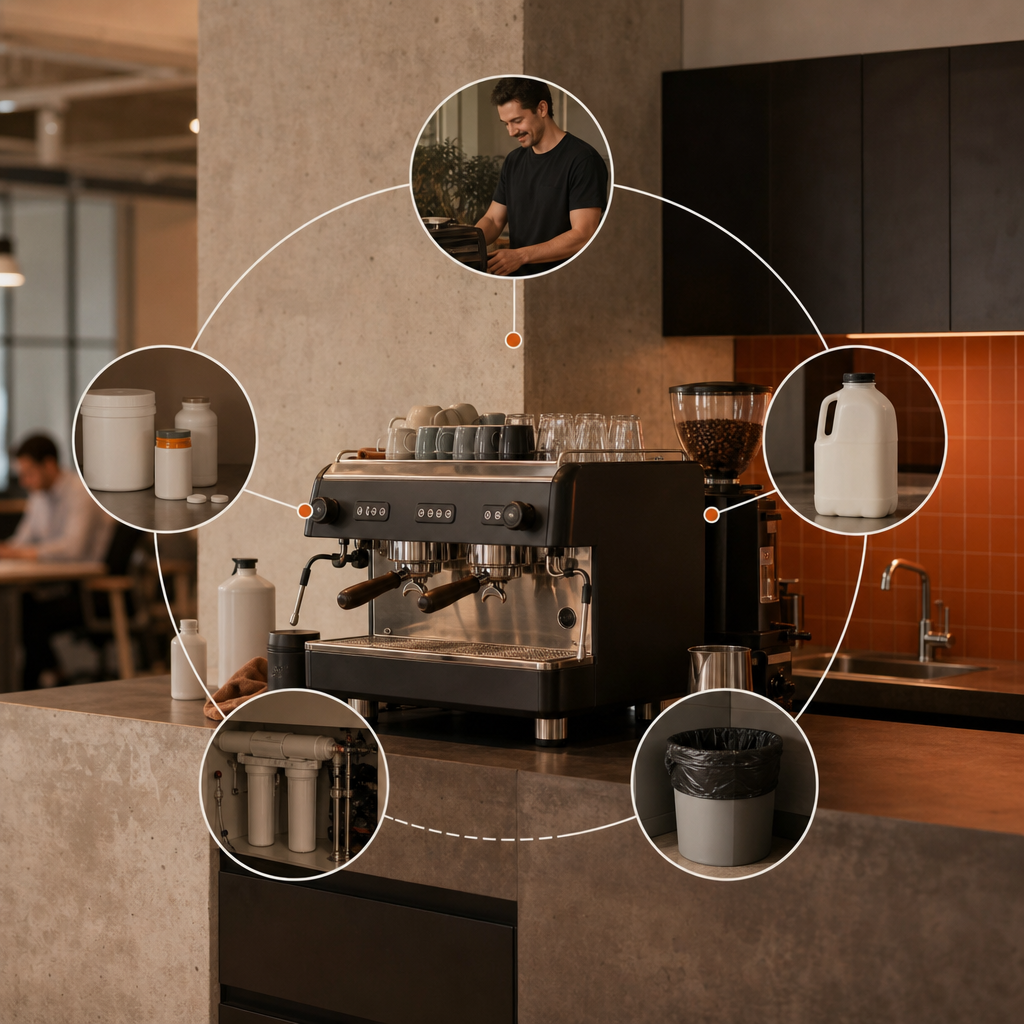
Commercial cleaning costs have five practical components: operator labour, cleaning chemicals, milk-system care, water treatment and waste. The invoice price of tablets or solution is only one part. A useful estimate must also include staff time, missed cleaning, discarded coffee and the consequences of residue accumulating inside the machine.
Daily operator labour
Staff should generally handle routine cleaning that does not require machine disassembly. Depending on the equipment, this can include:
- Running the automatic cleaning cycle
- Emptying and washing the grounds container
- Cleaning drip trays and external surfaces
- Purging and wiping steam wands
- Following the prescribed milk-system cleaning process
- Refilling products and checking warning messages
The internal cost can be calculated without relying on a generic industry benchmark:
Daily cleaning cost = staff time spent cleaning x loaded hourly employment cost
Use the actual time recorded in your office and include wages, superannuation and other employment on-costs used by your organisation. Then add the cost of approved cleaning products.
The hidden issue is compliance. If the process is complicated, it is often delayed or completed inconsistently. That can cause blocked milk lines, stale residue, poor flavour and avoidable service calls. A machine selected for an office should therefore be easy for ordinary users to clean correctly.
Cleaning chemicals and consumables
Commercial machines commonly require manufacturer-approved cleaning tablets, powder or liquid. Automatic milk systems may need a separate milk cleaner. Traditional espresso equipment also requires attention to group heads, baskets, steam wands and grinders.
Do not substitute a household cleaning product because it appears cheaper. The wrong chemical can leave residue, damage seals or conflict with manufacturer instructions. Ask suppliers to identify each required product and its replacement cadence before comparing proposals.
Descaling and water filtration
Descaling and filtration are related, but they are not interchangeable. A suitable filter reduces minerals and other water characteristics that may affect equipment or taste. Descaling removes deposits that have already formed in components where the manufacturer permits that process.
Replacement timing should follow the filter specification, measured water conditions and actual consumption. Calendar-only replacement can be misleading because two offices may use very different water volumes.
Australian drinking water is managed against the Australian Drinking Water Guidelines, but potable water can still contain minerals relevant to coffee equipment. The National Health and Medical Research Council explains the national framework at Australian Drinking Water Guidelines.
Coffee and milk waste
Cleaning consumes water and can involve discarded beans or milk. Poor grinder calibration adds further waste through rejected drinks and unnecessary test shots. These costs are usually small individually but repeat throughout the equipment's life.
Track waste for a short representative period. Record cleaning products, discarded ingredients and staff time. That produces a defensible site-specific figure rather than an unreliable national average.
Understanding Maintenance Expenses
Commercial espresso machine service cost includes preventive inspections, technician labour, travel, replacement parts and reactive repairs. The amount changes with machine type, age, drink volume and access. Maintenance should be treated as an operating system, not an emergency purchase made only after the coffee machine stops working.
Preventive servicing
A technician may inspect or service components such as:
- Boilers, valves and pumps
- Brewing units and seals
- Grinders, burrs and dosing systems
- Milk lines, refrigerators and foaming components
- Water filters and inlet connections
- Sensors, drains and waste systems
- Software alerts and drink settings
The exact checklist must come from the machine manufacturer and service provider. A bean-to-cup machine, traditional espresso machine and commercial pod system have different service requirements.
Preventive work also creates an opportunity to identify leaks, worn seals, grinder drift and restricted flow before a full failure. It does not eliminate every breakdown, but it can reduce preventable faults and make parts planning more orderly.
Parts and wear
Some components are consumable wear items. Others fail because of age, scale, usage or accidental damage. Ownership proposals often exclude parts from the advertised servicing price, so request an itemised explanation covering labour, call-out fees, travel and parts.
Ask these questions before signing:
- Which parts are included in scheduled servicing?
- Are call-outs charged separately?
- Does travel attract an additional fee?
- What counts as misuse?
- Is a loan machine available during a major repair?
- Who pays if the machine must be removed from site?
Downtime and internal coordination
Hidden cleaning costs in an office are often operational rather than mechanical. Someone must diagnose the problem, find the supplier's details, lodge a ticket, explain the setup and follow up. Staff may then leave the building to buy coffee while the machine remains unavailable.
Calculate downtime as a business-specific cost:
Downtime cost = internal coordination time + displaced staff time + external coffee purchases + lost amenity
Lost amenity is difficult to price precisely, so keep it separate from hard costs. It still matters when coffee is a valued workplace benefit or part of customer service.
DIY vs. Professional Servicing
Office staff should complete documented daily cleaning, but they should not attempt technical repairs involving electrical components, pressurised systems or internal plumbing. Professional servicing becomes necessary when work requires diagnosis, disassembly, specialist tools, replacement parts or safety checks. DIY is sensible only inside the operator procedures approved for that machine.
What staff can reasonably do
A clear workplace procedure should identify who cleans the machine, when it happens and which products are used. Training at installation is more effective than leaving an unopened manual beside the machine.
For many offices, the practical split is simple:
- Staff handle external cleaning, automatic cycles and basic replenishment.
- The coffee provider handles filtration, calibration, preventive servicing and faults.
- A licensed tradesperson handles any fixed electrical or plumbing work where required.
Safe Work Australia advises workplaces to manage electrical risks and use competent people for electrical work. Its model code for managing electrical risks provides the relevant workplace safety framework.
When DIY becomes false economy
DIY technical maintenance often looks cheaper because internal labour does not appear on a supplier invoice. The calculation changes when a manager spends time sourcing parts, the machine remains down, or an incorrect repair causes further damage.
An owner with an experienced facilities team and a local technician may manage this well. A smaller office without those resources may get better value by shifting the technical workload to a service provider.
Before choosing DIY maintenance, document:
- Who owns the cleaning schedule
- Who monitors filter capacity
- Which technician services the machine
- Expected response arrangements
- Availability of parts
- Whether the warranty requires authorised servicing
- What happens when the machine cannot be repaired on site
Consumer guarantees may apply to eligible business purchases, although coverage depends on the transaction and circumstances. The ACCC's guidance on consumer rights and guarantees explains the general framework. Businesses should also read the supplier's warranty and service terms.
The Boutique Coffee Advantage
Boutique Coffee combines machine rental, installation, training, coffee supply and ongoing service under direct personal accountability. The practical difference is one number, one person. There are no call centres and no corporate runaround. Most straightforward issues can be diagnosed quickly because the person answering already knows the client's machine and setup.
A machine chosen for actual demand
Cleaning and maintenance costs begin with equipment selection. A machine that is too small will be overworked. A machine that is unnecessarily complex can create higher cleaning demands without improving the office experience.
My position is direct: recommend the machine that fits the team, even when it is the cheaper option. A small team does not need a $15,000 Eversys. An 80-person workplace should not be expected to rely on a home-grade Jura. Boutique Coffee has installed equipment across workplaces serving more than 400 people, according to our own 2026 client records.
The Six-Step Process
Our Six-Step Process takes most Melbourne clients from first call to installation in 5-7 business days:
- Enquiry: The client provides basic team details, usually taking about 2 minutes.
- Phone call with Chris: A 15-20 minute discussion covers demand, preferences, machine options and rough pricing.
- On-site visit: Around 30 minutes is used to assess power, plumbing and bench space.
- Install day: The machine is connected, the grinder is dialled in and coffee is tested, generally within 45 minutes.
- First brew and training: At least two staff members receive about 20 minutes of practical training and a cheat sheet.
- Ongoing rhythm: Weekly or fortnightly visits keep beans and consumables stocked while supporting maintenance.
These timeframes are Boutique Coffee's operating process, not universal industry benchmarks. The point is to identify installation constraints before they become costly surprises.
Melbourne case study: matching the machine to the office
A mid-size Melbourne office had an existing coffee setup that was not meeting staff expectations. I assessed the workplace and upgraded it to a WMF commercial machine. Installation, training and ongoing service were included in the rental.
The site manager reported that daily use was easy, coffee and hot chocolate quality improved, and service remained consistent over the following years. The efficiency came from removing separate equipment, supply and servicing arrangements. It also gave the office one accountable contact.
The site manager later told me staff regularly expressed their appreciation for the coffee. His response was:
"No problem, just keep doing what you're doing."
That is a simple testimonial, but it captures the outcome that matters. The machine became a reliable part of the working day rather than another facilities problem.
Melbourne case study: reducing disruption when equipment fails
A busy Melbourne workplace had experienced serious disruption whenever its machine stopped during peak office hours. I supplied a commercial machine, established regular servicing and remained the direct contact for issues.
The client's workplace representative reported that reliable servicing meant the team had coffee when needed and avoided the havoc previously caused by a broken machine. No dollar saving was recorded, so I will not invent one. The demonstrated gain was operational: fewer service handovers, a known contact and a maintained machine.
Our active Melbourne rental base now includes more than 200 workplaces. The average active relationship exceeds 5 years, and the typical service-call response time is 24 hours, based on Boutique Coffee's 2026 records. That is the standard behind being a coffee partner, not a supplier.
Cost Comparison: Rental vs. Ownership
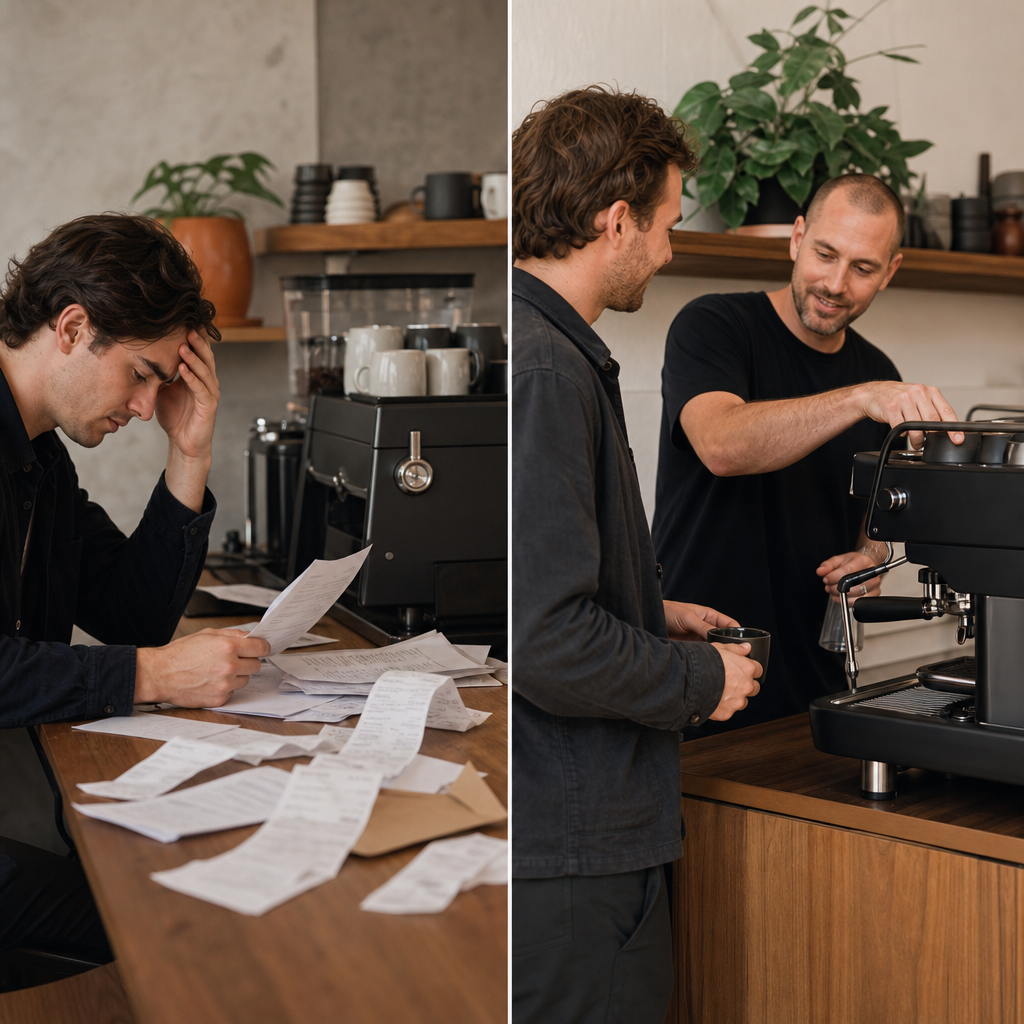
Ownership can suit businesses with capital available, internal facilities capability and predictable access to technicians. A serviced rental suits offices that value stable operating arrangements and transferred repair responsibility. The correct comparison is total cost over the expected use period, not the purchase price against one rental payment.
Calculating ownership properly
An ownership model should include:
Purchase price + finance cost + installation + cleaning supplies + filters + scheduled servicing + parts + reactive repairs + downtime + eventual replacement or disposal
Also consider whether the machine can handle future demand. An owner carries the risk that the equipment becomes unsuitable before its mechanical life ends.
Ownership may be reasonable when the business has multiple sites, in-house expertise or an established maintenance programme. It can also work where usage is stable and the selected equipment has strong local parts support.
Calculating rental properly
A rental comparison should include:
Rental payments + excluded consumables + staff cleaning time + any chargeable damage or services outside the agreement
Then assess service quality. A low rental price can become expensive if repairs require repeated calls, long ticket queues or poorly defined responsibility.
Boutique Coffee rentals are month-to-month, with one month's notice to exit and free machine pickup. No lock-in, ever. In 17 years of operating exclusively in this field, that policy has not cost us a client worth keeping. Long relationships should be retained by service, not paperwork.
For a broader decision framework, read the guide to renting versus buying a commercial coffee machine. You can also review how Boutique Coffee's service works.
Use a like-for-like quote request
Give each supplier the same information:
- Number of staff and expected visitors
- Peak drink demand
- Preferred drink types
- Available plumbing, power and bench space
- Current coffee consumption
- Required service response
- Cleaning responsibilities
- Filter and consumable requirements
- Contract, exit and equipment replacement terms
Ask for every inclusion and exclusion in writing. A generic coffee machine cleaning cost is not useful without the model, usage and service scope behind it.
The Most Expensive Fault Is Unclear Accountability
The overlooked cost is not scale, a worn seal or a cleaning tablet. It is fragmented responsibility. When equipment, beans, filtration and servicing come from different providers, each party can blame another. One accountable coffee partner shortens diagnosis, clarifies ownership and gives the workplace a practical route to resolution.
This is where my view differs from many corporate suppliers. Ticket systems may organise support internally, but they do not necessarily help the person standing beside a silent coffee machine.
I prefer founder-led, always. One person remains responsible from the site visit through installation and ongoing service. If a fix can be explained over the phone, it happens without escalation. If a visit is required, the site's configuration and history are already understood.
This approach also improves cost control. The person selecting the machine is accountable for maintaining it. That discourages upselling and exposes poor equipment matching quickly. It is a stronger incentive than separating sales, account management and service into different departments.
The practical lesson is to test accountability before comparing prices. Call the support number. Ask who answers, whether they know your machine and what happens if the first diagnosis fails. The answer tells you more about future hidden costs than a polished proposal.
If you want to assess the coffee and service before making a decision, request a free workplace coffee trial. To discuss cleaning, maintenance or a serviced rental for your Melbourne workplace, contact Boutique Coffee.
References
These sources support the Australian safety, consumer and water-quality context discussed above. Machine-specific cleaning and maintenance instructions must still come from the relevant manufacturer. Service inclusions should be confirmed directly with the provider because agreements, equipment designs and workplace operating conditions differ.
- Australian Competition and Consumer Commission, Consumer rights and guarantees.
- Safe Work Australia, Model Code of Practice: Managing electrical risks in the workplace.
- National Health and Medical Research Council, Australian Drinking Water Guidelines.
- Food Standards Australia New Zealand, Food safety standards.
FAQ_SCHEMA_JSON
Frequently asked questions
How much does commercial coffee machine cleaning cost in Australia?
There is no reliable universal price. Cost depends on machine type, drink volume, cleaning products, staff time, filter requirements, location and whether technical servicing is included. Calculate internal labour and consumables, then request an itemised technician quote covering call-out, travel, labour and parts.
How often should an office coffee machine be cleaned?
Operator cleaning should follow the manufacturer's instructions and may include tasks after use, at the end of the day or when prompted by the machine. Technical cleaning and servicing should follow usage, water conditions and the service schedule.
Is descaling included in professional servicing?
It depends on the machine and service agreement. Ask whether water testing, filter replacement, descaling labour and any required parts are included. Never assume a general service automatically covers scale removal.
Are coffee machine repairs included in a rental?
Often, but not always. Check whether the rental includes preventive servicing, call-outs, travel, labour, replacement parts and a temporary machine. Damage, misuse and services outside the agreed area may be excluded.
Is it cheaper to rent or own a commercial coffee machine?
Ownership can cost less when equipment is well matched and maintained. Rental may provide better value when it includes installation, servicing, repairs and support. Compare total costs, including downtime and internal administration.
Can office staff service a commercial espresso machine themselves?
Staff can complete approved operator cleaning after training. Internal electrical, pressurised or specialist repairs should be referred to an appropriate service technician unless the worker is competent and authorised.

Chris
Chris
Keep reading
Service coverage and delivery areas
Boutique Coffee supplies, installs and services commercial workplace coffee machines across Melbourne. Coverage includes machine rental, installation, staff…
Office Coffee Machine ROI Calculator: Justifying Your Investment in Workplace Coffee in Australia
An office coffee machine ROI calculator compares the total cost of renting or purchasing with measurable benefits such as reduced café trips, lower downtime…
Essential Features of a Commercial Office Coffee Machine: What to Look For in Australia
The essential office coffee machine features are consistent drink quality, useful beverage customisation, a practical milk system, sufficient peak-hour…